PPPoE through the second XGS 3300: carried by the host at the gigabit link's rate, none of it in hardware, 2026-11-14
A WAN over PPPoE is common, and the drivers were read to refuse it: a connection whose route leaves by an
interface that is not Ethernet underneath gets no next hop, so it stays with the host
(contrib/octep/octep_nhop.c, contrib/npuep/npunhop.c). Before anything was built for it, the question was
measured: is that what happens, and what does it cost the host?
How it was measured
2026-11-14 from 21:19 to 21:59 UTC: the second XGS 3300 (vendor version 22, AMD Ryzen Embedded V1780B, eight
CPUs, octep.ko edb2b920) between two ends on the FreeBSD test machine (FreeBSD 15.1, two USB 2.5 Gbit/s
adapters, linked at 1 Gbit/s).
- The path: Port4 and Port3 taken out of the LAN bridge for the runs. A VNET jail on the test machine (10.99.80.x) sends through Port4, where the XGS 3300's address is its gateway; the XGS 3300 routes it out of Port3 to the test machine's other adapter, where iperf3 listens.
- Two ways out of Port3:
- Ethernet: plain addresses at both ends (10.99.91.x).
- PPPoE: mpd5 on both ends. The XGS 3300 is the client, pppoe9 over Port3, with the settings OPNsense
26.7 writes for a PPPoE interface (
interfaces.inc), the MSS clamp among them: 1,452 bytes. It was started from the command line, not from OPNsense's pages, so no default route moved andconfig.xmlwas not touched. The server is mpd5 on the test machine, asking for no authentication; the two ends of the link are in 10.99.90.x. - Routed, not translated: pass rules in a pf sub-anchor, and a route back to the jail's network at the server.
- Each with the flow maker on and off (
dev.octep.0.dp.auto1 and 0), so four cases: A Ethernet and maker on, B Ethernet and maker off, C PPPoE and maker on, D PPPoE and maker off. - Five runs of each, both ways: iperf3, four TCP connections, 30 seconds, the jail sending and then
receiving (
-R). Read around every run: - the rate at the receiver, and the sender's retransmissions;
- ping to the far end once a second through the run;
- the XGS 3300's CPUs (
kern.cp_times), each and all; - the driver's counters (
auto_made,fast_made,flow_nonhop); - the coprocessor's own frame counters: every frame from the wire, those it forwarded wire to wire, those handed to the host (the script behind XGS: Overview);
- at second 15, the jail's connections in the list behind XGS: Offloaded Flows, and pf's states for them.
- Taken away after: the ports back in the bridge, no address, rule, PPPoE interface or state left, the
flow maker as it was,
config.xmlunchanged.
Results
| Case | Jail | Received, five runs | CPUs busy, all | Busiest CPU | Wire to wire | In hardware at 15 s |
|---|---|---|---|---|---|---|
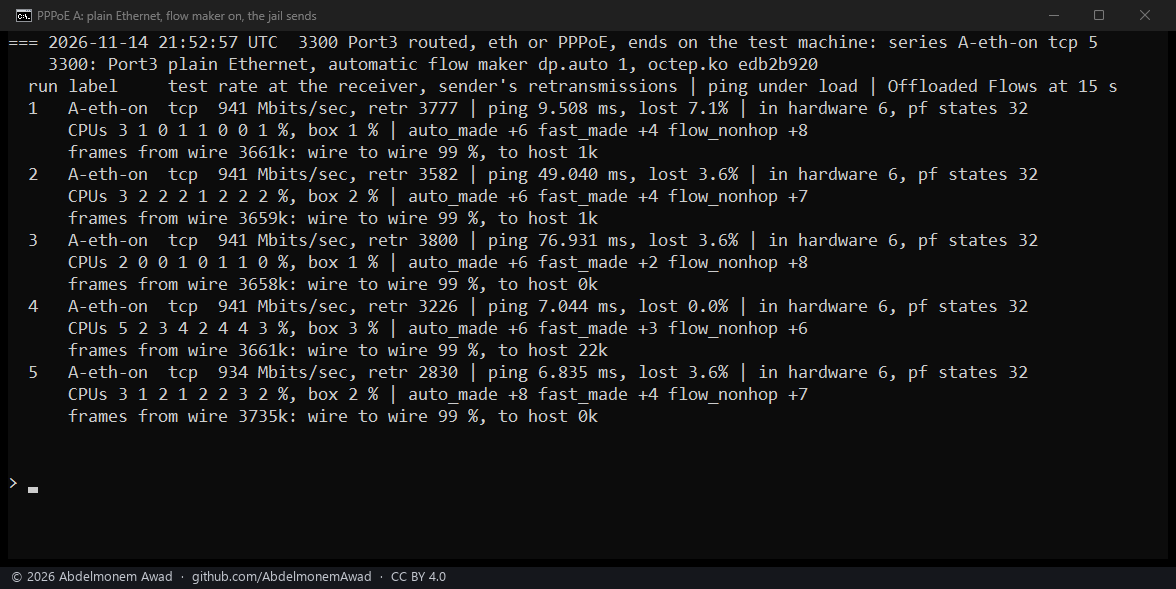
| A Ethernet, maker on | sends | 934 to 941 Mbit/s | 1 to 3 % | 2 to 5 % | 99 % | 6 |
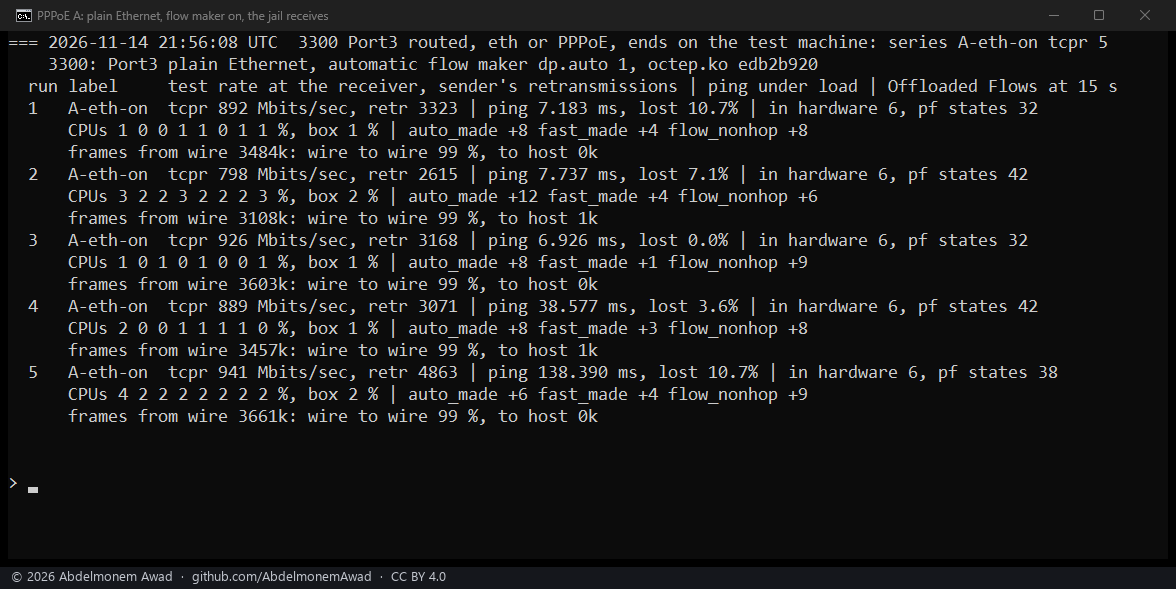
| A Ethernet, maker on | receives | 798 to 941 Mbit/s | 1 to 2 % | 1 to 4 % | 99 % | 6 |
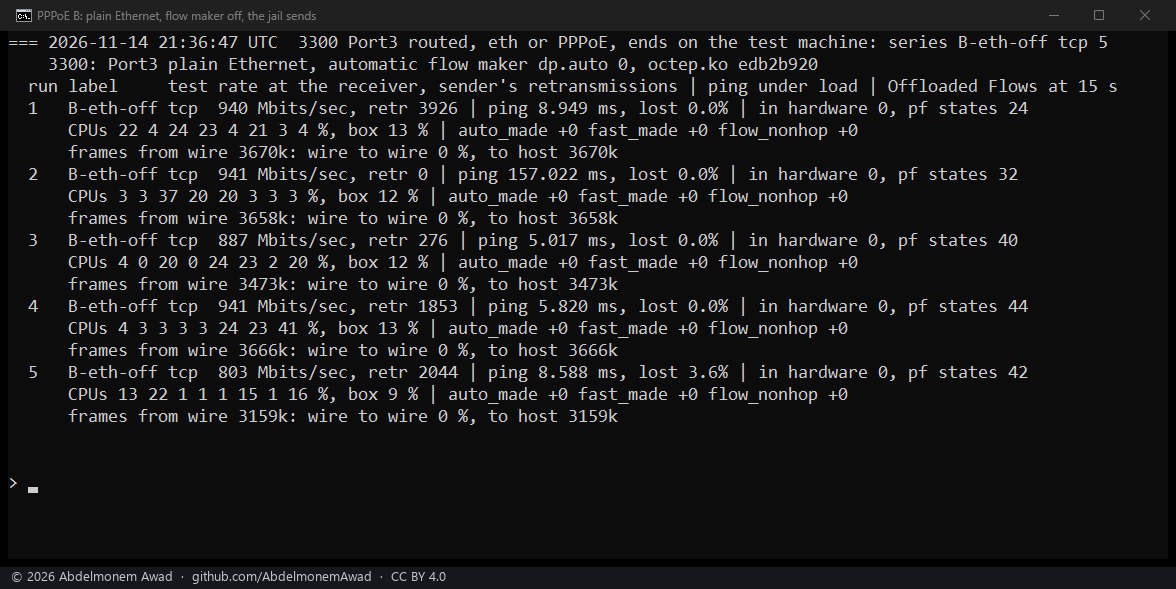
| B Ethernet, maker off | sends | 803 to 941 Mbit/s | 9 to 13 % | 22 to 41 % | 0 % | 0 |
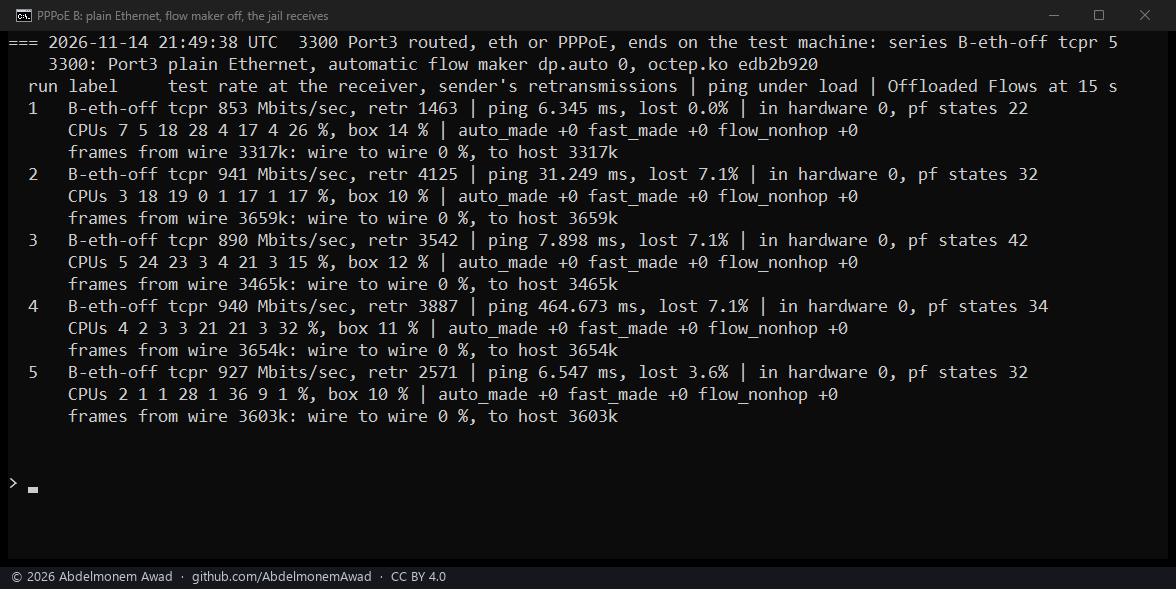
| B Ethernet, maker off | receives | 853 to 941 Mbit/s | 10 to 14 % | 19 to 36 % | 0 % | 0 |
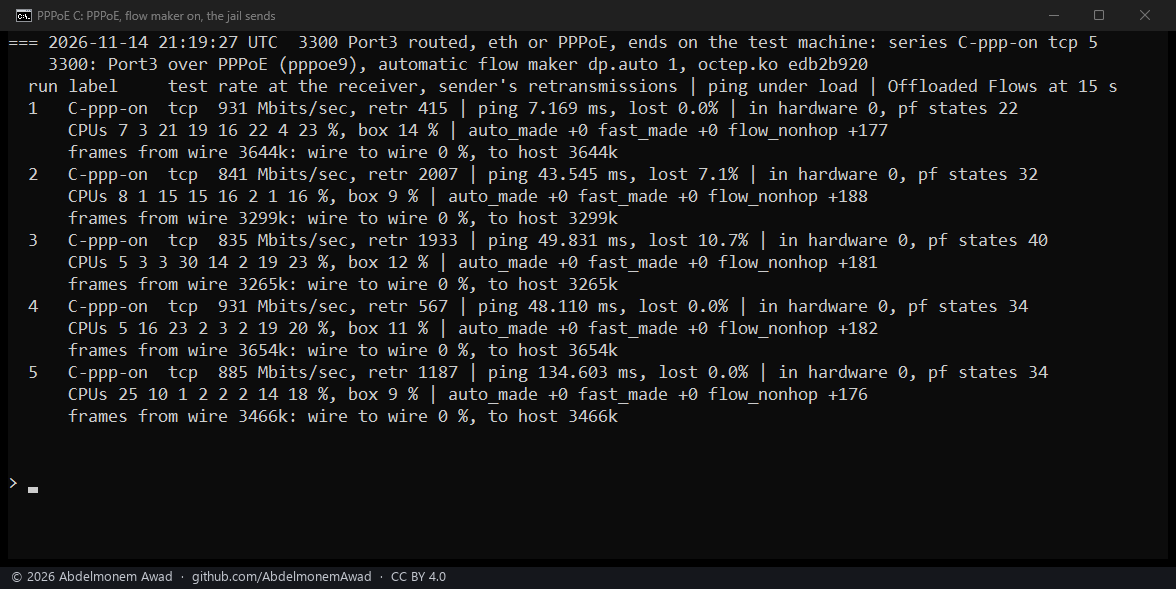
| C PPPoE, maker on | sends | 835 to 931 Mbit/s | 9 to 14 % | 16 to 30 % | 0 % | 0 |
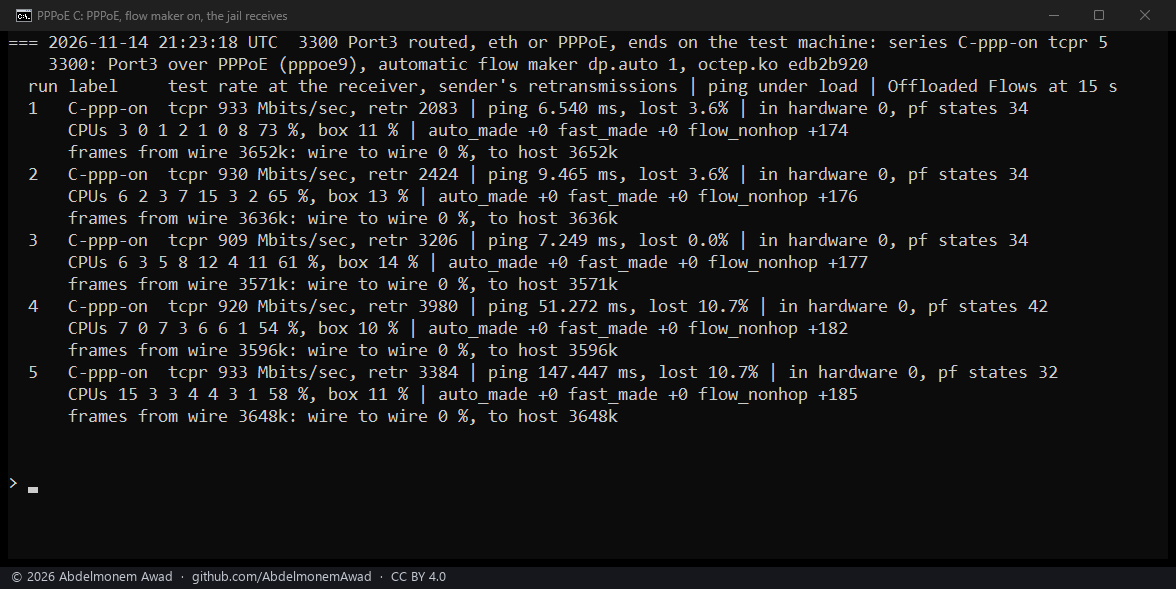
| C PPPoE, maker on | receives | 909 to 933 Mbit/s | 10 to 14 % | 54 to 73 % | 0 % | 0 |
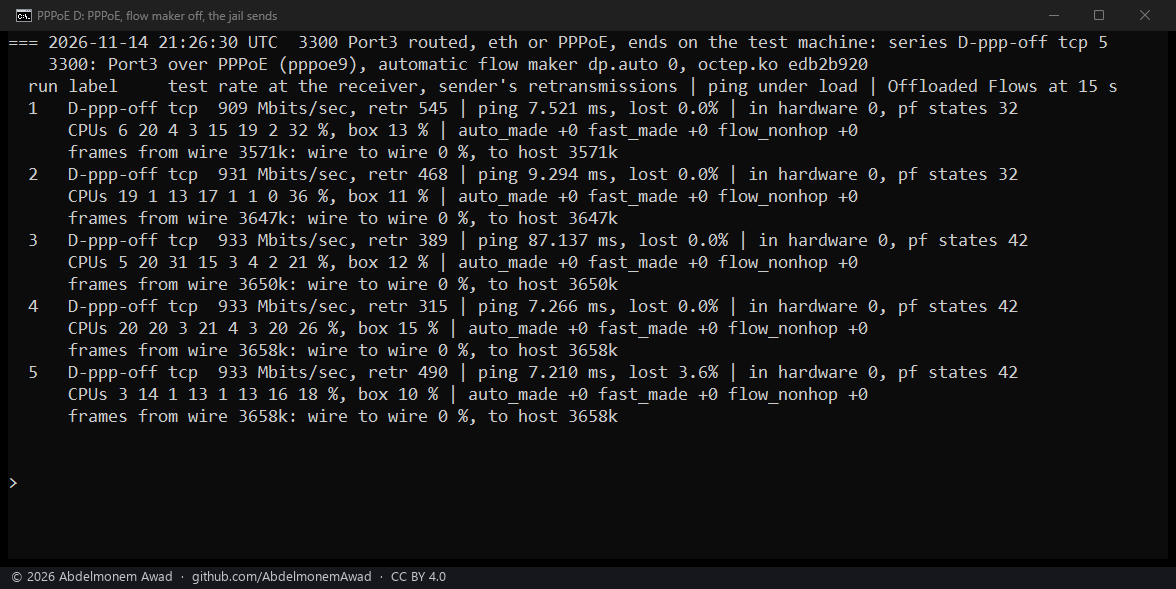
| D PPPoE, maker off | sends | 909 to 933 Mbit/s | 10 to 15 % | 18 to 36 % | 0 % | 0 |
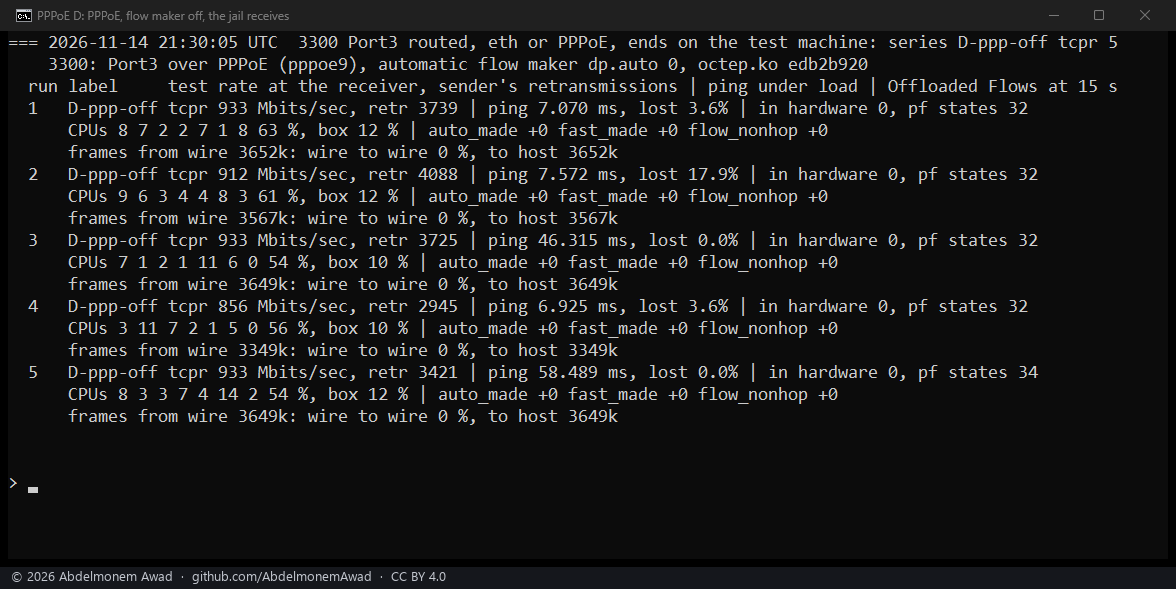
| D PPPoE, maker off | receives | 856 to 933 Mbit/s | 10 to 12 % | 54 to 63 % | 0 % | 0 |
- No PPPoE connection went into hardware, with the flow maker on or off: every frame went to the host.
With the maker on, each run's connections were refused 174 to 188 times, all of them counted under "no
next hop" (
flow_nonhop). - Plain Ethernet on the same ports went into hardware: 99 % of the frames forwarded wire to wire, the CPUs 1 to 3 % busy.
- The host carries PPPoE at the gigabit link's rate: 835 to 933 Mbit/s, about what it carries plain Ethernet at with the maker off (803 to 941), with the CPUs 9 to 15 % busy against 9 to 14.
- Receiving through PPPoE falls on one CPU: with the jail receiving, one of the eight CPUs was 54 to 73 % busy, against 19 to 36 % for plain Ethernet through the host. On a link faster than this one, that CPU would be the first limit; not measured above 1 Gbit/s.
- The refusals cost nothing that shows: C and D are the same within the runs' spread.
What these figures do not mean
- They stop at 1 Gbit/s, the test machine's adapters' link.
- Ping under load is no latency figure here: with the link full it rose above 40 ms in some runs of every case - to 138 ms in the hardware one (A), to 464 ms in one run through the host (B) - and where the queue grew was not measured.
- The PPPoE client was mpd5 started by hand with OPNsense's settings; the kernel's path is the same, OPNsense's own scripts around a link going up were not run.
- No translation: a WAN translates, and translating costs the host a little more.
- Four series were run again: in runs through the host the test machine's USB adapters stalled three times - one kept counting frames sent while the XGS 3300's switch port took in none, or sent oversize and corrupt frames, which that port counted (933 oversize by then) - and a fourth series started while a stalled one was still running. None of those is counted; each was run again after the adapter was taken down and up. No stall came in a run in hardware.
Why it stays with the host
The coprocessor is told where a connection's frames go with a next hop: two MACs, an ethertype, a VLAN, a
port, its flags and an MTU (octep_rpc.c, npuflow.c build it). Nothing in it, in a connection's microflow
key or in a logical interface holds a PPPoE session, and the only header the fast path adds or takes off is a
VLAN tag. A frame that is not IPv4 or IPv6 - every PPPoE session frame from the WAN - goes to the host. So a PPPoE header cannot be added or taken off in hardware on either family; only the
coprocessor's own firmware could, and it does not.
What changed after it
Until then the XGS 3300 counted a PPPoE connection with the faults under "no next hop", and its reason read "the port the other direction arrives on has no link"; the XGS 136 listed it as "nhop error 51". The refusal is told apart now, on both families:
- The drivers answer a route out of a PPP link - mpd5's interface, which OPNsense uses for PPPoE, PPTP
and L2TP - with a reason of its own, "the route leaves by a PPP link (PPPoE, PPTP or L2TP), and the
coprocessor is given nothing that can carry its header - the host keeps the connection", and count it:
dev.octep.0.dp.flow_ppp_refusedon the XGS 3300,dev.npuep.0.flow.ppp_refusedon the XGS 136. A route out of another interface that is not Ethernet underneath, a tunnel's, says so too. - XGS: Offloaded Flows shows a "PPP links" card once there is one, and XGS: Overview lists "Out of a PPP link, such as PPPoE" among the reasons a connection stayed with the host.
Tested 2026-11-14 from 22:14 to 22:25 UTC:
- The second XGS 3300, octep.ko
8c359419, the same PPPoE path: one run counted 187 such refusals (flow_nonhopup 189), and a by-hand make (dev.octep.0.dp.accelerate) during a transfer gave the new reason. Plain Ethernet on the same ports after it: 941 Mbit/s, 99 % wire to wire, the counter unchanged. - The XGS 136 (vendor version 21, AMD Ryzen Embedded R1606G, npuep.ko
f8ab04b9), the PPPoE client over its Port11 to mpd5 on the test machine, traffic from the XGS 3300 over the Port6-Port7 link: its candidate list gave each connection "nhop error 43 (a PPP link: the host keeps it)",flow.ppp_refusedrose by 62 in 20 seconds, and none was in hardware.
The discussion of this page is held in the project's GitHub Discussions. Showing it here loads giscus from giscus.app and GitHub, and writing in it needs a GitHub account - what that means.