A tunnel brought up over a connection in the XGS 136's hardware. Measured, 2026-10-20
Until this, a connection the XGS 136 had put in hardware stayed there when an IPsec policy came to cover it, and its frames went on leaving the appliance unencrypted (issue 575). Now the flow maker asks the kernel's policy database, as the XGS 3300's driver has since its tunnel flows: a connection a policy covers is never made into a flow, and one already in hardware is taken out the moment a policy comes to cover it. Measured both ways, on the build before and the build after.
What the driver does now
- Before a flow is made, both of the connection's directions are asked of the policy database,
each as an outbound and as an inbound selector, the way
ipsec4_forwardandipsec6_forwardask (addresses and protocol, ports as ANY) and then once more with the ports, for a selector that names them. An IPsec policy or a discard one covers the connection, and it stays with the host, which applies the policy; a bypass or no policy does not. Counted indev.npuep.0.flow.ipsec_refused. - When the kernel's policy generation moves - a policy added or removed - the once-a-second sweep
asks the same about every connection in hardware, and takes a covered one out, its packet counts
handed to pf first. Its next frame is the host's. Counted in
dev.npuep.0.flow.ipsec_taken. - Both are in npuipsec.c (
npuipsec_flow_covered) and npuflow.c (npuflow_make,npuflow_policy_sweep); theflow.flowsheader line prints them beside the other counts.
A new connection a tunnel covers had not been made into a flow before either, but only because its other direction arrives as ESP and never becomes a candidate - the coprocessor's metadata deciding, not the driver.
How it was measured
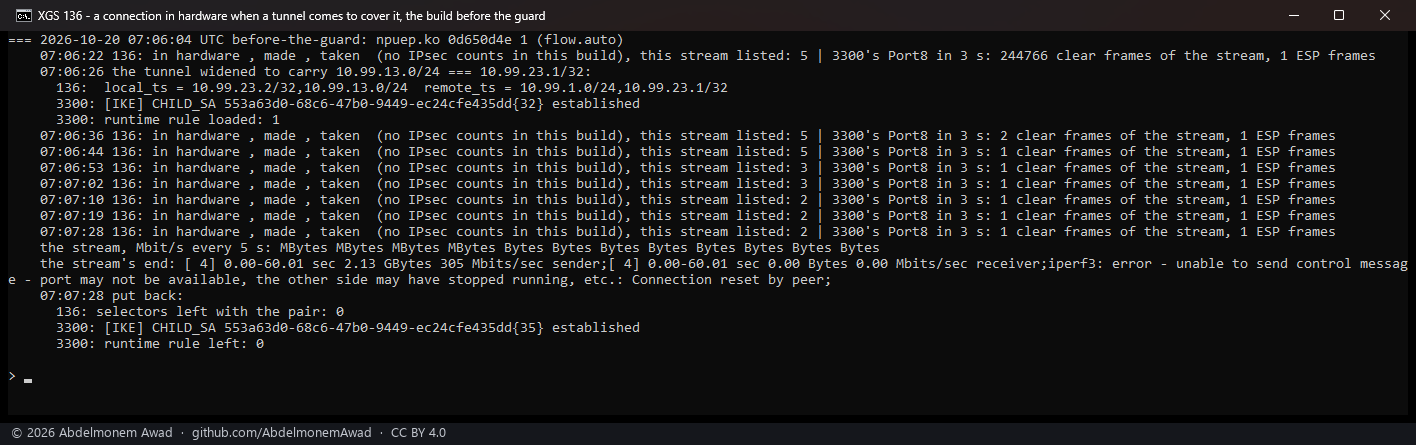
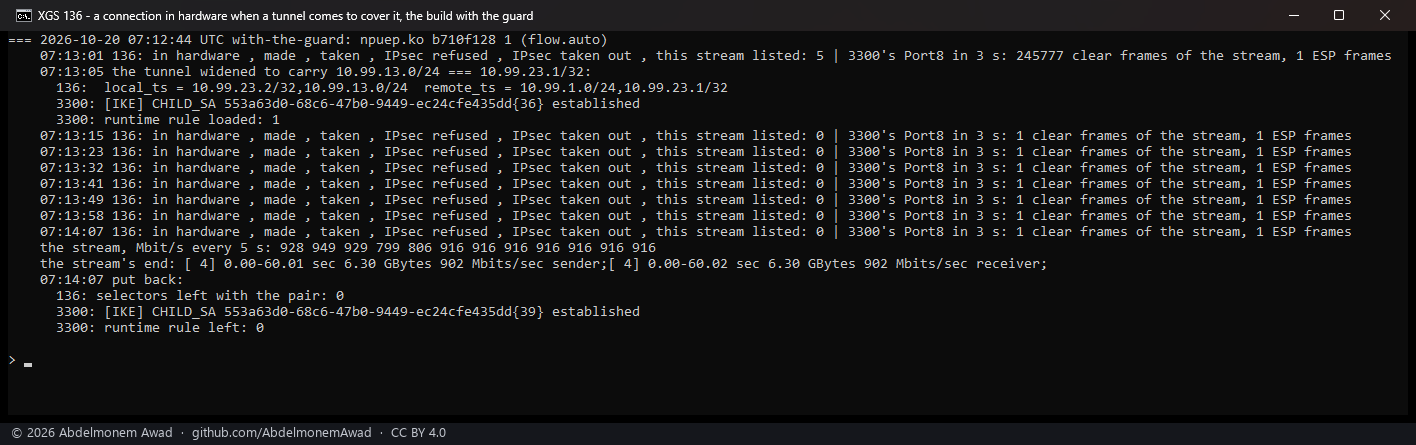
One stream of 60 seconds from the bench PC by its USB adapter into F1, through the XGS 136 to the
second XGS 3300's Port8 address, in hardware (the flow maker on). Fifteen seconds in, the lab tunnel's
child was widened at both ends to carry exactly that pair, and the 3300 was given a runtime rule
passing it on enc0; from then on the kernel's policy says the pair is IPsec's. Every few seconds: the
136's flow table, and how many of the stream's frames reached the 3300's Port8 in the clear in three
seconds (tcpdump there). At the end both ends' swanctl.conf were put back and the 3300's rules
reloaded. images/deploy/lab-136-policy.sh, not in this repository; photographed.
the build before (npuep.ko 0d650d4e) |
with the guard (b710f128, 254,568 bytes) |
|
|---|---|---|
| before the policy | in hardware; 244,766 clear frames in 3 s | in hardware; 245,777 clear frames in 3 s |
| the connection after the policy | still listed in the flow table for the 60 seconds | out of the flow table at the next look, within ten seconds of the policy |
| its frames reaching the 3300 in the clear | one in the first count after it, none in the six after - the sender backing off | none |
| the stream | stopped dead: the 3300's kernel refused the clear frames by its own policy check; the sender's report never came back | went on through the tunnel: 916 Mbit/s every five seconds to the end, 6.30 GB in 60 s |
| the 136's counts afterwards | - | ipsec_taken 5, ipsec_refused 40; the engine encrypted 3,096,986 frames of it and decrypted 3,096,990 |

On the XGS 3300
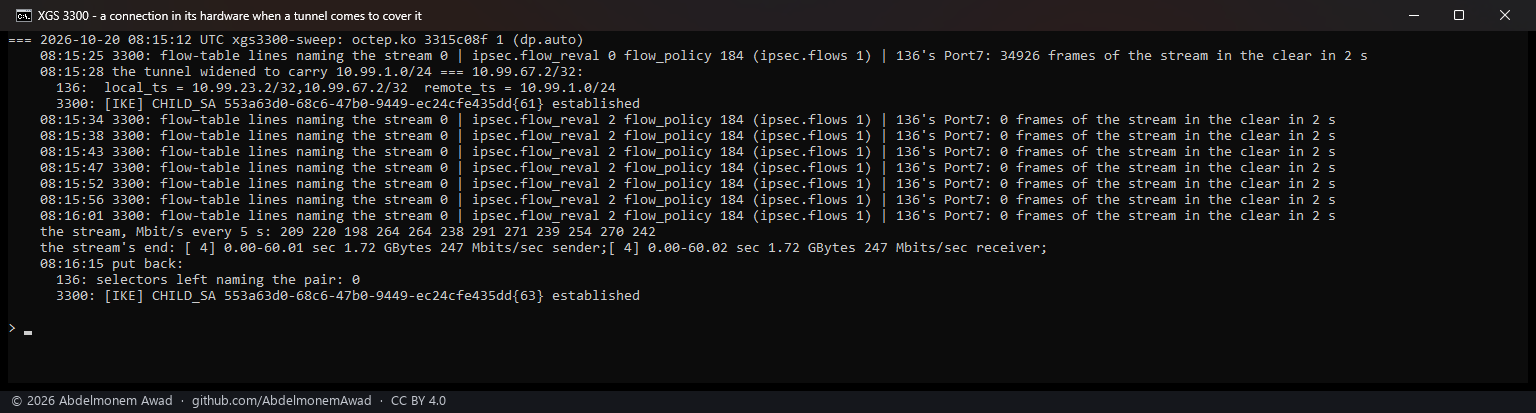
The same answer from its own driver, measured the same morning. The XGS 3300's octep has asked
the policy since its tunnel flows (octep_ipsec_flow_resolve), and its sweep takes out a connection
whose policy changed; until now that was built and not measured this way. The second XGS 3300
(octep.ko md5 3315c08f, dp.auto on, ipsec.flows 1) was put in the 136's place: one stream of
60 seconds from the bench PC's 10G port through the 3300 to the XGS 136's Port7 address, plain and in
the 3300's hardware; fifteen seconds in, the lab tunnel between the 3300 and the 136's Port8 widened at
both ends to carry exactly that pair. Counted at the far end this time, on the 136's Port7
(images/deploy/lab-3300-policy.sh, photographed):
| before the policy | after it | |
|---|---|---|
| the stream's frames reaching the 136's Port7 in the clear, in two seconds | 34,926 | 0 in each of the seven counts |
the 3300's ipsec.flow_reval - connections taken out because the policy over them changed |
0 | 2: the stream's two connections |
| the stream | in the clear, through the 3300 in hardware | on through the tunnel to the end: 1.72 GB in 60 s, 247 Mbit/s on average |
The tool's look for the stream in the 3300's flow table matched no line, before or after - its listing does not print the addresses the way the tool searched for them - so the driver's own count is the evidence it was there and was taken out. The stream ran at 198 to 291 Mbit/s throughout, before and after the policy alike; that path's rate was not looked into here.
What it does not mean
- The leak was narrow, and the peer here closed it. It needs a connection already in hardware when a policy comes to cover it - a tunnel brought up for a network a connection already reaches. The 3300's kernel refused the clear frames because its inbound policy says the pair must arrive encrypted; a peer that does not check would have taken them, and anything between would have read them.
- The forty refusals are the flow maker asking again: the stream's frames go on being punted as candidates, and each pass would make them into a flow and is refused - a policy lookup each time.
- The counts in the first two photographs are blank: the tool asked the 136 for them through
echoin a shell that reads\1as a control byte, the fault recorded on the IPv6 page. The flow table's listing beside them is correct, and the counts were read and photographed after the run (the third). The tool now usesprintf; its frame count also adds one line of its own, and the figures above are less that line. - Not tunnel connections in hardware. The guard keeps covered connections out; putting a tunnelled connection in the flow table with its association, as the XGS 3300 does, is the next piece, and the parity table's grey cell.
All the numbers are in the run's log, measurements/policy-136-2026-10-20.log (kept with the bench,
not in this repository).
The discussion of this page is held in the project's GitHub Discussions. Showing it here loads giscus from giscus.app and GitHub, and writing in it needs a GitHub account - what that means.