3. Eight months of looking
From that spring, for eight months and a few weeks, nothing was built. It was a survey - and I mean that literally: reading, comparing, opening things, and trying to understand a whole class of hardware before touching one machine of it.
Evenings, and an old profession
This was never a day job. Mornings belonged to my work in administration. After hours, the time was shared with other projects of my own - Odoo applications, software for 3D printing, and more besides.
But there is one field I always come back to. Before my current job I worked in network engineering, and networks and the devices that run them have stayed the thing I never tire of. Other projects I sometimes put down, or come back to from a different angle. This one kept pulling me back.
What the survey covered
- The XGS 136 beside the XG 330. One appliance whose ports belong to the host, one whose ports belong to a coprocessor - the clearest possible pair for seeing where the difference lies.
- Appliances from other vendors. Security appliances from other manufacturers were compared, to understand how crypto and network coprocessors are used in this class of hardware: what is handed to them, how the host hands it over, and where the line between the two computers is drawn.
- Teardowns. Boards opened and studied - which chip sits where, what connects to what, which parts answer to the host and which to the coprocessor.
- The sources. Whatever had been published about the silicon, the platforms and the software around them, collected and read.
Not every machine I bought for research earned its place. Some gave nothing either way - no answer, no useful dead end - and they are not in this story, because they would cost the reader the same time they cost me.
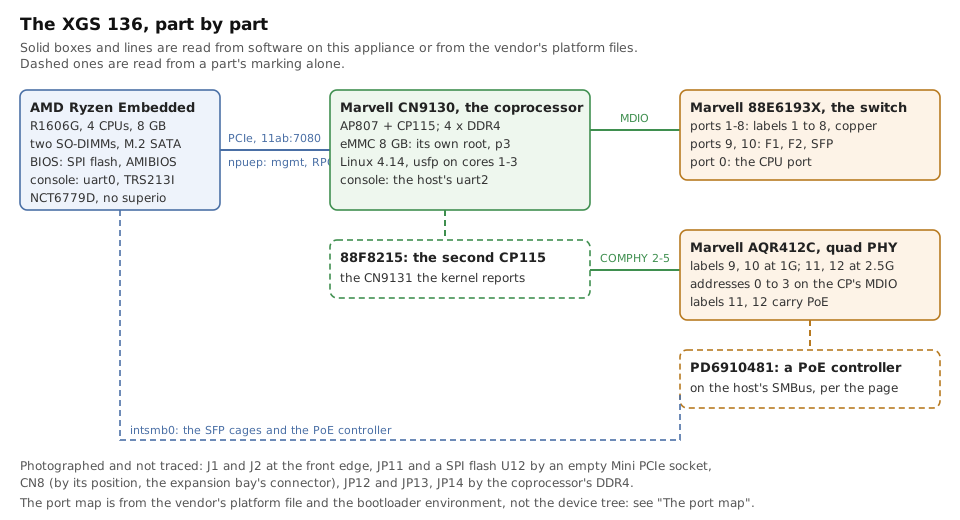
The kind of map the survey was building towards: every part of the XGS 136 placed and named, and which computer each one belongs to. This drawing is a later one, made for the repository.
Where it left me
By the end of those months the shape of the problem was clear, even if the answer was not. The coprocessor is not a peripheral waiting for a register to be poked; it is a second computer running the vendor's software, and the host would have to learn that software's language. What I did not yet know was where that language could be learned from.
That is where the next appliance came in.
Previous: 2. The XGS 136 arrives · Next: 4. The first XGS 3300
The discussion of this page is held in the project's GitHub Discussions. Showing it here loads giscus from giscus.app and GitHub, and writing in it needs a GitHub account - what that means.