The appliance in OPNsense's own settings
Written 2026-10-17, from OPNsense's System: Settings: Miscellaneous page read option by option against these two appliances: what each option means on an XGS 3300 and an XGS 136, what this plugin sets, and what it leaves alone and why. Nothing of the coprocessor goes into that page - it is core and calls no plugin hook (offload-is-a-setting.md); the coprocessor's own settings are on its own page (coprocessor-section.md).
| option | on these appliances | what the plugin does |
|---|---|---|
| Cryptography: hardware acceleration | the list offers hifn, padlock, qat and safe, and none of them is in either box; AES-NI is always used | nothing |
| Thermal sensors | both hosts are AMD Family 17h, and amdtemp attaches to both |
sets it to amdtemp, once |
| Power savings: PowerD | off; the CPUs run at their top P-state | nothing - measured below |
| Swap file | both have an 8 GB swap partition already | nothing |
| /var/log and /tmp in memory | ZFS on an SSD with TRIM in both | nothing |
| Startup and shutdown beep | /dev/speaker attaches on both |
nothing - |
Thermal sensors: amdtemp
The two hosts are an AMD Ryzen Embedded V1780B (XGS 3300) and an R1606G (XGS 136), and amdtemp
attaches to both as "AMD Family 17h CPU On-Die Thermal Sensors": 38.6 C and 53.6 C at idle on
2026-10-17. With it set, OPNsense loads the module at every boot - after a reboot of the XGS 3300 the
same day the CPU read 40.2 C with no amdtemp line left in loader.conf.local - and the CPU's temperature reaches
its own dashboard; the page shows it as set, and the owner changes it there.
scripts/xgs/defaults.php sets it when the plugin is installed, once, and only when nothing is
chosen on the page: an AMD host, the module present, and the module attached after loading it.
Its name is then recorded in /conf/os-xgs-npu-defaults, so an owner who sets the page back to
None afterwards is not overridden by the next install or update. Run on both appliances on
2026-10-17: --check said what it would set, the run set it, a second run left it.
Before this, the installer loaded amdtemp from a line it wrote in loader.conf.local, on the XGS
3300 only, and the Miscellaneous page said None while the module was loaded. The installer now takes
that line out once OPNsense's setting carries the module - on the XGS 3300 only, because the XGS
136's loader.conf.local was written by hand and is the owner's.
PowerD, measured
Off is OPNsense's default, and both appliances run that way: hwpstate holds the CPU at its top
P-state, 3350 MHz on the XGS 3300 (levels 3350, 2300, 1600) and 2600 MHz on the XGS 136 (2600,
1700, 1400). PowerD in hiadaptive lowers the clock while the CPU is idle and raises it under load.
Measured on the XGS 3300 on 2026-10-17, PowerD started by hand in hiadaptive and stopped after,
the configuration untouched. TCP to and from the host itself - iperf3 on the appliance, the PC
across the 10G link to F1, four streams for 15 seconds - so the host's own CPU carries every
packet; at MTU 1500 that is the limit, at 9000 the link is.
| PowerD | MTU | PC to the 3300 | the 3300 to the PC | images |
|---|---|---|---|---|
| off | 9000 | 9.88 Gbit/s | 9.59 Gbit/s | in, out |
| off | 9000 | 9.90 Gbit/s | 9.20 Gbit/s | a repeat; meant for MTU 1500, but the PC refused the change without administrator rights |
| off | 1500 | 5.31 Gbit/s | 5.42 Gbit/s | in, out |
| hiadaptive | 1500 | 5.36 Gbit/s | 5.35 Gbit/s | in, out |
| hiadaptive | 9000 | 9.91 Gbit/s | 9.76 Gbit/s | in, out |
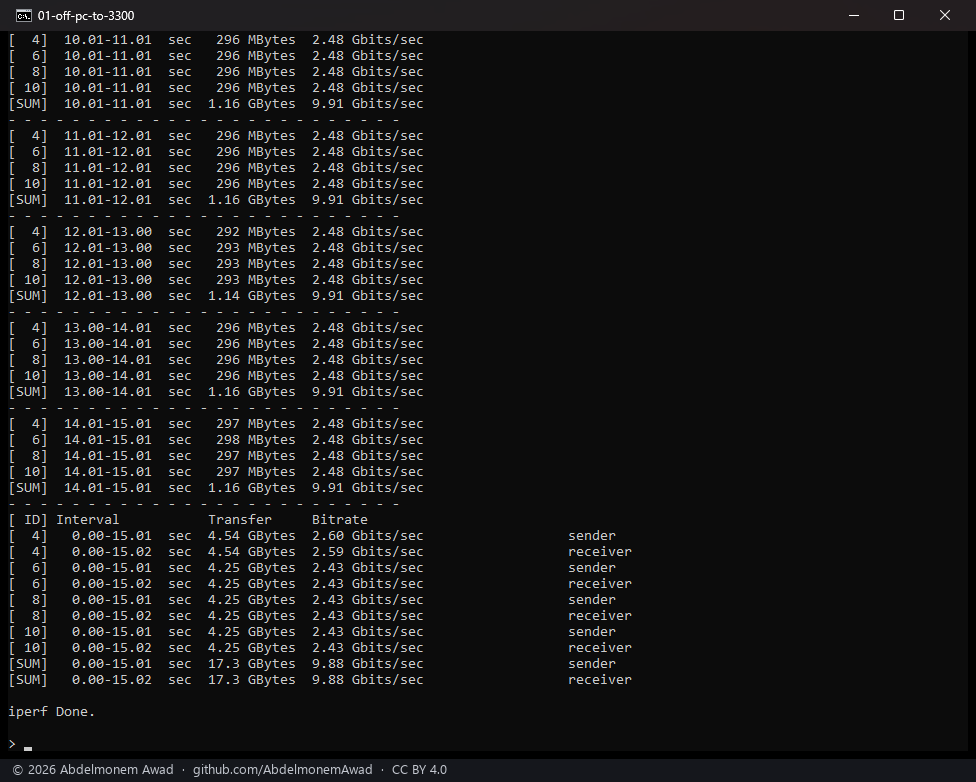
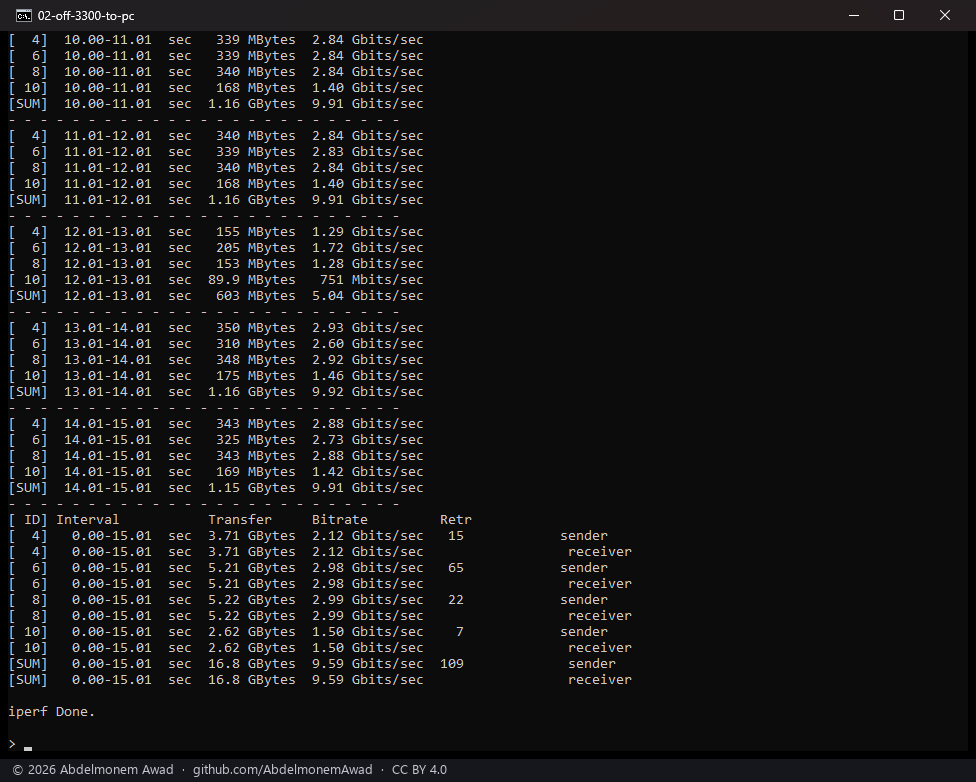
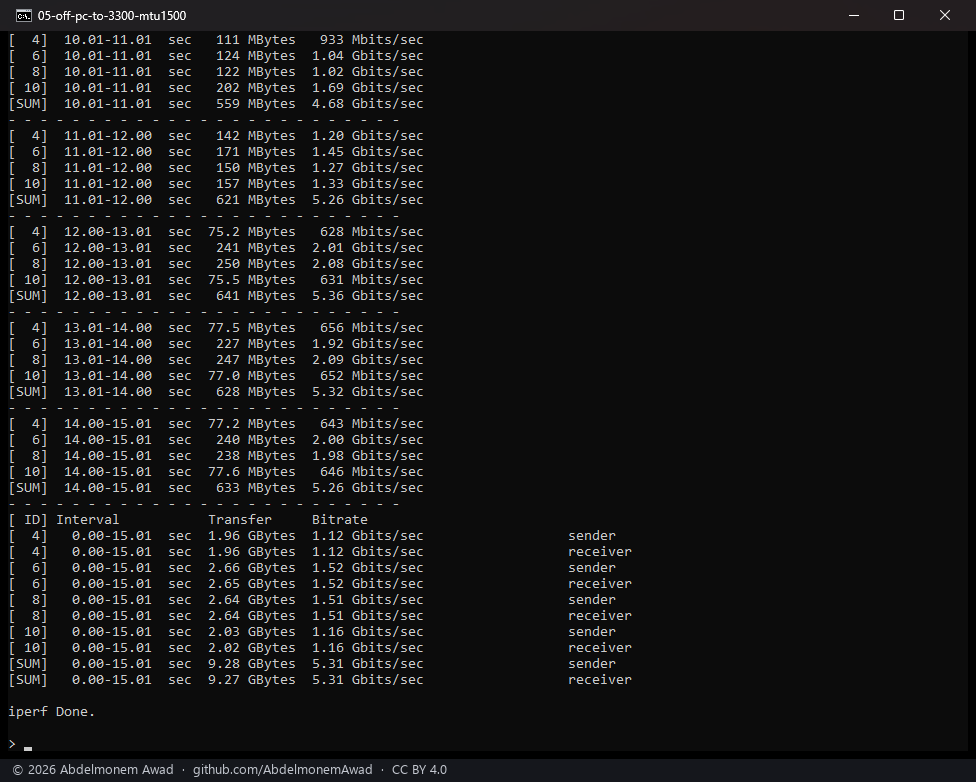
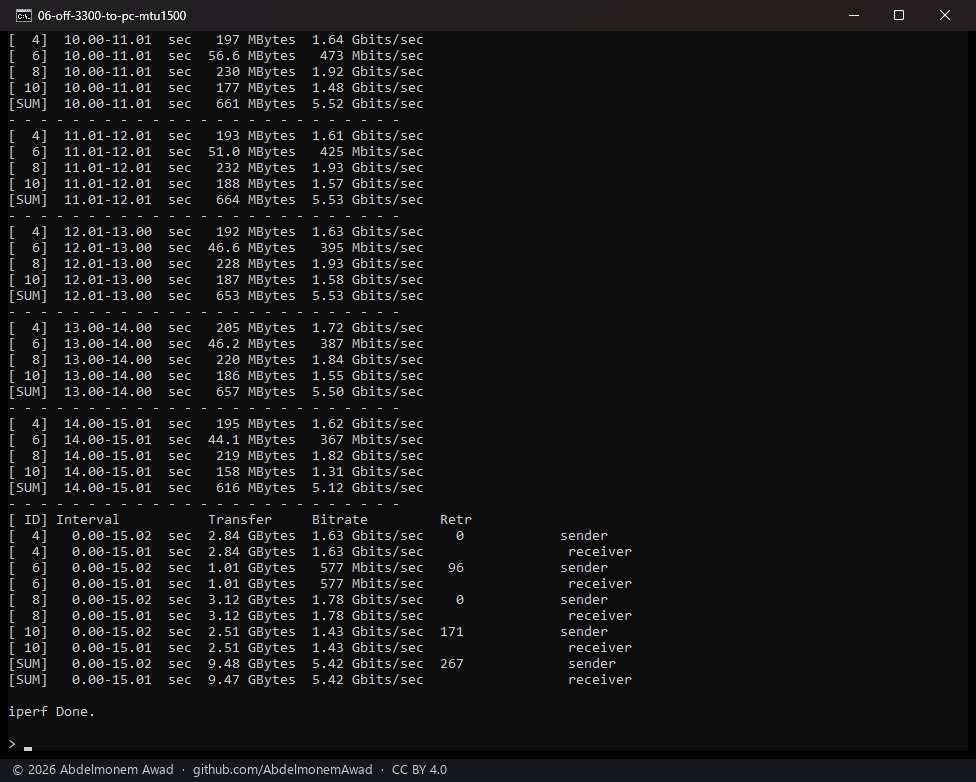
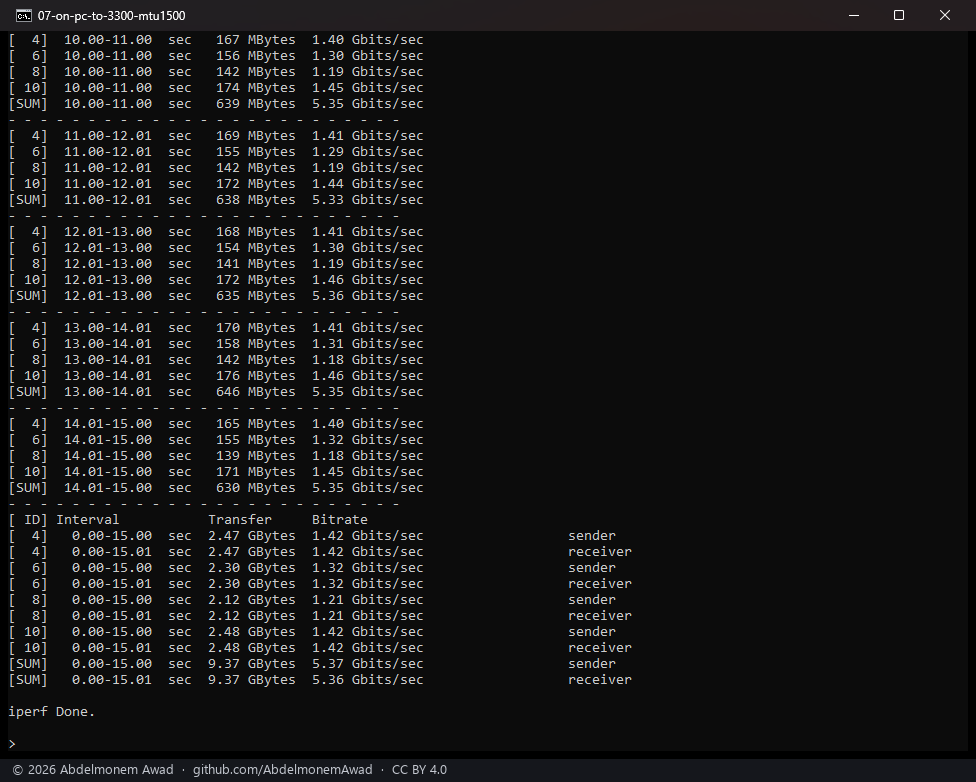
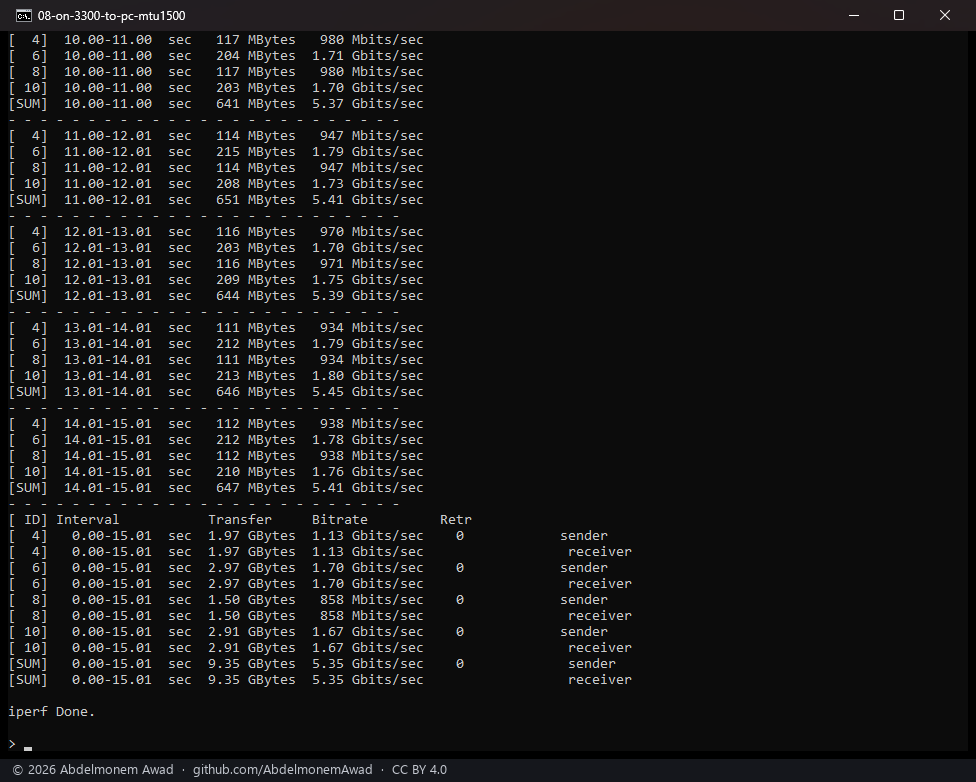
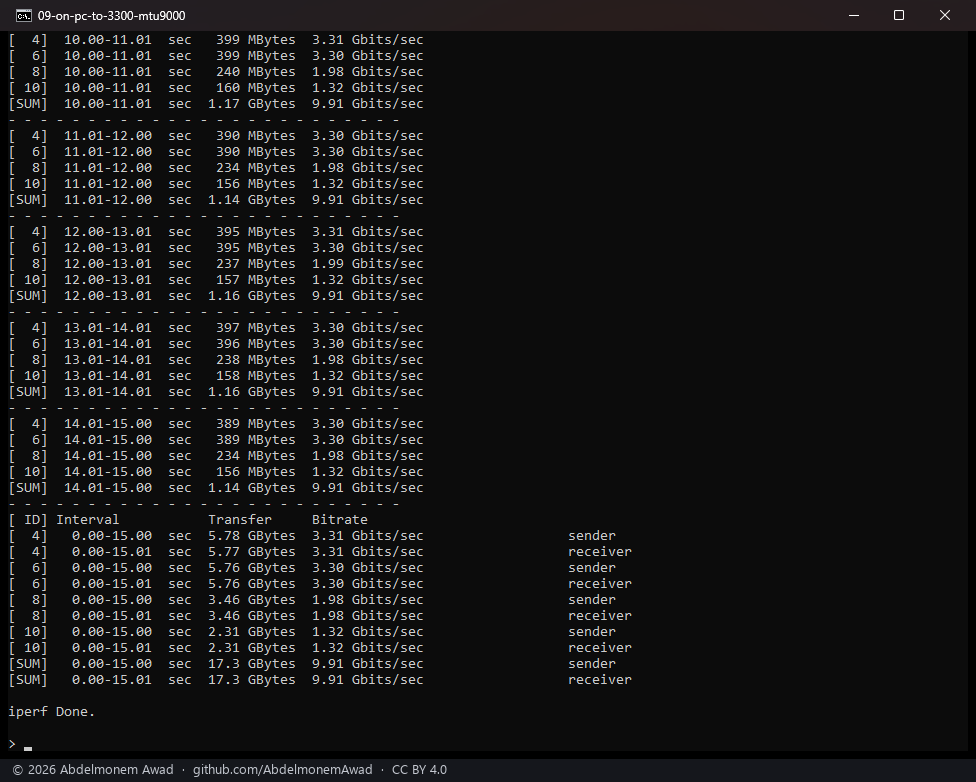
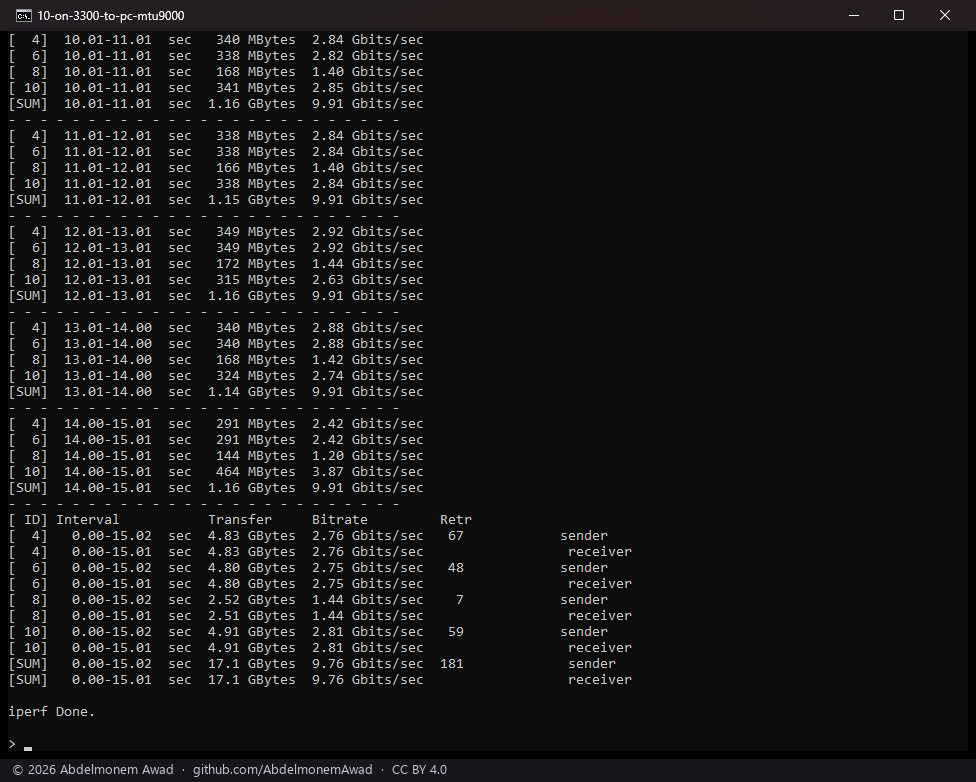
MTU 1500 was set on the appliance's end of the link, F1, through OPNsense, and put back to 9000 after; the PC then advertised and used a segment of 1460 bytes. A first attempt with iperf3's own segment size option failed on both ends ("unable to set TCP/SCTP MSS") and measured nothing.
The round trip, 100 pings 0.2 s apart from the PC: 0.977 ms on average with PowerD on (0.594 to 1.444), 1.023 ms with it off (0.738 to 1.281).
At idle, sampled every 20 seconds - the CPU's die (amdtemp), and the board's CPU, NPU and inlet readings from the CPLD:
| PowerD | clock | die | board CPU | NPU | inlet | fans |
|---|---|---|---|---|---|---|
| off | 3350 MHz | 37.6 - 37.7 C | 37 C | 69.6 C | 27 C | 6900 - 7200 rpm |
| hiadaptive, after 4 minutes | 1600 to 3350 MHz | 37.0 - 43.1 C | 37 - 43 C | 68.5 - 69.6 C | 26 - 27 C | 6900 - 7200 rpm |
The clock under PowerD jumps to the top for the sample itself, and the 43 C reading was taken with the load average still at 0.9 from the run before.
What this says: on the XGS 3300 PowerD cost nothing measurable - not throughput where the CPU is the limit, not the round trip - and bought nothing measurable either: the idle temperatures are within a degree, and the fans did not slow. What it saves in power was not measured, because there is no meter on this bench. So the plugin leaves it as OPNsense leaves it, off, and the owner may turn it on. Not measured on the XGS 136.
Swap, and the logs in memory
Both appliances have an 8 GB swap partition from the installer (/dev/ada0p3 on the XGS 3300,
/dev/gpt/swap0 on the XGS 136), so the page's 2 GB swap file adds nothing. Both run ZFS on an SSD
that takes TRIM - a 256 GB LITEON L8H-256V2G-41 in the XGS 3300, a 120 GB Transcend MTS420S in the
XGS 136 - with /var/log and /tmp as datasets of their own. Putting either in memory would save
little wear on an SSD and would lose the logs at every reboot, which is when this plugin's boot
hooks write the lines that say what the coprocessor did. Left off.
The beep
/dev/speaker is there on both, but spkr attaches to the PC timer that every x86 board has, so
it says nothing about whether a speaker is fitted. The beep at boot and shutdown runs either way;
whether it is heard is to be checked by ear. Until then the option is left as it is. Listened for
by its owner through a reboot of the XGS 3300 on 2026-10-17: no beep. With nothing to hear,
the option changes nothing there that anyone would notice, and is left as it is. The XGS 136 has not
been listened to.
The hardware watchdog
Both hosts carry the AMD FCH watchdog timer, and FreeBSD's amdsbwd attaches to it on each:
amdsbwd0: <AMD FCH Rev 41h+ Watchdog Timer> at iomem 0xfed80b00 on the XGS 3300 (2026-10-12) and
on the XGS 136 (2026-10-17). OPNsense has no page for it and nothing arms it, so until now a host
that stopped scheduling stayed stopped until somebody pulled the power.
The coprocessor's Settings page now has Hardware watchdog, on by default by the owner's decision
(2026-10-17). scripts/xgs/watchdog.sh loads the driver and starts watchdogd -t 128 -s 1: the
timer is patted every second and fires after 128 seconds without a pat. The start hook
08-xgs-watchdog arms it at the end of every boot, and the stop hook 05-xgs-watchdog disarms it
first thing at every shutdown - watchdogd disarms the timer only when it is asked to stop, and a
timer left armed through a halt would reset the appliance two minutes after it was told to power
off. Apply on the page arms or disarms it at once.
Measured 2026-10-17: armed, disarmed and armed again by hand on both appliances; then through a reboot of the XGS 3300 with nothing done by hand - the stop hook ran at 14:24:53, the start hook at 14:27:27, and the timer was armed one second later. That the timer actually resets a host that has stopped was not tested: it would mean stopping the host on purpose. Whether it did, when a host restarts without a shutdown, is recorded at the next boot since 2026-10-18: bit 25 of the chipset's reset record, which the problem report of that restart names (docs/problem-reports.md).
The discussion of this page is held in the project's GitHub Discussions. Showing it here loads giscus from giscus.app and GitHub, and writing in it needs a GitHub account - what that means.