Two hours of TLS through the XGS 136, every byte checked, 2026-10-19
The XGS 3300's integrity soak (two hours of TLS), made on the XGS 136 for the first time:
- a 1 GiB file of random bytes, served over HTTPS by three TLS servers on the second XGS 3300;
- downloaded by the bench PC in three loops at once for 120 minutes, in through the XGS 136's F1 and out of its Port8 to the XGS 3300;
- each pass checked twice: curl's own TLS, which refuses a record that does not authenticate, and the file's SHA-256 against the server's;
- the XGS 136 - npuep 9619e07c, v0.1.0-alpha.2, its flow maker on - read over its LAN before and after, and nothing on it changed for the run.
Script: images/deploy/lab-136-soak.sh.
Measured
| passes, in 120 minutes | 795 - 264, 263 and 268 GiB on the three loops |
| passes curl failed | 0 |
| passes whose file differed | 0 |
| bytes | 795 GiB, every pass the whole 1 GiB |
| rate, the three loops together, over the whole run | 945 Mbit/s on average - the gigabit link nearly full for two hours |
| the XGS 136's CPUs, over the whole run | 2.5 % busy |
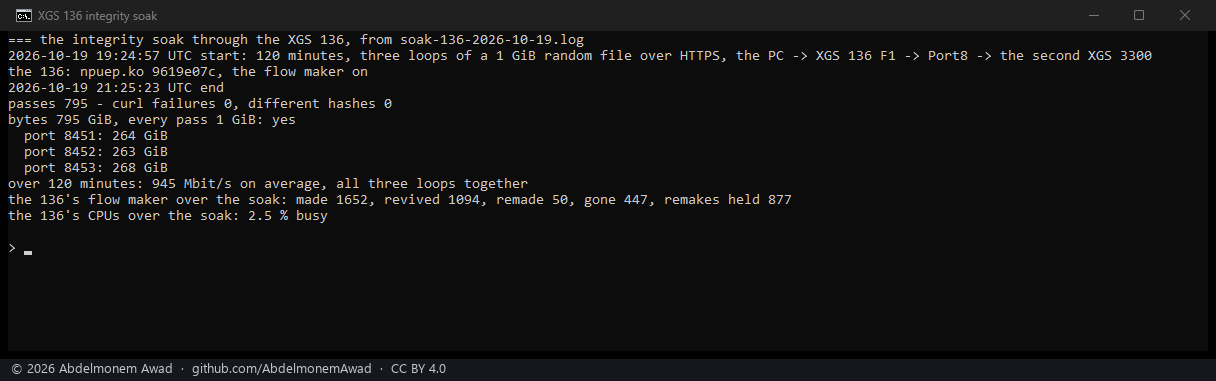
The flow maker over the run
Its counters, read before and after:
| over the run | |
|---|---|
connections it put in hardware (flow.auto_made) |
1,652 |
given back by the fast path and put back in place (flow.revived) |
1,094 |
let go while pf still held them, and made again (flow.remade) |
50 |
given back soon after they were made, and left with the host a while (flow.remake_held) |
877 |
taken back because pf no longer held them (flow.auto_gone) |
447 |
795 passes are 795 TLS connections, so a connection was put in hardware about twice on average, and many were given back along the way - revived in place, or held with the host by the give-back fix of #532. Whichever path carried a stretch of a connection, the bytes that arrived were the bytes sent: that is what this run measures, and all it claims. How much of the 795 GiB the coprocessor forwarded is not read here.
What it does not show
- One appliance, one firmware, one build: the XGS 136 above, on the bench of 2026-10-19.
- TLS over TCP and IPv4 only, at about a gigabit; no IPsec and no IPv6.
- A soak finds corruption that happens; two hours without any is not a proof that none can.
The discussion of this page is held in the project's GitHub Discussions. Showing it here loads giscus from giscus.app and GitHub, and writing in it needs a GitHub account - what that means.