What a cage carries, read from its module, measured, 2026-10-19
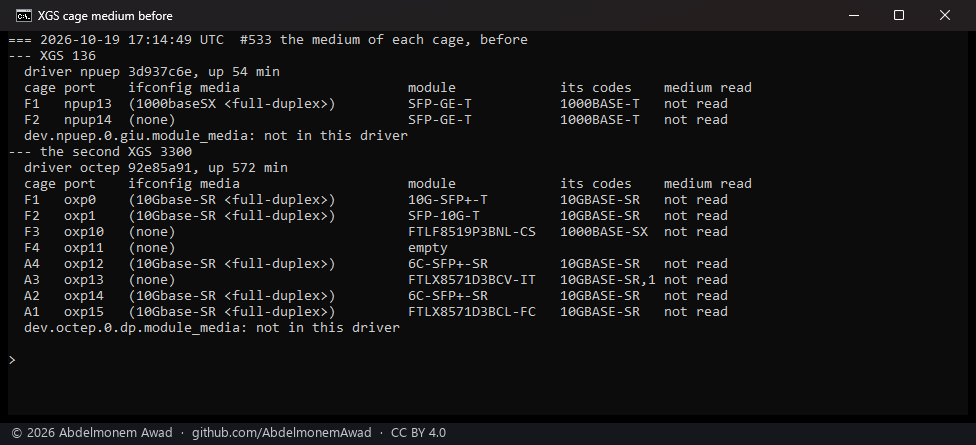
A port in a cage reported a medium that nobody had read (#533):
- On the XGS 136,
npueptook both cages to be fibre. F1 said1000baseSXwith a copper SFP-GE-T in it. - On the second XGS 3300,
octepsaid10Gbase-SRfor every port at 10 Gbit/s and1000baseTfor every one at a gigabit. Its F1 and F2 hold copper 10GBASE-T modules. Its F3 holds a 1000BASE-SX module, which would have been called copper.
Neither driver can read a module. The modules' memory is on the coprocessor's I2C, which the host
does not reach. Now the Transceivers page's script, which reads every cage on the coprocessor, also
tells the driver what each module is. A cage's port reports that medium, and unknown until it has
been told.
How
- The drivers. Each gained one sysctl,
dev.npuep.0.giu.module_mediaon the XGS 136 anddev.octep.0.dp.module_mediaon the XGS 3300. - A write is
"<interface> <at 1G> <at 10G>", each an Ethernet media subtype asnet/if_media.hnumbers it, 0 where nothing was read. - The port reports the one for the speed it is running at.
- The switch's RJ45 sockets are not cages and keep
1000baseT. - On the XGS 136 the speed the kernel is told,
if_baudrate, now comes from the port's speed and not from the medium, so an unread cage still has its speed. - The script,
scripts/xgs/transceivers.py, reads more of each module than before: its connector (byte 2) and its compliance codes (bytes 3, 6, 8 and 36). From those it takes the medium at a gigabit and at ten, with two exceptions: - a module with an RJ45 connector is copper whatever its codes say;
- some copper 10GBASE-T modules claim 10GBASE-SR and an LC connector outright. The two in the
XGS 3300's F1 and F2 do, and the owner confirmed both are copper. So a part number with a
Tof its own (SFP-10G-T,10G-SFP+-T,SFP-GE-T) is taken as copper, and the page says that is where it came from. - When the script writes it: at every read, every five minutes from the cron and on Read
again now. Also at boot, from a new start hook,
64-xgs-transceivers: - at once from what was read before the boot;
- then from the modules themselves, asking again every 20 seconds for up to three minutes. On the
XGS 3300 the console the script reads through was busy at boot with another plugin's first read,
and one refusal left every cage
unknownuntil the cron came round. - The Transceivers page has a Medium column, with "from its part number" where that is where it came from.
Measured
The builds: npuep 9619e07c on the XGS 136, octep 3315c08f on the second XGS 3300. Each was
installed by hand with the plugin's changed files, and each appliance rebooted onto it.
Before, the modules as the page read them, and what the ports said:
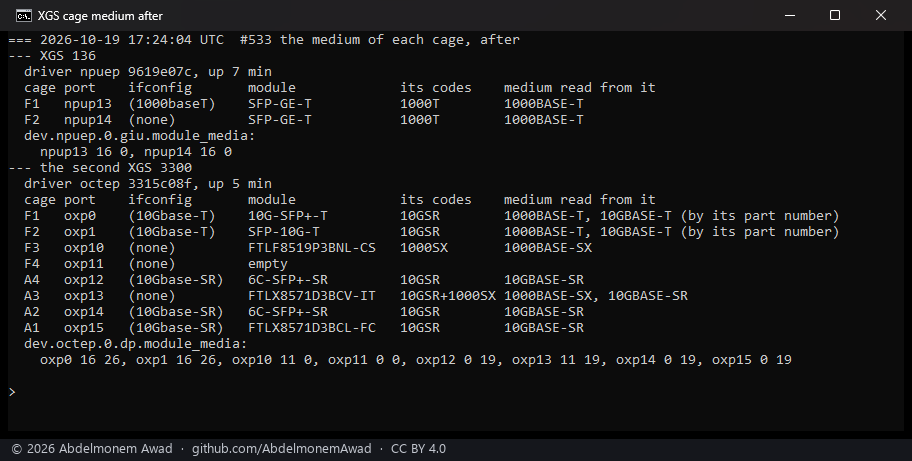
After the reboots: F1 on the XGS 136 says 1000baseT. F1 and F2 on the XGS 3300 say
10Gbase-T, from their part numbers. A1, A2 and A4 say 10Gbase-SR, from their codes. F3, its
SX module without a link, is told 1000BASE-SX for when it has one.
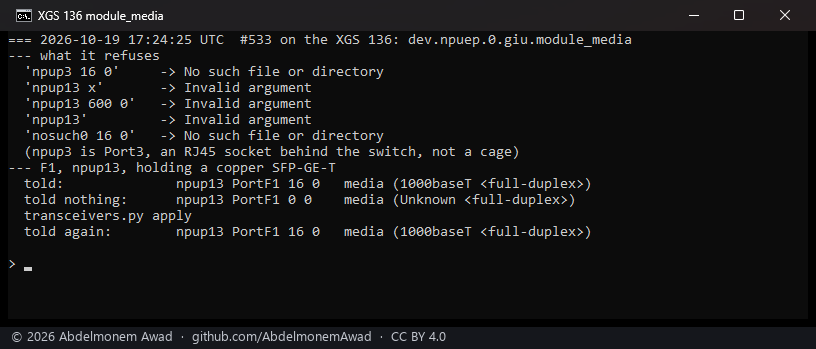
The driver's side, on the XGS 136:
module_mediarefuses a port that is not a cage, an interface that does not exist, a subtype that is not a number or out of range, and a line without both subtypes.- A cage told nothing reports
Unknown. That is what F1 said in the seconds after the boot, before the start hook had written it. transceivers.py applyputs the medium back from what was read last.
At boot:
- XGS 136: the start hook ran 70 seconds after the boot and wrote both cages at its first read.
- XGS 3300: its first read was refused, the console busy, and every cage stayed
Unknown; that was the build without the retry. - The retry, then added, was tried with the console held for 25 seconds by another command: the read went through on a later attempt, 64 seconds after it started, and every cage was written. It has not been through a boot yet.
Not measured
- The Transceivers page itself, its new column, in the browser: the GUI's login is the owner's. The page reads the same file the script writes, as before.
- A 1000BASE-SX module with a link. F3 on the XGS 3300 has none; it is told, and has not shown it.
- A copper expansion module (RJ45 in the bay). Its ports would be written as copper from the coprocessor's "not an SFF port".
The discussion of this page is held in the project's GitHub Discussions. Showing it here loads giscus from giscus.app and GitHub, and writing in it needs a GitHub account - what that means.