Extended sequence numbers on the XGS 136's engine, both ways. Measured, 2026-10-20
Yes, both ways. The XGS 136's crypto engine keeps an association's 64-bit sequence count when SA_ADD
asks it to - bit 18 of the control word, ext_seq - and it did, for every frame of three runs at the
gigabit link's rate: 4,305,432 frames decrypted on one association, none failed, and 5,796,289
frames encrypted that the peer's kernel checked with no authentication failure and no replay.
On the XGS 3300 the same question has a one-sided answer: its coprocessor decrypted about a million frames of an ESN association and then failed every one on authentication until a rekey, so what arrives stays with the kernel there (under ESN, what arrives stays with the kernel). The ARMADA's engine is another engine, and it was measured on its own.
What the driver does now
npuipsec.c sets ext_seq in SA_ADD for an association the kernel
marks with SADB_X_SAFLAGS_ESN, and takes both directions:
- outbound, always - before this change an outbound ESN association was left to the kernel;
- inbound, while
dev.npuep.0.ipsec.esn_decryptis 1, the default. At 0 an inbound ESN association is left to the kernel and counted inesn_refused. Before this change an inbound ESN association was handed to the engine without the bit, as a 32-bit one. Nothing measured that, and it could not be reached from the GUI: OPNsense's IPsec pages have no ESN field, and strongSwan takes ESN only through the ESP proposal (aes256gcm16-esn), set here by hand. esn_taken_encryptandesn_taken_decryptcount the associations on the engine;dev.npuep.0.ipsec.sasprintsesnbeside each one.
How it was measured
The lab tunnel between the XGS 136 (behind its Port8) and the second XGS 3300, AES-GCM-16-256, the
bench PC on the 3300's side. images/deploy/lab-136-esn.sh (not in this repository) edits the
child's ESP proposal in swanctl.conf on both ends to aes256gcm16-esn or back to aes256gcm16,
loads it, and has the 3300 make the child again; then one stream from the PC to the 136 (the 136
decrypting) and one back (the 136 encrypting), with iperf3, and what each end counted: the 136's
engine (tx_accel, the frames it encrypted; rx_done, rx_bad, rx_nosa, what became of the frames
it decrypted) and the 3300's kernel ESP counters. The 3300's engine decrypts the plain proposal
itself, and leaves an inbound ESN association to its kernel, so the 3300's kernel counts exactly the
136's ESN frames and checks every one of them.
The first build measured (npuep.ko md5 b1db7d96) had the inbound side off by default; it was
turned on with the sysctl after the "outbound only" run. The build that ships (059cf005, 252,776
bytes, compiled on the appliance) has it on, and the last run is that build after a reboot.
Results
| run | the 136's associations | PC to the 136 (the 136 decrypting) | the 136 to the PC (encrypting) | counted |
|---|---|---|---|---|
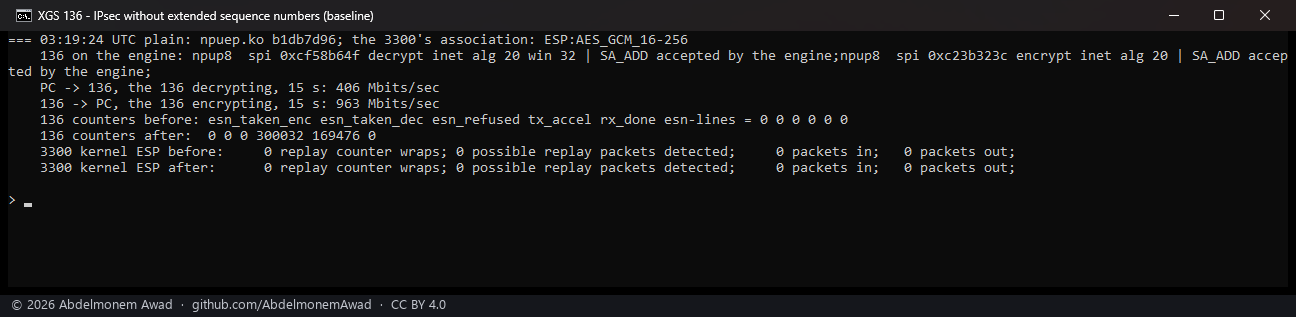
| plain, for comparison | without ESN, both on the engine | 406 Mbit/s, 15 s | 963 Mbit/s, 15 s | - |
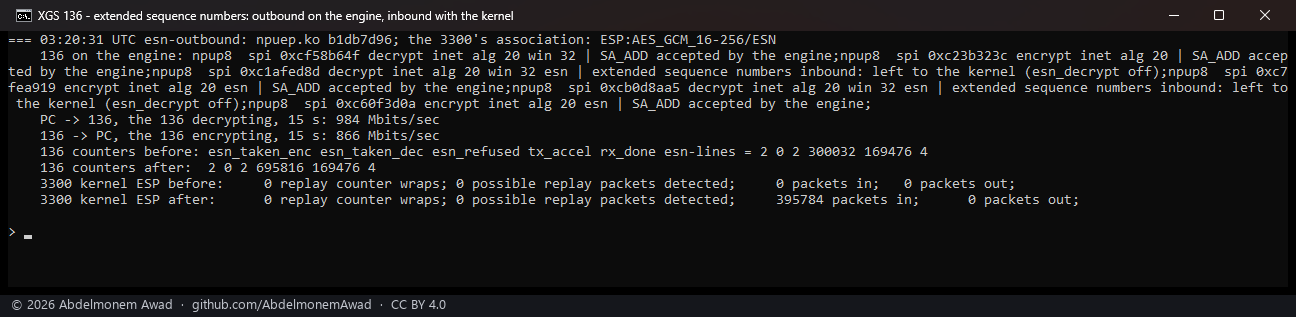
| ESN, outbound only | outbound on the engine; inbound with the kernel (esn_decrypt 0) |
984 Mbit/s (the kernel's cipher) | 866 Mbit/s | the 136 encrypted 395,784; the 3300's kernel took 395,784 |
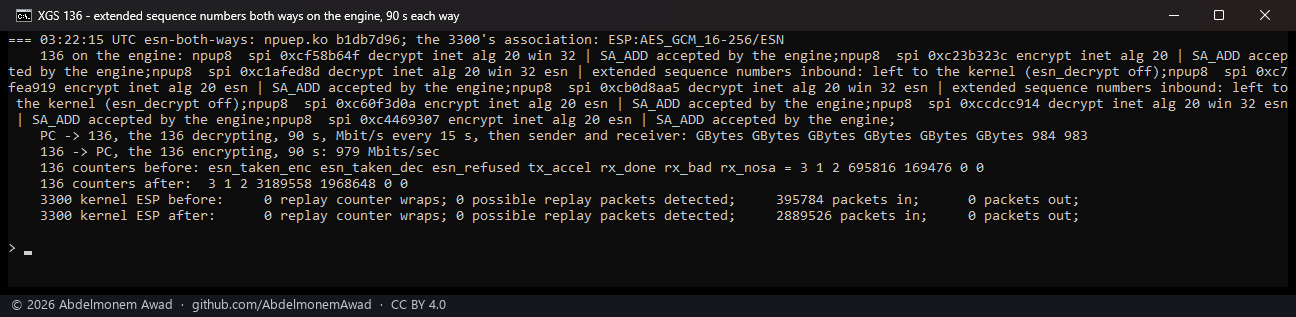
| ESN, both ways | both on the engine | 984 Mbit/s, 90 s | 979 Mbit/s, 90 s | the 136 decrypted 1,799,172 and encrypted 2,493,742; the 3300's kernel took 2,493,742 |
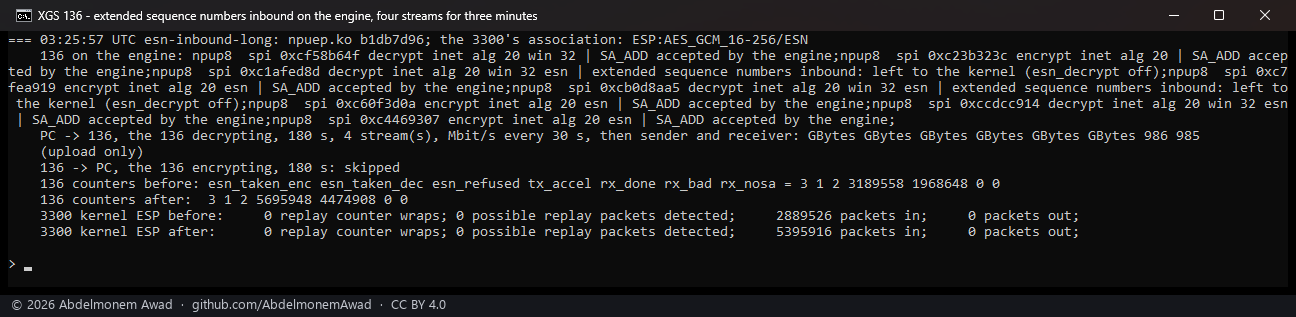
| ESN inbound, four streams | both on the engine, the same association | 985 Mbit/s, 180 s | - | the 136 decrypted 2,506,260 more, 4,305,432 on that one association; it encrypted 2,506,390 (the streams' acknowledgements), the 3300's kernel took 2,506,390 |
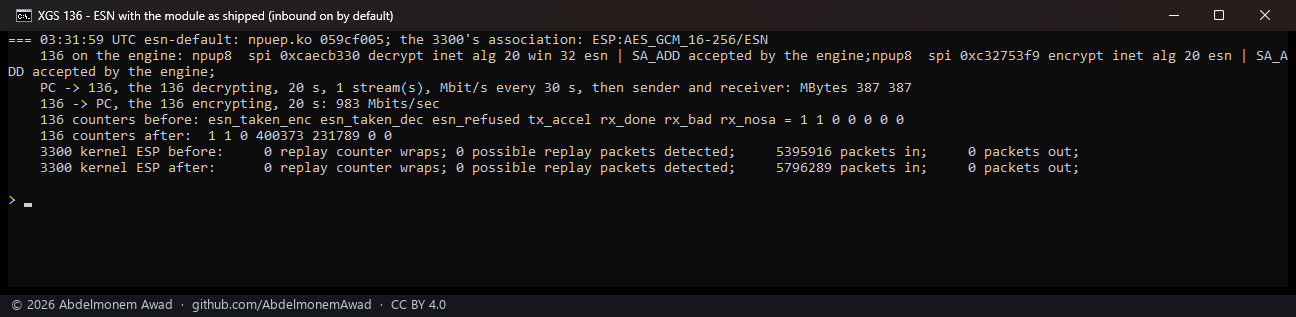
| ESN, the build that ships, after a reboot | both on the engine, esn_decrypt 1 by default |
387 Mbit/s, 20 s | 983 Mbit/s, 20 s | the 136 decrypted 231,789 and encrypted 400,373; the 3300's kernel took 400,373 |
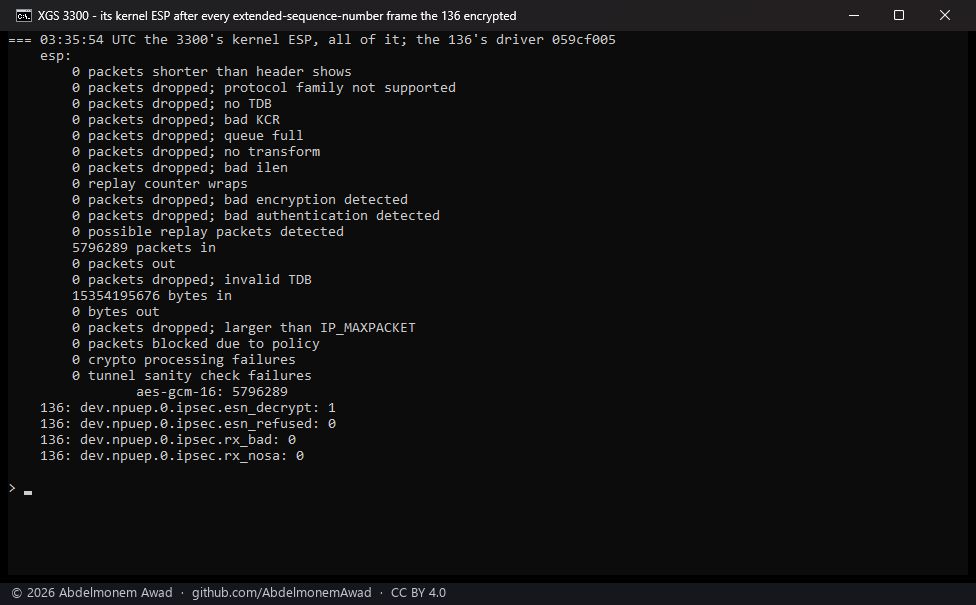
rx_bad and rx_nosa stayed 0 through every run. The 3300's kernel, read at the end: 5,796,289
packets in - the sum of the four counts above, to the packet - 0 dropped for bad authentication, 0
for bad encryption, 0 possible replays, 0 replay counter wraps, 0 crypto processing failures.



What it does not mean
- The two slow uploads are not ESN's, and not the plain proposal's. 406 Mbit/s (plain) and 387 Mbit/s (ESN, the build that ships) were both measured within a quarter of an hour of the 136's boot; every run between them, plain or ESN, carried 984. A stream into the 136 slow for the first minutes after a boot is issue 531, seen there into F1; here it is into Port8, through the tunnel.
- Not the 32-bit wrap. 4.3 million frames is about a thousandth of 2^32; no run crossed the point where the high half of the count changes. What was measured is that the engine, asked for ESN, computes and checks the integrity value with the 64-bit count from the first frame - with the wrong count, every frame would have failed - and keeps doing so for millions of frames, which is where the XGS 3300's coprocessor stopped. The crossing itself would need a rekey-free association for 2^32 frames, about 14 hours at this link's rate.
- One association pair, one cipher. AES-GCM-16-256 only; AES-CBC with an HMAC under ESN was not run.
All the numbers are in the log of the run, measurements/esn-136-2026-10-20.log (kept with the
bench, not in this repository); the addresses in three of the photographs are blurred.
The discussion of this page is held in the project's GitHub Discussions. Showing it here loads giscus from giscus.app and GitHub, and writing in it needs a GitHub account - what that means.