pfsync to a peer: a UDP connection in hardware lost its state about a minute in, and keeps it now, 2026-11-15
With pfsync between two appliances, the state of a UDP connection the flow maker had put in hardware was
replaced 60 to 70 seconds in (#1160). pfsync sends a
state's update when pf passes one of its packets, and a connection in hardware passes none: the driver's
keepalive refreshed the state's expiry by writing it, and pfsync never heard of it, so the peer's copy expired on
udp.multiple (60 s) and the delete its expiry sent back removed the live state. Since the change the keepalive's
refresh is handed to pfsync's own update, on the same state under the same lock (octep_pf_sync). That is the XGS
3300's driver: the XGS 136's keepalive did not refresh a state in hardware at all (below).
How it was measured
2026-11-15 at 05:15 and 05:23 UTC: the second XGS 3300 (vendor version 22, AMD Ryzen Embedded V1780B) carried the connection, the XGS 136 (vendor version 21) was its pfsync peer.
- pfsync alone, no CARP:
ifconfig pfsync0 syncdev ... syncpeer ...on both, over the two boxes' Port8 link, set at run time with a pass rule for it in a pf sub-anchor; brought up and left two minutes before each run. - The connection: UDP at 50 Mbit/s for 100 seconds from a fixed client port, from a jail on the test machine through the XGS 3300's Port4 and out of its Port3, routed, in hardware.
- Read every 5 seconds: the XGS 3300's state for it (
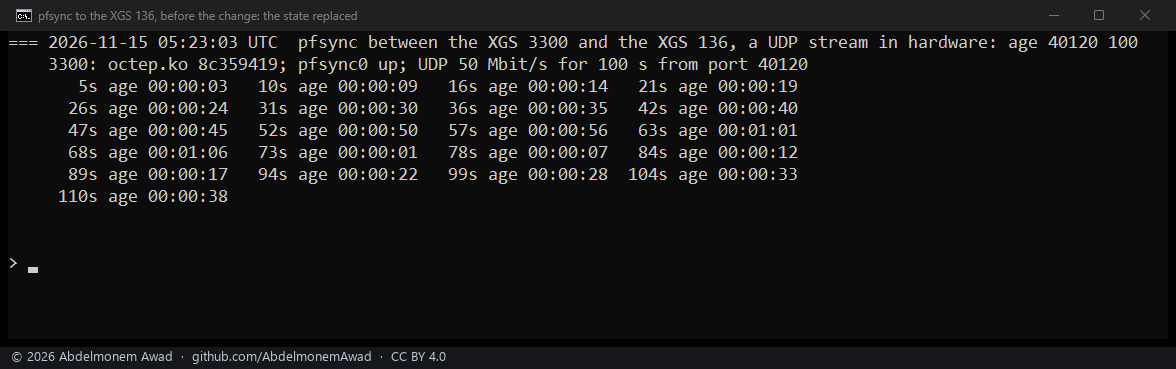
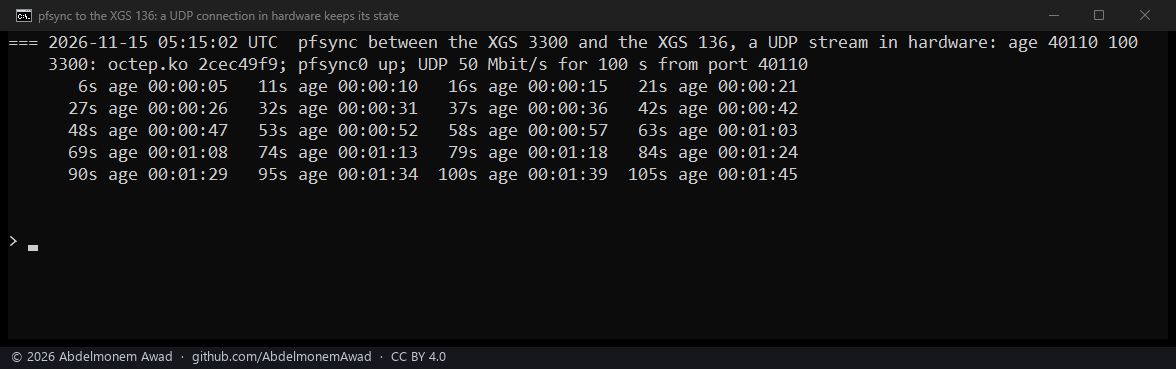
pfctl -ss -vv), its age. A state replaced shows as its age falling back. - Before and after: the same run with octep.ko
8c359419, which has no such call, and with2cec49f9. - Taken away after: pfsync0 down and unset on both, no rule or state left,
config.xmlunchanged.
Results
| octep.ko | the state's age, read every 5 s | replaced |
|---|---|---|
8c359419, before |
1:06 at second 68, then 0:01 at second 73 | about 72 s in |
2cec49f9, after |
0:05 to 1:45, rising at every read | no |
- Before: replaced once about 72 seconds in, as on 2026-11-14, when four runs of four replaced it 60 to 70 seconds in and a fresh state with pfsync down never was.
- After: never replaced. On 2026-11-14, with the change, pfsync sent 172 compressed updates in a 105-second run: one a connection every keepalive pass, as pf sends for a connection it sees.
What these figures do not mean
- Not an HA failover. No CARP ran: what happens to a connection in hardware when the backup takes over is not measured here. What a TCP connection's copy holds for a takeover: the numbers for pfsync.
- UDP only. A TCP state's own timeout is a day, so a TCP connection would meet the same only after a day in hardware; not measured.
- The XGS 3300 only. On the XGS 136 the keepalive asks whether a state exists and gives pf its counts, and
does not refresh its expiry:
npuep_pf_touch, which would, and which tells pfsync since this change (npuep_pf_sync), has no caller.So there a UDP state in hardware lapses at its own timeout with or without pfsync, and the change does nothing yet; not measured.Since the same day's second part of phase 2 the XGS 136's keepalive restamps a state in hardware and tells pfsync (the XGS 136's UDP state); pfsync with the XGS 136 carrying the connection was not measured. - Right after pfsync was first brought up on 2026-11-14, the XGS 3300 sent hundreds of thousands of compressed updates over two to four minutes, once with the change and once without, and never again after; the cause was not found, and every run here began two minutes after pfsync came up.
The discussion of this page is held in the project's GitHub Discussions. Showing it here loads giscus from giscus.app and GitHub, and writing in it needs a GitHub account - what that means.