netmap on the XGS 136's own rings: four of them, and jumbo frames through Suricata, 2026-11-11
Suricata in IPS mode reads a port through netmap. On the XGS 136's ports netmap used its emulated adapter,
and that adapter cuts every frame to one 2,048-byte cluster on its way out (FreeBSD's
nm_os_generic_xmit_frame: "size 2048 < len 9014"), so a port at MTU 9000 cannot run through Suricata in
IPS mode (measured the same day). npuep now gives each front port an adapter of its
own, behind a loader tunable.
What changed
hw.npuep.netmap=1at the loader (0 by default): each front port gets a native netmap adapter. A frame from receive queue N is copied into ring N, so both directions of one connection share a ring and the four queues fill four rings; transmit takes a ring's frames to the transmit queue of the same number. As many host rings as hardware rings.hw.npuep.netmap_slotsat the loader: slots in each ring, a power of two from 256 to 2048 (1024 by default); read-only asdev.npuep.0.giu.netmap_slots. 2048 is what fits netmap's default ring objects (dev.netmap.ring_size), and every slot holds a buffer: Suricata in IPS mode opens sixteen rings a port (four each way, and as many host rings), 16,384 buffers at 1024 slots against netmap's default 163,840.- One frame, one slot. A port whose MTU is above netmap's buffer size is refused when a reader opens it:
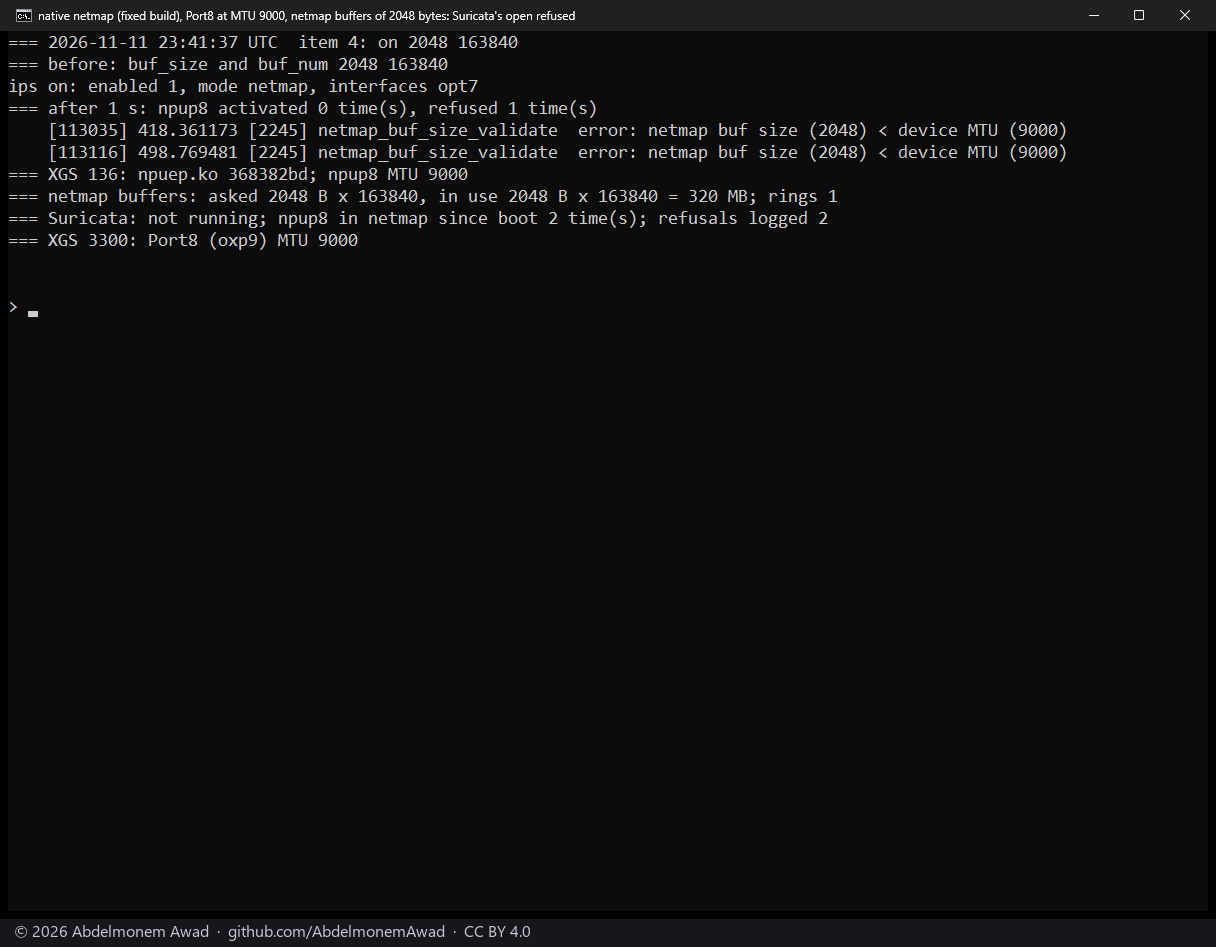
for a port at MTU 9000,
dev.netmap.buf_size=9216. A frame is never spread over several slots: Suricata's IPS path sends what it read back through the host rings, and netmap hands each slot of a chain to the stack as a frame of its own. - A reader's close waits for the wake-ups the receive path has already taken for its rings, and drops those it has not taken, before netmap may tear the rings down; a reader's open or close resets only the rings whose mode changes.
- Counts for each port under
dev.npuep.0.giu.netmap_port.<port>: its rings, each ring's frames in, frames dropped (nm_rx_drop) and among them frames longer than one buffer (nm_rx_toolong), and what transmit sent, found full or dropped. - At 0 nothing changes: the ports have no adapter of their own and netmap uses its emulated one, as before.
How it was measured
The XGS 136 (vendor version 21, four CPUs, four queues), OPNsense 26.7.8_2 on FreeBSD 15.1-RELEASE-p6, its
release module in /boot/modules. The module with this change was built on the appliance against its own
kernel's sources with no warning (md5 368382bd) and loaded in place with kenv hw.npuep.netmap=1, on
2026-11-11 from 23:29 UTC; the release module was loaded again after, the tunable removed.
- Intrusion Detection in IPS mode on Port8 (
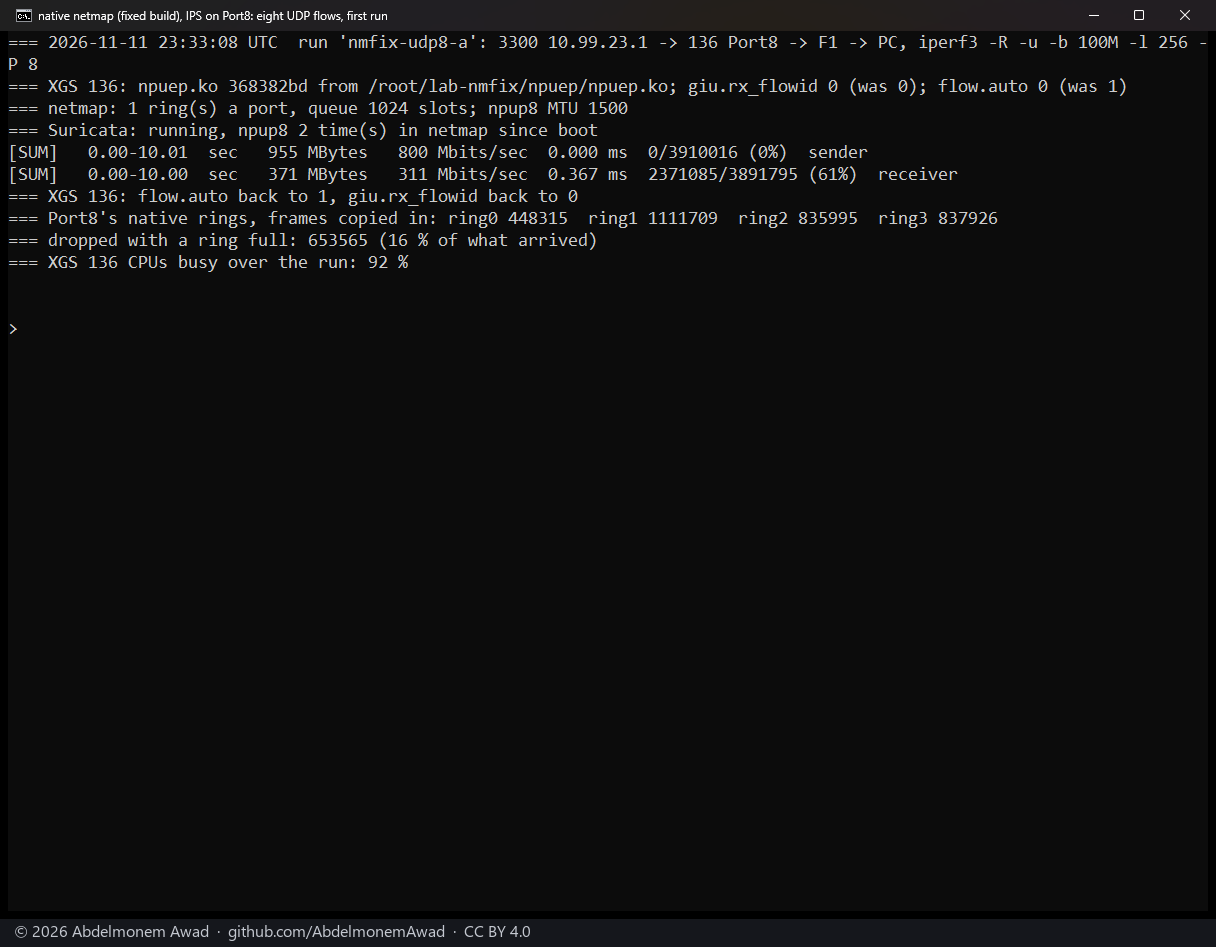
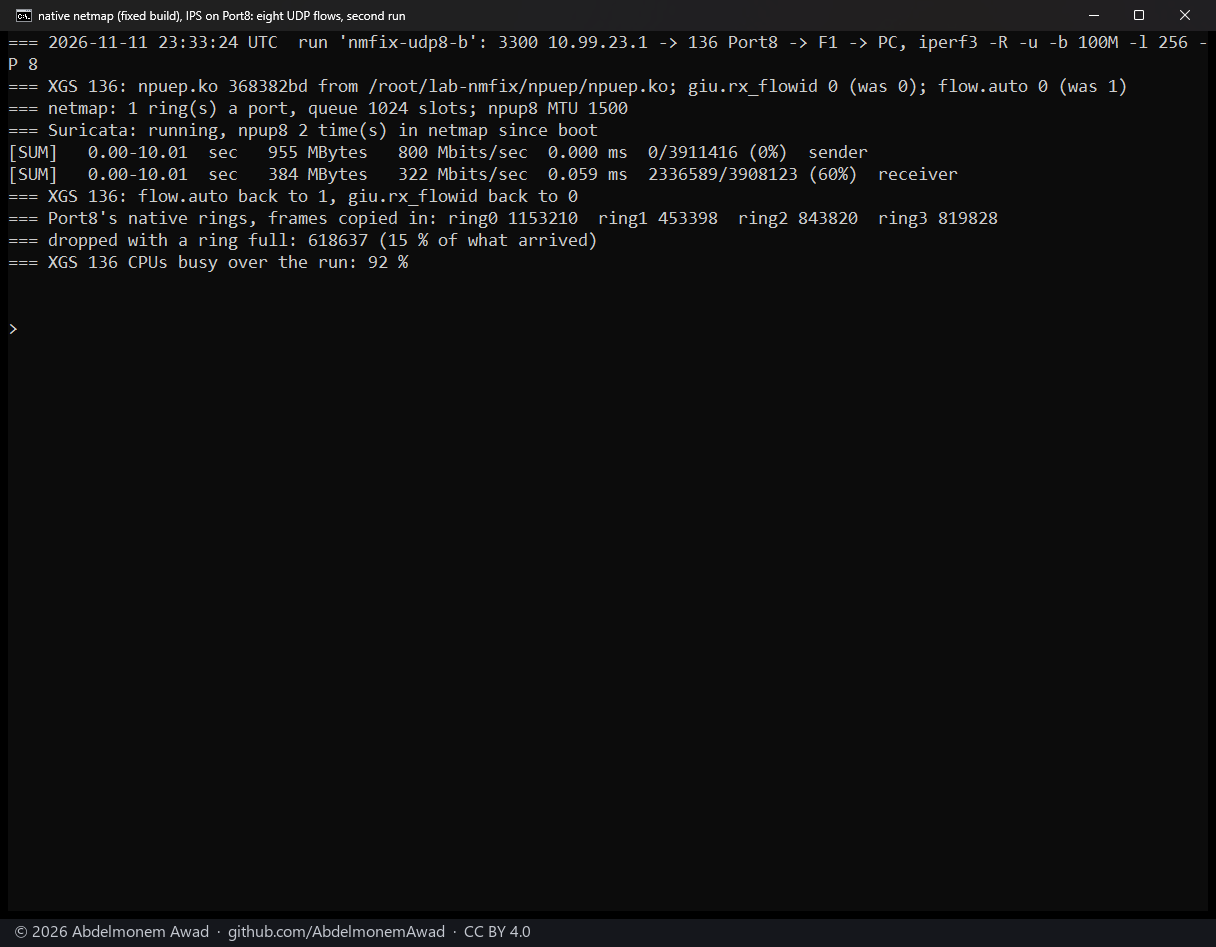
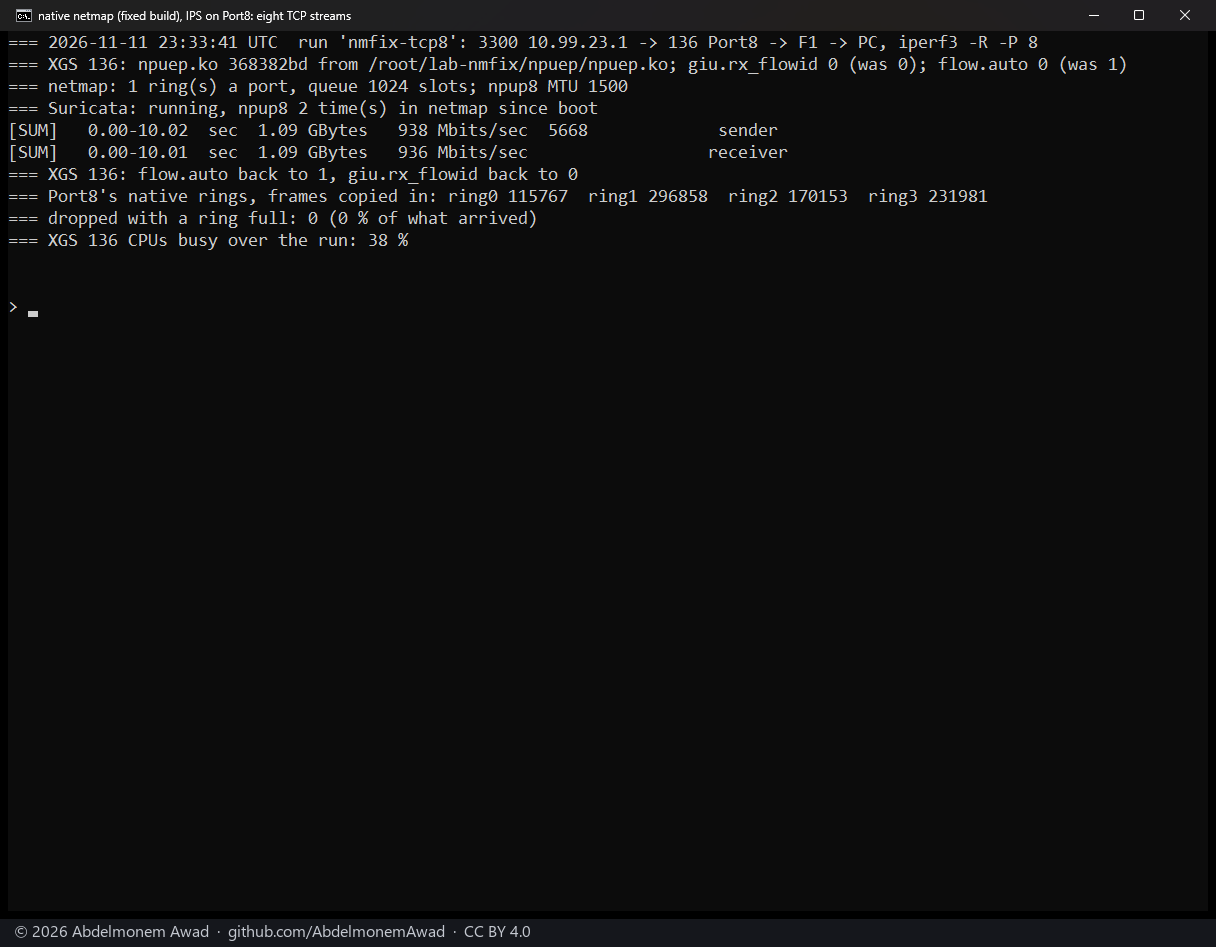
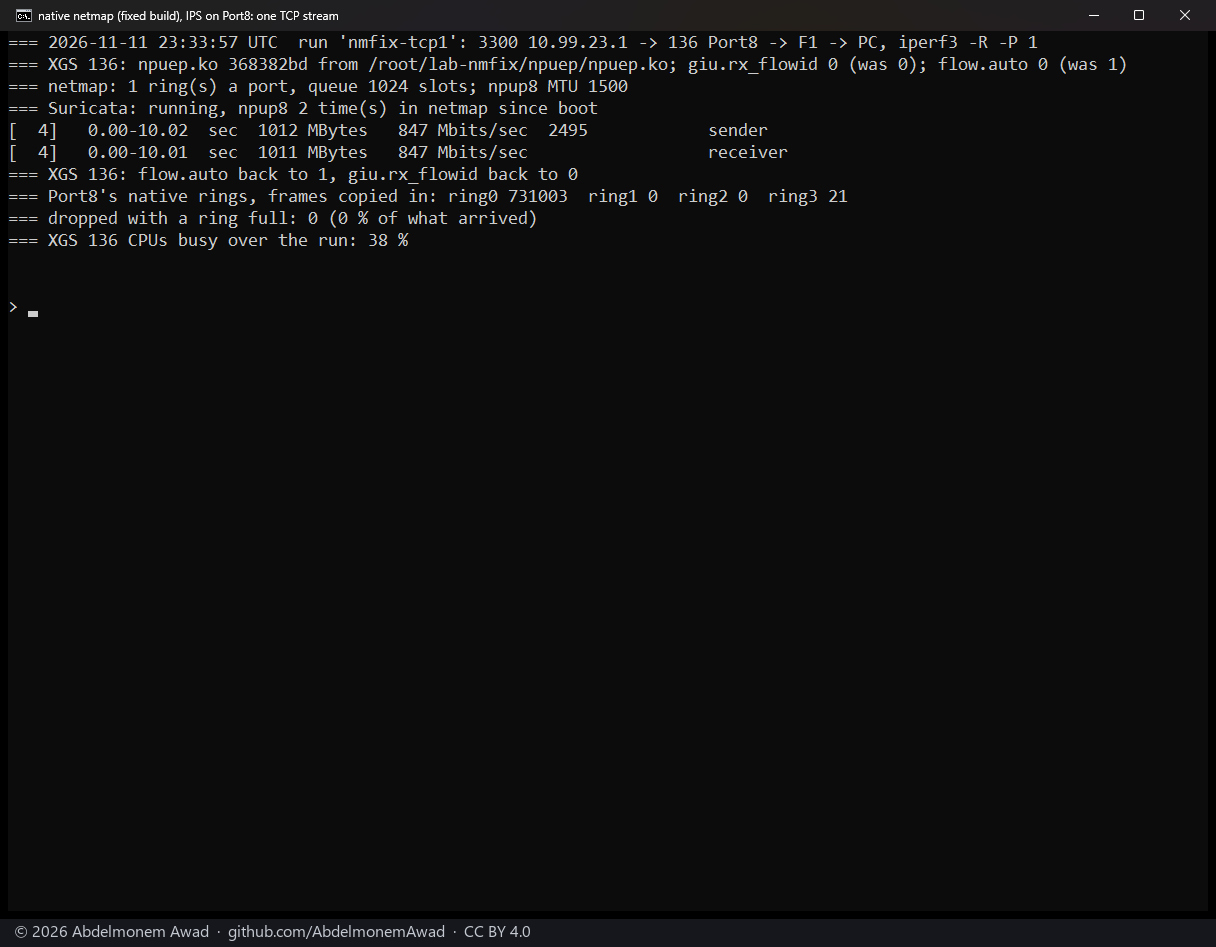
npup8), the driver's automatic acceleration at 0 for each run so every frame crossed Suricata. - The traffic from the second XGS 3300 through Port8 and out of F1 to a PC with iperf3: eight UDP flows of 100 Mbit/s in 256-byte datagrams, eight TCP streams, one TCP stream, 10 s each.
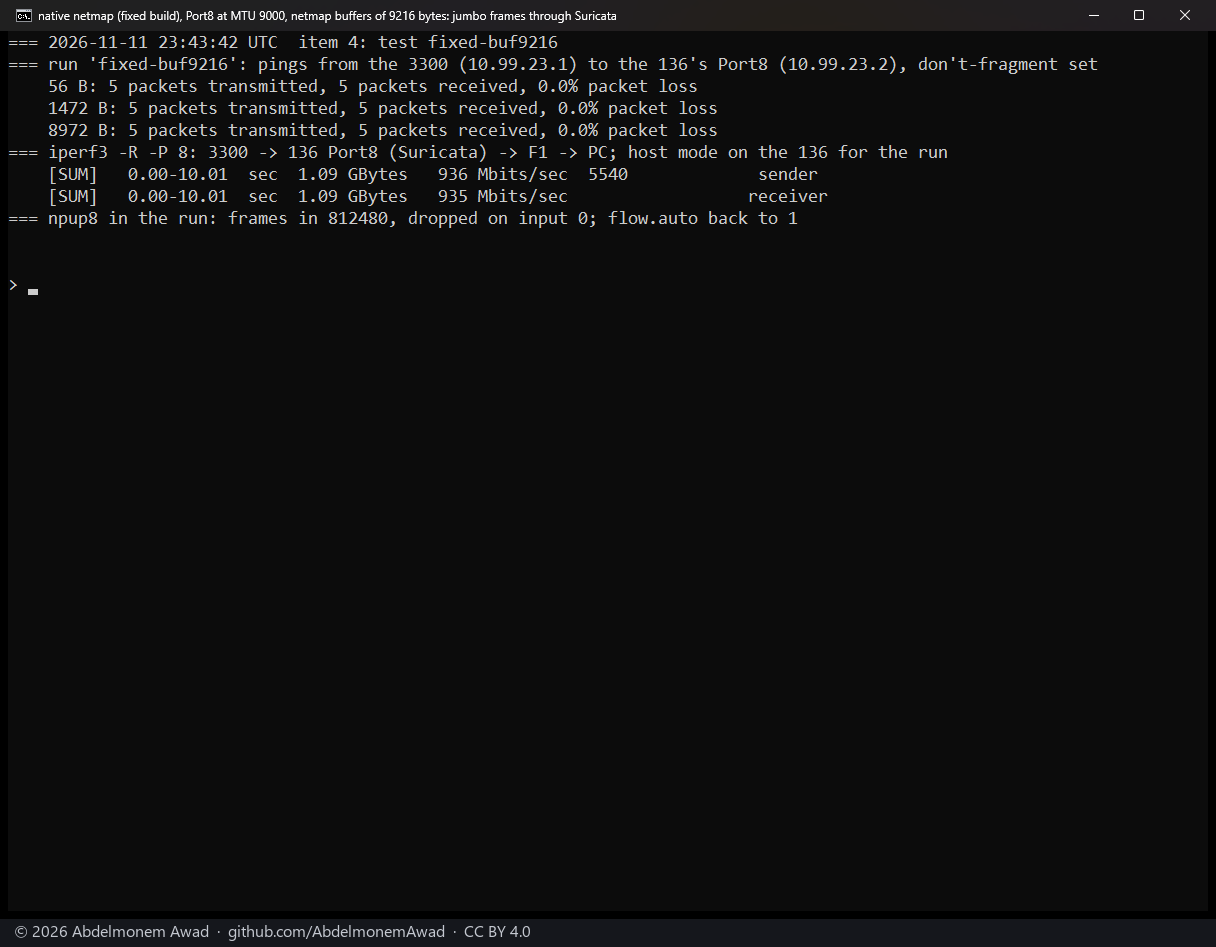
- Jumbo frames: Port8 and the second XGS 3300's port facing it at MTU 9000; pings of 56, 1,472 and 8,972
bytes from the XGS 3300 to Port8 with don't-fragment set, then eight TCP streams, with netmap's buffers at
2,048 bytes (163,840 of them, 320 MB) and then at 9,216 (36,864 of them,
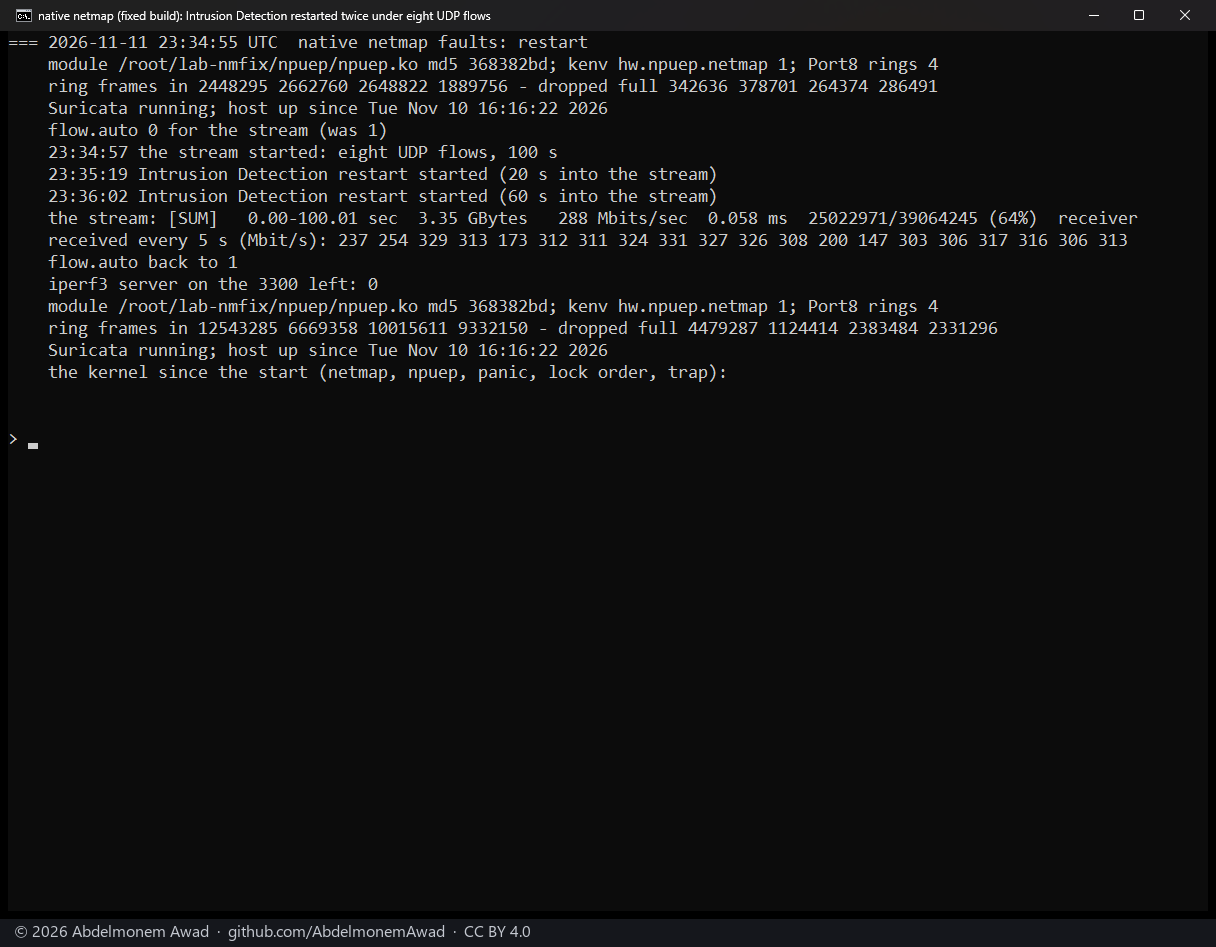
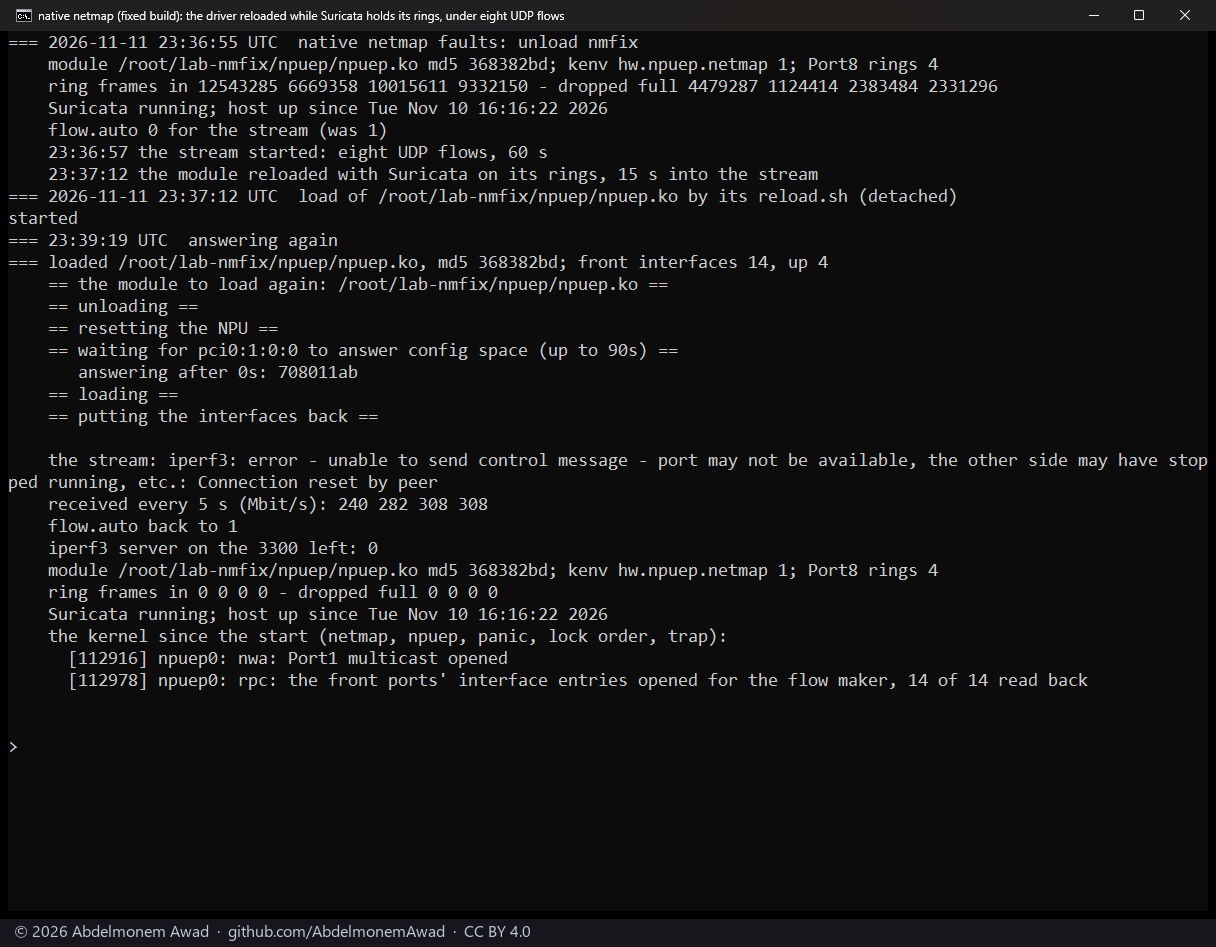
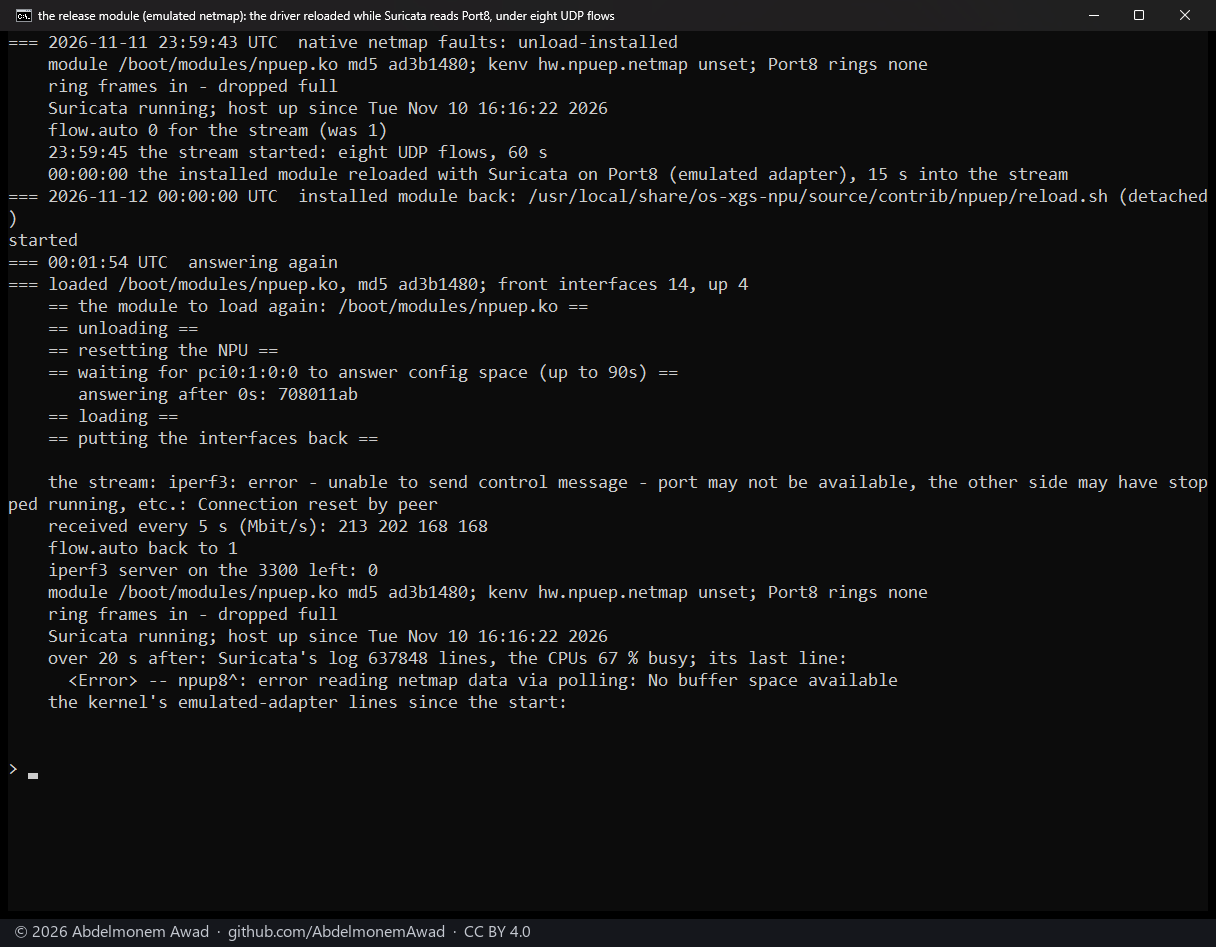
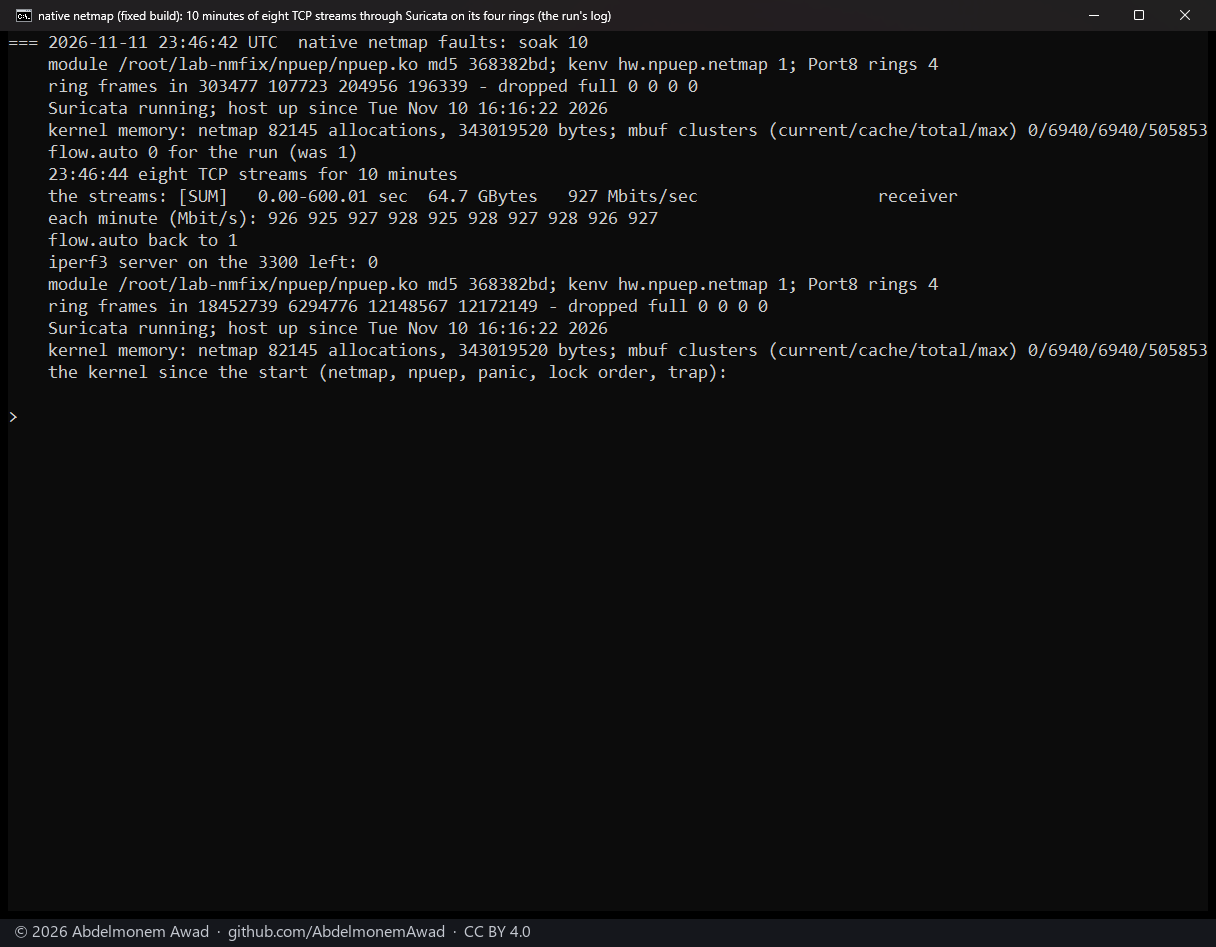
dev.netmap.buf_num, 324 MB). - Faults: Intrusion Detection restarted twice during a 100 s stream of the eight UDP flows; the driver reloaded 15 s into a 60 s stream - unloaded, the coprocessor reset and the driver loaded again, as the plugin's recovery in place does - with Suricata on its rings; then ten minutes of eight TCP streams.
- Read on the XGS 136: the frames copied into each ring and dropped with a ring full, how busy its CPUs were, the kernel's log, and whether the host stayed up (its boot time).
Results
| Run | Received | Dropped at the rings | CPUs busy |
|---|---|---|---|
| eight UDP flows, two runs | 311 and 322 Mbit/s | 16 and 15 % | 92 % |
| eight TCP streams | 936 Mbit/s | 0 | 38 % |
| one TCP stream, three runs | 847, 929 and 925 Mbit/s | 0 | 38, 30 and 28 % |
| Pings through Suricata to a port at MTU 9000 | 56 B | 1,472 B | 8,972 B | eight TCP streams |
|---|---|---|---|---|
| netmap buffers of 2,048 bytes | the port refused: Suricata does not start | |||
| netmap buffers of 9,216 bytes | 5 of 5 | 5 of 5 | 5 of 5 | 935 Mbit/s |
- Four rings carry the load, and the CPUs are then the limit: eight UDP flows filled all four rings (for example 448,315, 1,111,709, 835,995 and 837,926 frames) and were received at 311 and 322 Mbit/s with the CPUs 92 % busy - what the emulated adapter reaches with four rings and the receive queue as the flow id (the measurement). The native adapter's gain is not speed.
- It is jumbo frames: with 9,216-byte buffers every 8,972-byte ping crossed Suricata whole, and the four rings took the run's 812,495 frames with none too long and none dropped. With 2,048-byte buffers netmap refuses Suricata the port ("netmap buf size (2048) < device MTU (9000)"), rather than let a frame reach Suricata in pieces.
- One TCP stream stays in one ring: 925 to 929 Mbit/s, and once 847.
Faults
| Fault | The stream | The host | Suricata |
|---|---|---|---|
| Intrusion Detection restarted twice, 22 and 65 s into 100 s of eight UDP flows | 288 Mbit/s on average; 173, then 200 and 147 in the 5 s after each restart, then back to 300-330 | up, no kernel message | running, on the rings |
| the driver reloaded 15 s into 60 s of eight UDP flows | ended: F1, the PC's way in, went down with the driver | up, no kernel message but the driver's own | running, but on the old rings: see below |
| ten minutes of eight TCP streams, every frame through the rings | 927 Mbit/s, each minute 925 to 928 | up, no kernel message | running; 48.3 million frames through the four rings, none dropped |
- A restart under load costs a few seconds: the stream dipped once for each and came back.
- A reload under Suricata leaves the host up, and Suricata on rings that are gone. The driver came back
with new rings, and Suricata, still running, never read them: it logged "npup8: error reading netmap data
via polling: No buffer space available" about 30,000 times a second, the CPUs were 98 % busy, and the next
stream passed Port8 uninspected. Intrusion Detection restarted ended it.
The release does the same with netmap's emulated adapter: the module from
/boot/modulesreloaded under Suricata, which logged 637,848 lines in 20 seconds with the CPUs 67 % busy - the recovery path restarts nothing (1153). - Ten minutes under load, nothing lost: eight TCP streams at 925 to 928 Mbit/s each minute, 48.3 million frames through the four rings with none dropped, netmap's memory and the mbuf clusters the same before and after, and nothing in the kernel's log.
What it does not mean
- TCP with jumbo frames was not measured: the streams' other legs, out of F1 to the PC, set their segment size, and only the pings above are known to have crossed Port8 at 8,972 bytes.
dev.netmap.buf_size=9216was run withdev.netmap.buf_num=36864to keep netmap's memory near its default; other counts were not tried.- Only the XGS 136 was measured, and only npuep has the tunable.
The discussion of this page is held in the project's GitHub Discussions. Showing it here loads giscus from giscus.app and GitHub, and writing in it needs a GitHub account - what that means.