The XGS 3300's own MACs counted on XGS: Ports, 2026-10-20
The switch's counters gave XGS: Ports a row for Port1 to Port8 and for the two cages behind the switch - on the XGS 3300, F3 and F4. Its F1 and F2 and the expansion module's ports are not on the switch: they hang off the coprocessor's own BGX blocks, and nothing read what those count.
Each BGX LMAC counts its own frames: what it took in good, PAUSE frames, what its address filter
dropped, what a full receive FIFO dropped, what arrived with an error; and what it sent, and what it
sent short of data. Cavium published the registers in its board development kit, which coreboot
carried (bdk-csrs-bgx.h): BGX(a)_CMR(b)_RX_STAT0 to 8 and TX_STAT0 to 17, at
0x87E0E0000000 + a * 0x1000000 + b * 0x100000 on the CN83XX, 48 bits, not cleared by a read -
so reading them takes nothing from anyone else who does. The coprocessor reads them with busybox
devmem.
Which LMAC is which port:
- F1 and F2 are BGX 2's LMACs 0 and 1, from the coprocessor's own enumeration (docs/families/octeon-tx.md).
- The module's ports are BGX 0's LMACs in the order of their tags in
ports.json- on this 4x10G module (AMDA0207) A4, A3, A2 and A1 are LMACs 0 to 3. Read here first from all eleven LMACs: A3's is the one at zero, and A3 is the one cage whose module sees no light; the other three moved with their interfaces. A second module would go on in BGX 1; none has been fitted.
portstats.py asks for them in the same visit to the coprocessor's console as the switch's counters,
and XGS: Ports shows them in the same table, now headed Errors and drops on the ports: frames and
bytes each way, received in error (RX_STAT8) beside the switch's error kinds, dropped, receive
buffer full (RX_STAT6) beside its drops, sent short of data (TX_STAT16) beside its send errors.
What the address filter dropped (RX_STAT4) and the PAUSE frames are kept but not shown as faults.
Measured on the second XGS 3300
portstats.py from the working tree run on the appliance, and the host's own counters for the same
ports read straight after (netstat -I):
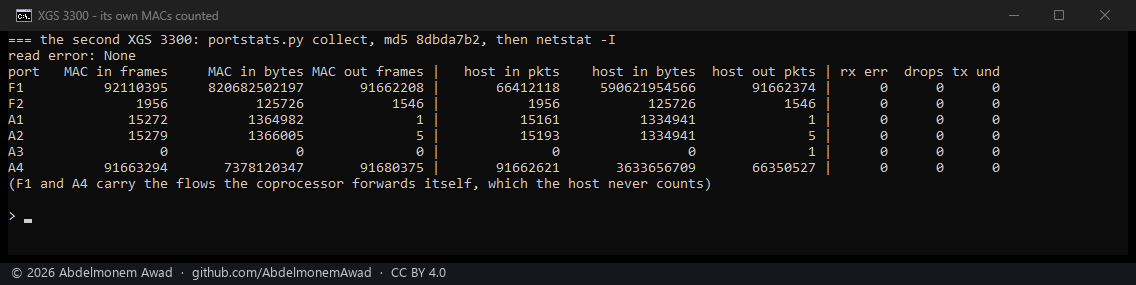
| port | the MAC: in, frames and bytes | out, frames | the host: in, frames and bytes | out, frames |
|---|---|---|---|---|
| F2 | 1,956 · 125,726 | 1,546 | 1,956 · 125,726 | 1,546 |
| A1 | 15,272 · 1,364,982 | 1 | 15,161 · 1,334,941 | 1 |
| A2 | 15,279 · 1,366,005 | 5 | 15,193 · 1,334,941 | 5 |
| A3 | 0 · 0 | 0 | 0 · 0 | 1 |
| F1 | 92,110,395 · 820,682,502,197 | 91,662,208 | 66,412,118 · 590,621,954,566 | 91,662,374 |
| A4 | 91,663,294 · 7,378,120,347 | 91,680,375 | 91,662,621 · 3,633,656,709 | 66,350,527 |
- F2 agrees to the frame and to the byte each way: a port whose every frame crosses the host.
- A1 and A2: the same frames out; about 110 more in at the MAC than the host counted - frames the coprocessor took and did not hand up. Which ones has not been looked into.
- A3: nothing on the wire. The host's one frame out never left - the cage has no light.
- F1 and A4 carry the flows the coprocessor forwards itself, which the host never sees - the reason the MAC's counts are the ones to read there.
- Every error and drop counter read 0, on all six.
Script: images/deploy/lab-3300-mac-counters.sh, photographed.
What it does not mean
- No error was made on purpose. On the XGS 136 the switch's frame limit was lowered and ten frames sent too long to see the counter move; nothing here has been made to fail, so the error counters are read, and at zero, not shown to count.
- One module, one appliance. BGX 1, for a module with more than four ports, is computed, not measured.
The discussion of this page is held in the project's GitHub Discussions. Showing it here loads giscus from giscus.app and GitHub, and writing in it needs a GitHub account - what that means.