The coprocessor's own watchdog and memory error reports, 2026-10-25
Discovery 24 of the discoveries.
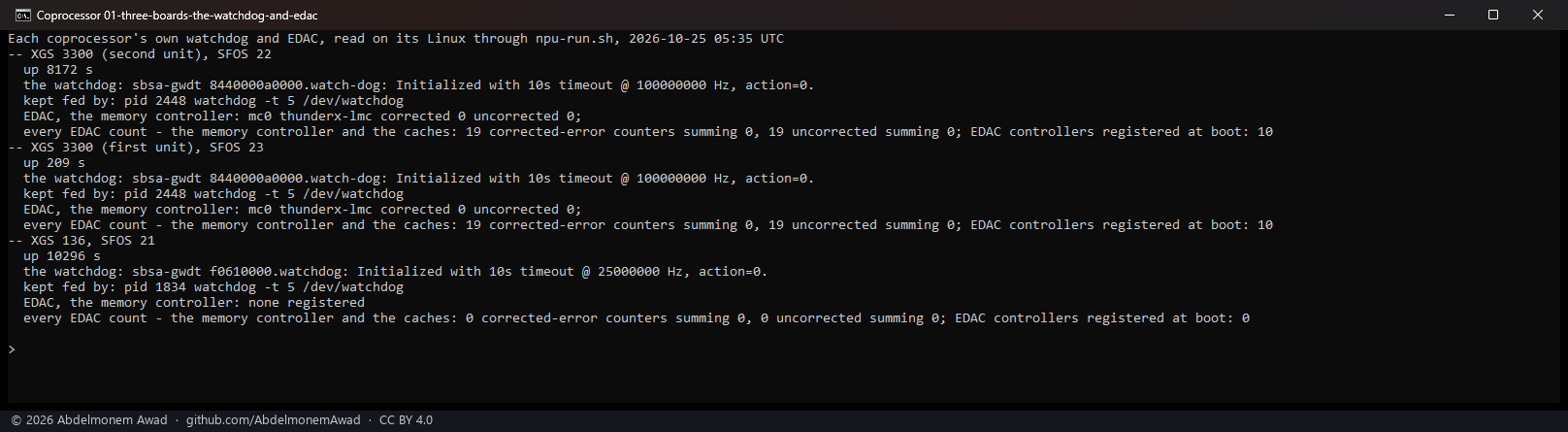
Both coprocessors have a watchdog of their own and the XGS 3300's reports memory errors (EDAC); whether
anything fed the watchdog, and what its firing would do, were not known. Read on the three
coprocessors' own Linux through npu-run.sh - the second XGS 3300 on SFOS 22's software, the first
on SFOS 23's, the XGS 136 on SFOS 21's - and the watchdog left unfed once on the first XGS 3300, three
times (images/deploy/lab-copro-health.sh, lab-copro-wdt.sh, lab-copro-wdt2.sh).
What each has
| XGS 3300, SFOS 22 | XGS 3300, SFOS 23 | XGS 136, SFOS 21 | |
|---|---|---|---|
| the watchdog | sbsa-gwdt, reset on expiry (action=0) |
the same | the same |
| kept fed by | busybox watchdog -t 5: every 5 s, its timeout set to busybox's default, 60 s |
the same | the same |
| EDAC | the memory controller (thunderx-lmc) and nine L2 cache controllers: 19 corrected-error counters, 19 uncorrected |
the same | none registered |
| errors counted | 0 and 0 | 0 and 0 | - |
The kernel logs the watchdog at 10 s, and the feeder sets it to 60 at its start - busybox's -T,
not given here, defaults to 60.
When the watchdog goes unfed, the XGS 3300's host goes down with it
The feeder was stopped (kill -STOP: it keeps the device open and writes nothing) on the first XGS
3300, whose host is reached on its own management port, which no coprocessor carries; and the host
was asked every 3 s for its heartbeat with the fast path, its management link to the coprocessor and
whether the coprocessor answered.

| run | the host last answered | silent | the host booted again | why, as its chipset recorded it |
|---|---|---|---|---|
| 1 | 56 s after the stop | - | 134 to 194 s after | the hardware watchdog expired |
| 2 | 57 s | 64 s | 220 s | the hardware watchdog expired |
| 3 | 56 s | 63 s | 220 s | the hardware watchdog expired |
Everything stood until the coprocessor's 60 s ran out; then the host stopped answering on its own management port and logged nothing more, and the watchdog that reset the appliance was the host's - the AMD FCH's, armed at 128 s by os-xgs-npu (XGS: Settings, on by default since 2026-10-17) and fed from the host every second. 60 s, then 128 s, then the time a boot takes before its kernel starts: 220 s. So the coprocessor's reset froze the host, and the host's own watchdog brought the appliance back - about four minutes in all, with every port and tunnel through it down. Nothing records that the coprocessor's watchdog started it: the reason the host's chipset keeps is its own.
What it means for os-xgs-npu
- The host's watchdog is what brings an XGS 3300 back after its coprocessor resets itself, and it does - so it stays on by default.
- A coprocessor reset should not freeze the host. It does on the XGS 3300, which is now an issue.
- The coprocessor's EDAC counts are readable on the XGS 3300 and could be shown with the appliance's health; not built. The XGS 136 has none to show.
What it does not say
- What froze the host - the driver, the PCIe link or the processor - and whether a host with its watchdog off would stay frozen: not tried.
- The XGS 136: its host has no management port this bench reaches apart from the coprocessor's own ports, so a frozen one could not be reached or restarted from here - it was read, not left unfed.
- Why the coprocessor's feeder would stop in the field: here it was stopped by hand.
The discussion of this page is held in the project's GitHub Discussions. Showing it here loads giscus from giscus.app and GitHub, and writing in it needs a GitHub account - what that means.