The TCP window of a connection in hardware, checked there. Measured, 2026-10-22
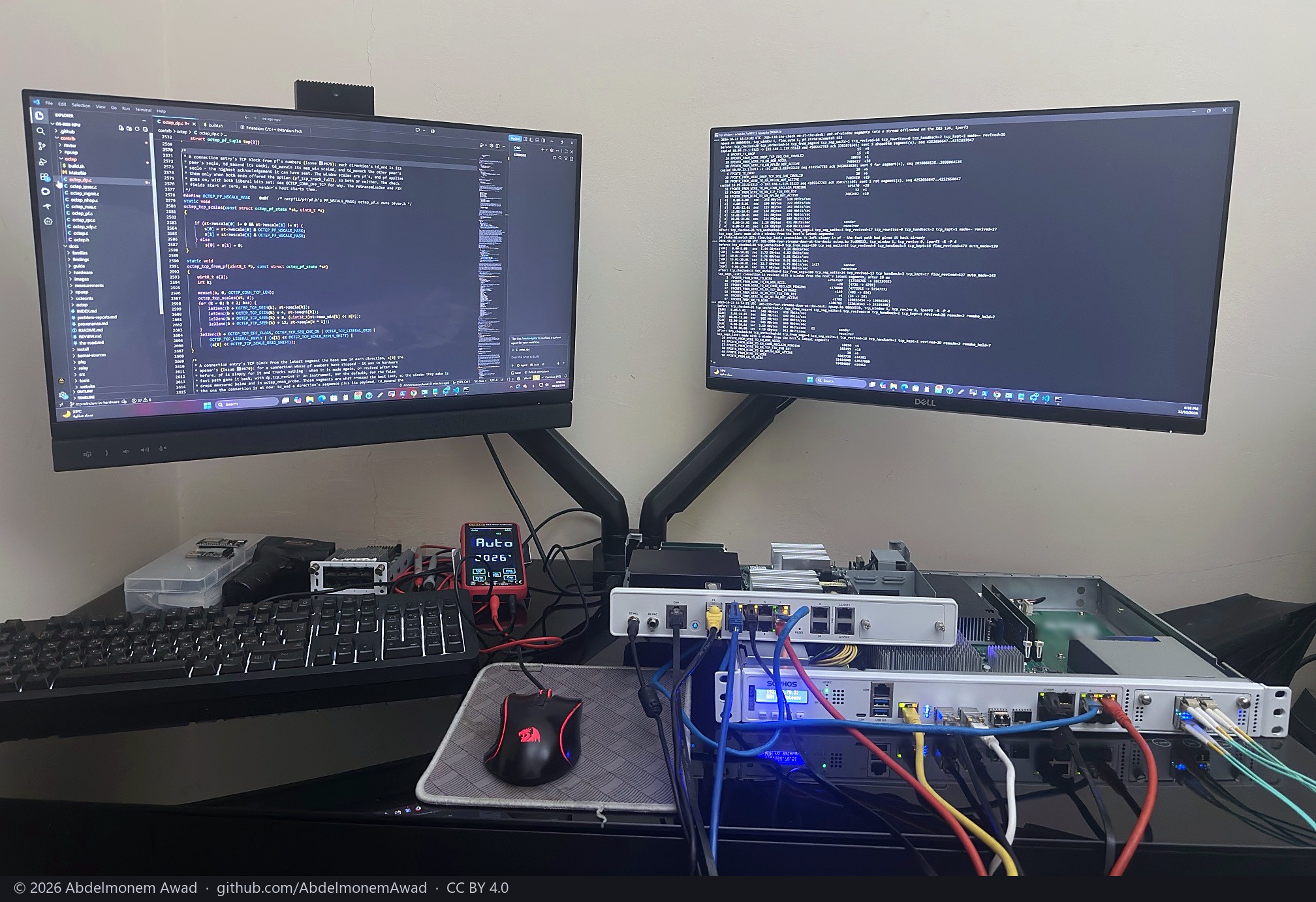
The bench the evening it was measured: the code that fills the window from pf's numbers on the left, a run of the series on the right, and below them the two appliances it ran on.
Until this, a TCP connection the coprocessor forwarded had its window checked by nobody: the driver sent its connection entry with the TCP block at zero and the check off, and marked pf's state sloppy, because pf would otherwise drop the connection's frames against a window it no longer saw move (679, the discovery).
Now, on both families:
- A connection is made with its window from pf's own numbers - each direction's
seqlo,seqhi,max_winand window scale - and the fast path checks every segment against it, the way the vendor's own conntrack hands it over. A segment outside the window is dropped in hardware and counted (FPCNTR_FROM_WIRE_DROP_TCP_SEQ_CHK_INVALID). - A take-back gives pf the fast path's numbers back and clears the sloppy mark the driver set, so pf checks the connection again on the host.
- A connection pf rewrites in every packet is not made at all -
modulate state,synproxy state,scrub reassemble tcp- since the fast path would forward its sequence numbers or timestamps unchanged. A rule's ownsloppyis kept, and the check stays off for it; so is a tunnel's connection, which has one direction in hardware.
New counters, dev.octep.0.dp.* and dev.npuep.0.flow.*: tcp_checked, tcp_unchecked,
tcp_rewrites, tcp_handback, tcp_kept, tcp_lost, tcp_revived, and tcp_last, which says
what the last take-back of a checked connection did with its window. tcp_window 0 sends every
connection as before. tcp_revive, tcp_from_segs, tcp_seg_waits and tcp_segs_last belong to
the instruments below. The modules measured:
octep.ko 7cd98513 on the second XGS 3300, npuep.ko 0806653b on the XGS 136.
How it was measured
Each run in a window of its own, photographed (images/deploy/lab-tcp-window-series.ps1); the text of
every run, these and the ones before them, is kept in the run log.
- XGS 3300: iperf3 from the PC, on the second XGS 3300's F1, through the second XGS 3300 to the first, which runs the iperf3 server. The lab tunnel between the two 3300s covers that pair, and is taken down for each run and brought up after.
- XGS 136: iperf3 from the PC on the 136's LAN (Port3) through the 136's Port8 to the second XGS 3300, which runs the server.
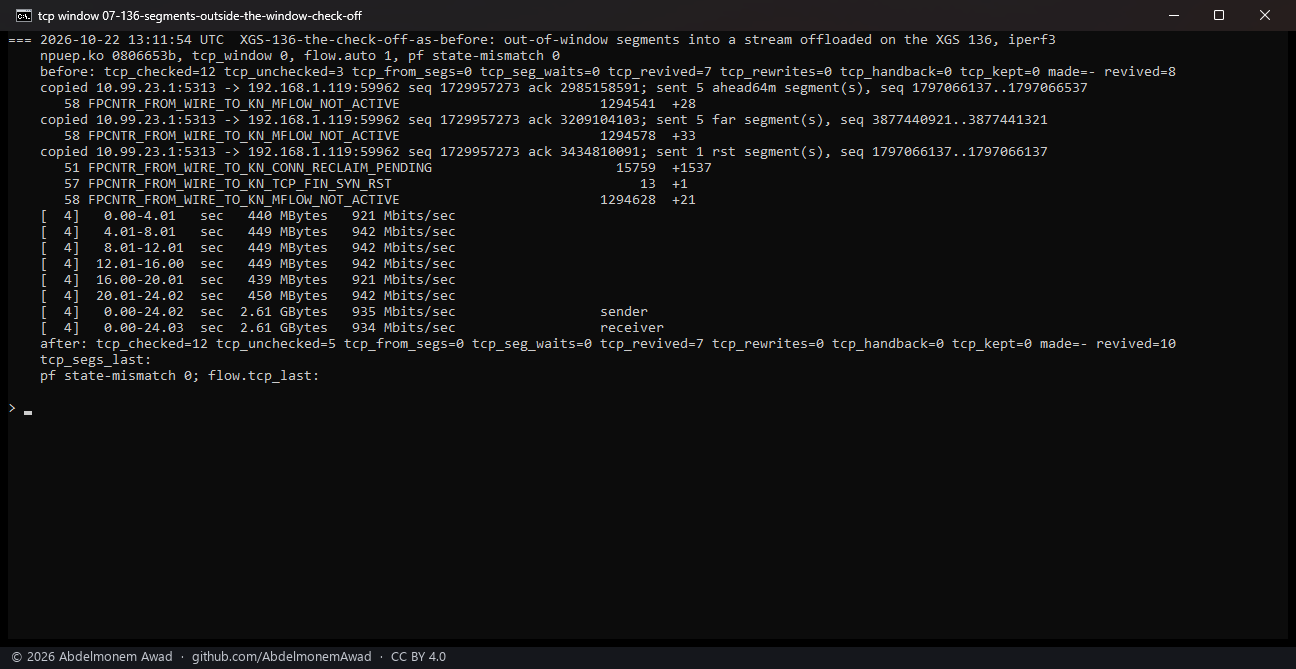
- Segments outside the window (
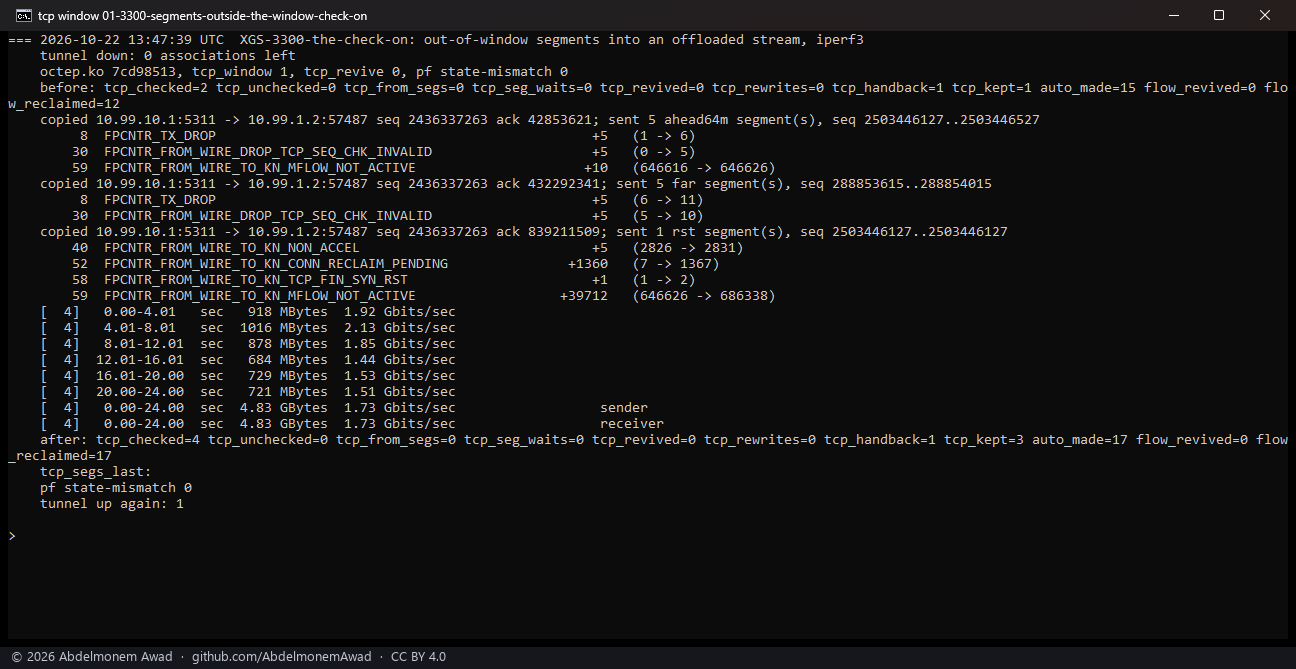
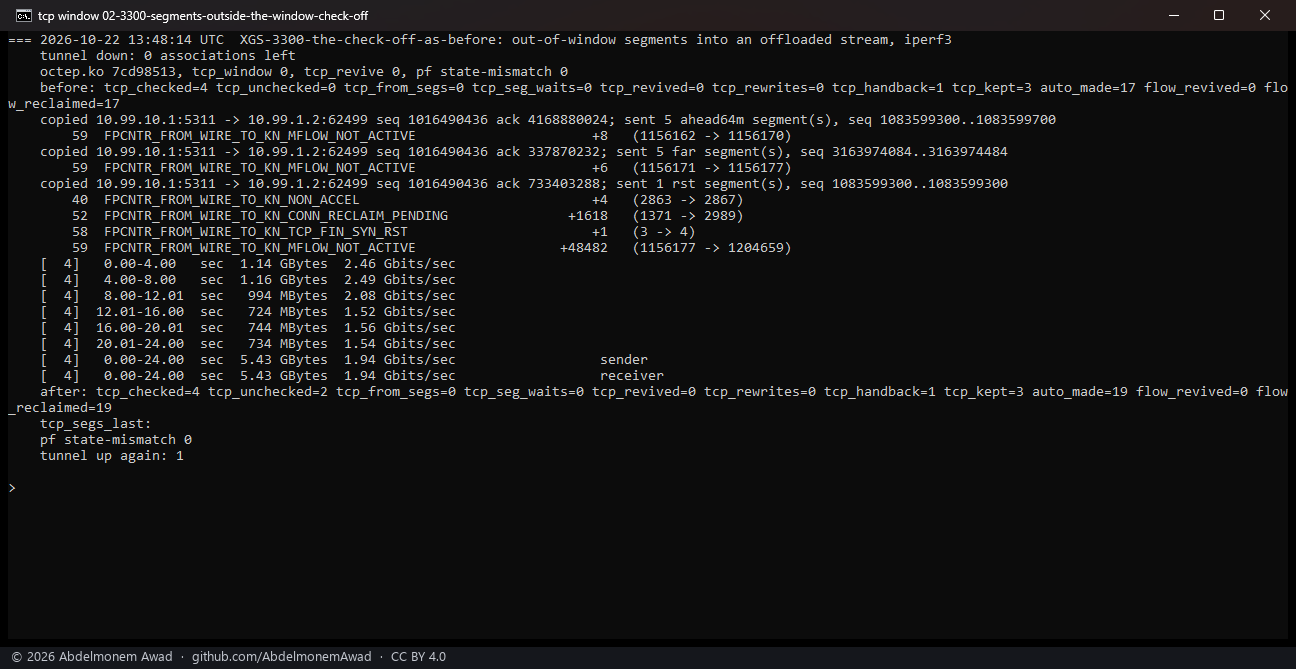
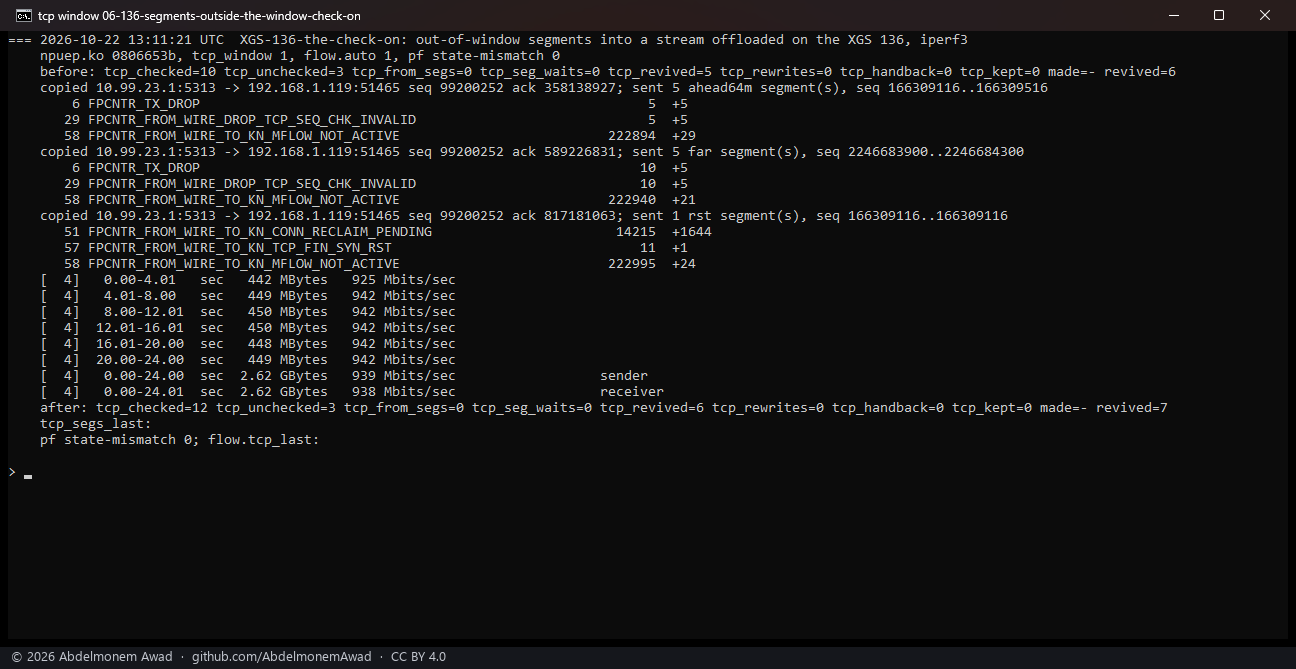
lab-tcp-inject.sh,lab-136-tcp-inject.sh): at second 8 of a stream, the server's end puts on the wire, by BPF and past its own pf, copies of the stream's own segment with the sequence moved (tcp-inject.py): five data segments 64 MiB ahead - outside any window, inside the fast path's liberal span of 2^30 - five 2 GiB ahead, and one RST 64 MiB ahead. The DUT's fast-path counters are read around each. - The take-back (
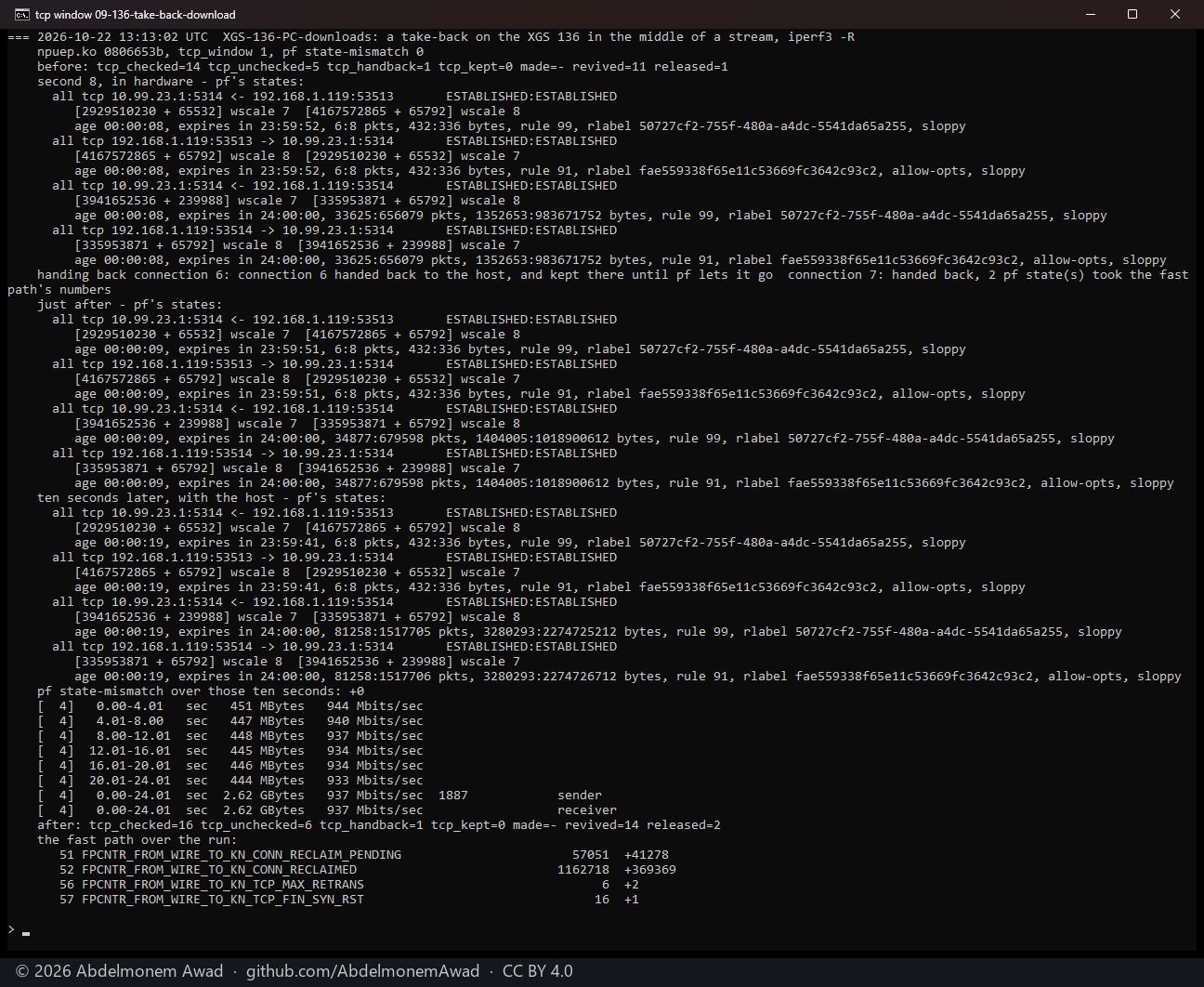
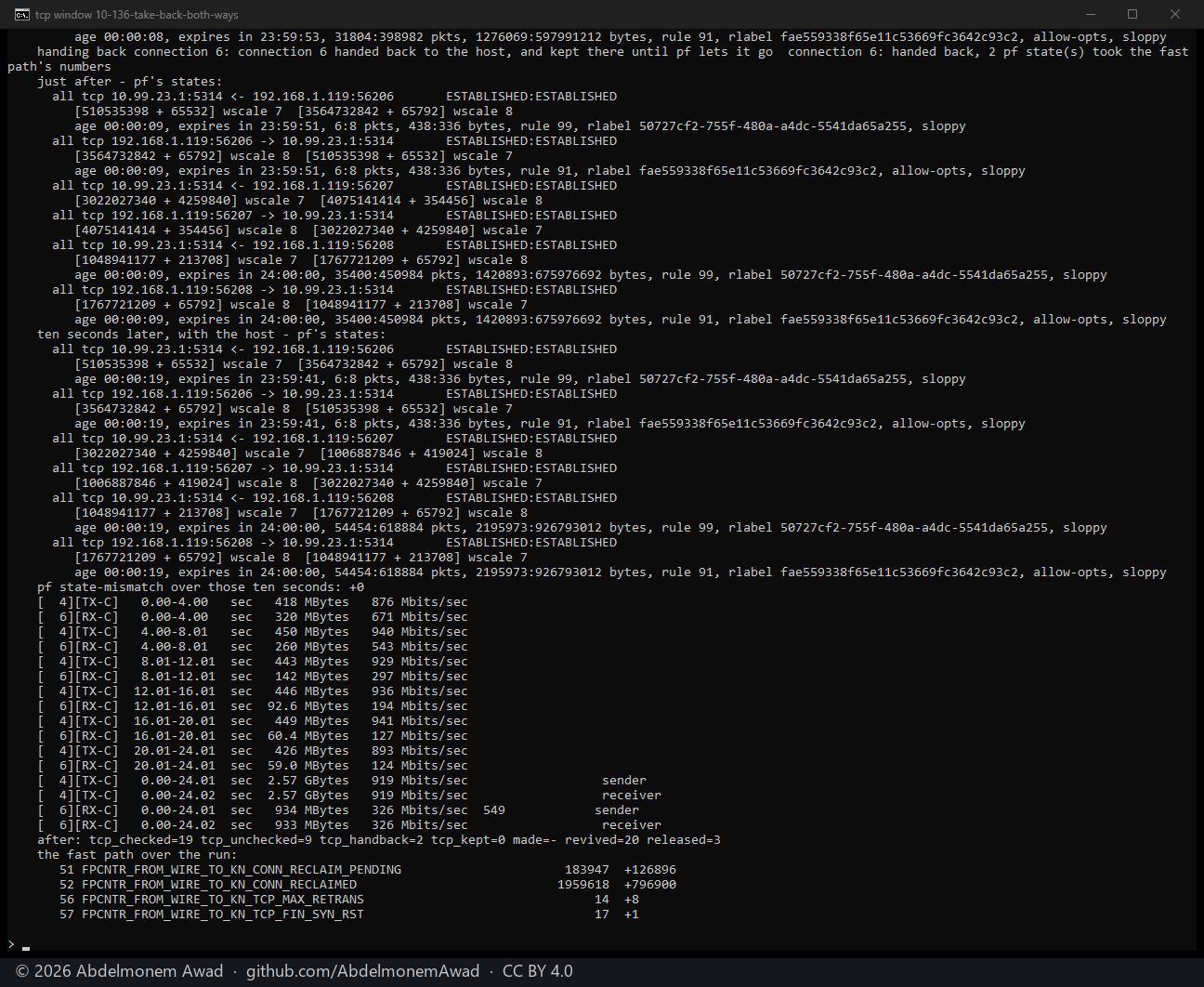
lab-tcp-handback.sh,lab-136-tcp-handback.sh): at second 8 of a stream - and on the XGS 3300 a second time at second 3 - its connection is handed back with the Flows page's "hand back" and kept with the host; pf's states are printed before, just after, and ten seconds later, and pf'sstate-mismatchcount is read across those ten seconds. The line after "handing back" istcp_last: the last take-back of a checked connection - when it names another connection, the one handed back was no longer checked. - Ordinary streams (
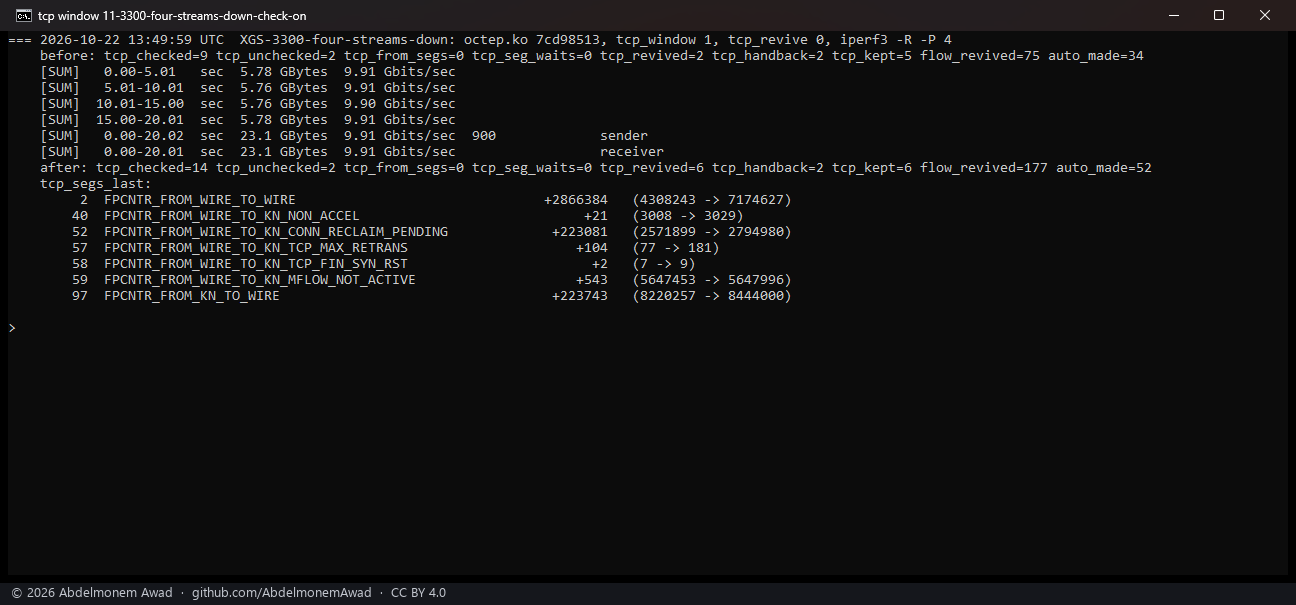
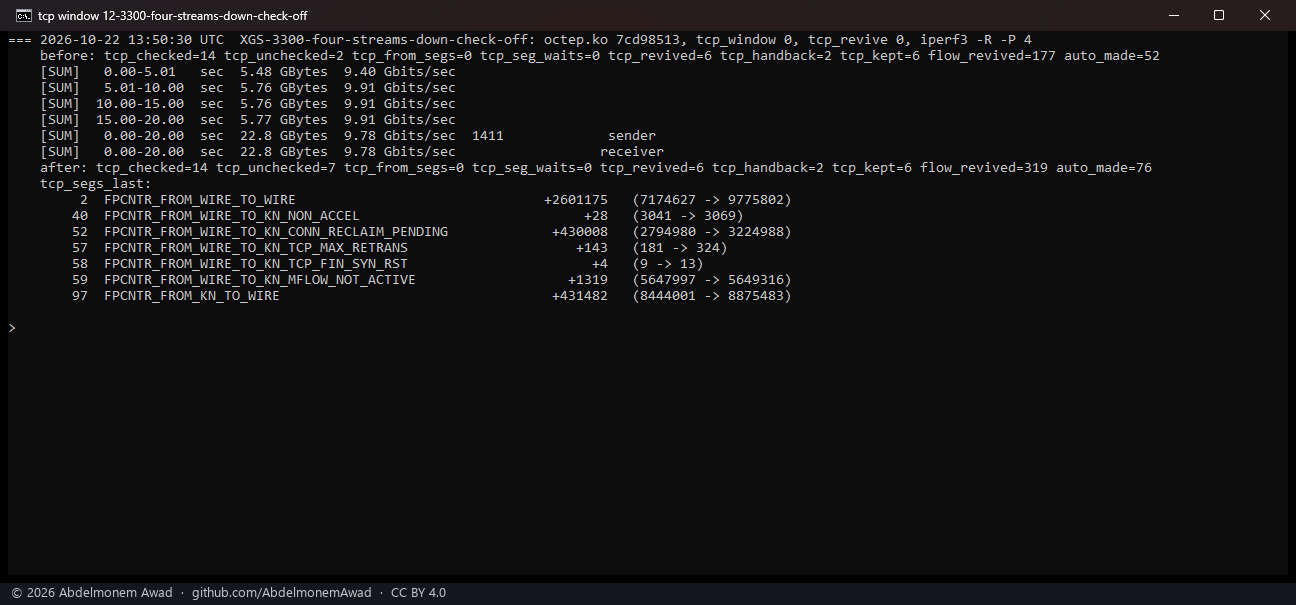
lab-3300-tcp-run.sh,lab-136-tcp-run.sh): four streams down for 20 seconds, the check on and off, and what the fast path counted over the run.
Segments outside the window
| 64 MiB ahead (5) | 2 GiB ahead (5) | RST 64 MiB ahead (1) | |
|---|---|---|---|
| XGS 3300, check on | 5 dropped | 5 dropped | to the host, the connection given back |
| XGS 3300, check off (as before) | none dropped | none dropped | to the host |
| XGS 136, check on | 5 dropped | 5 dropped | to the host, the connection given back |
| XGS 136, check off (as before) | none dropped | none dropped | to the host |
The take-back
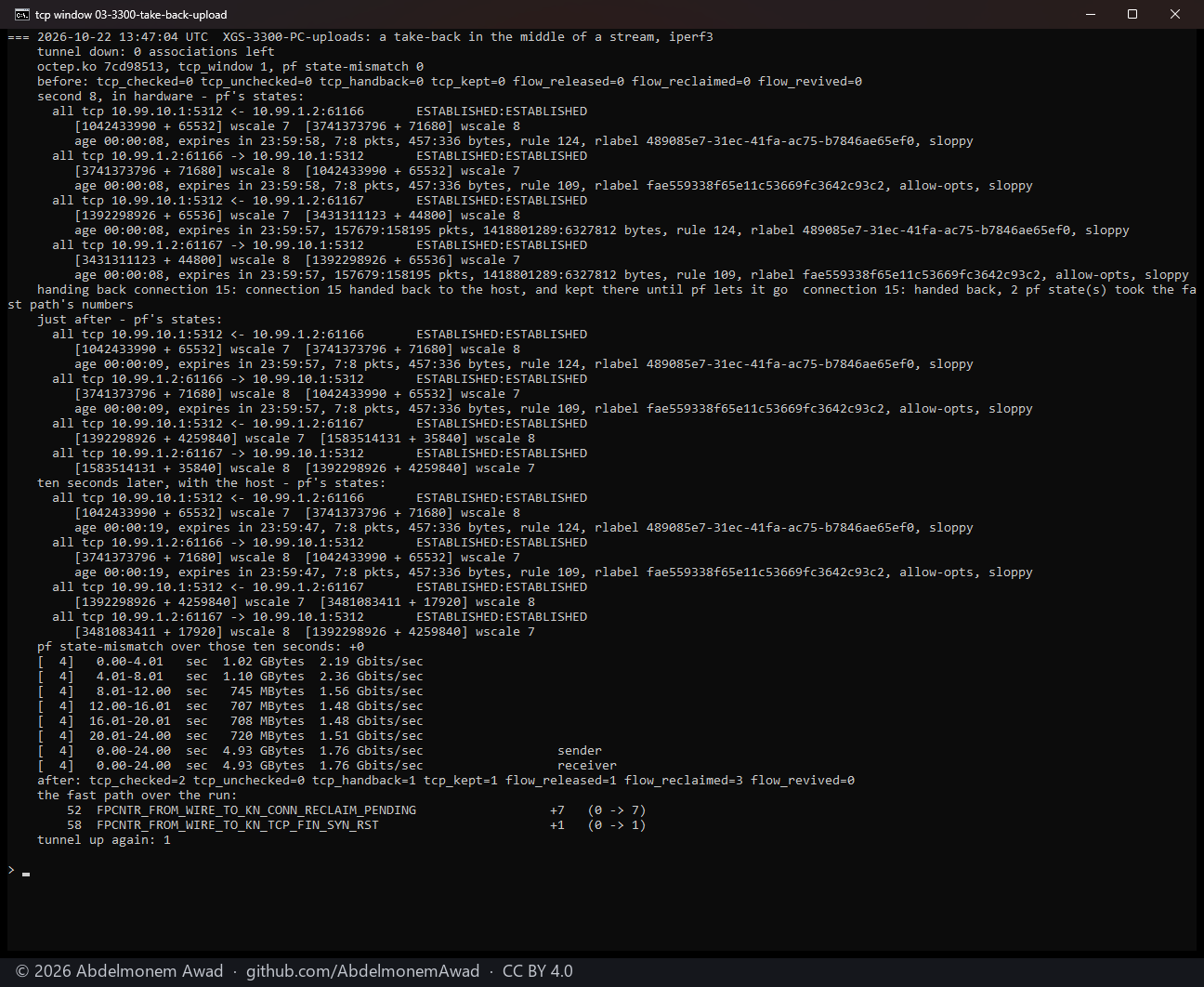
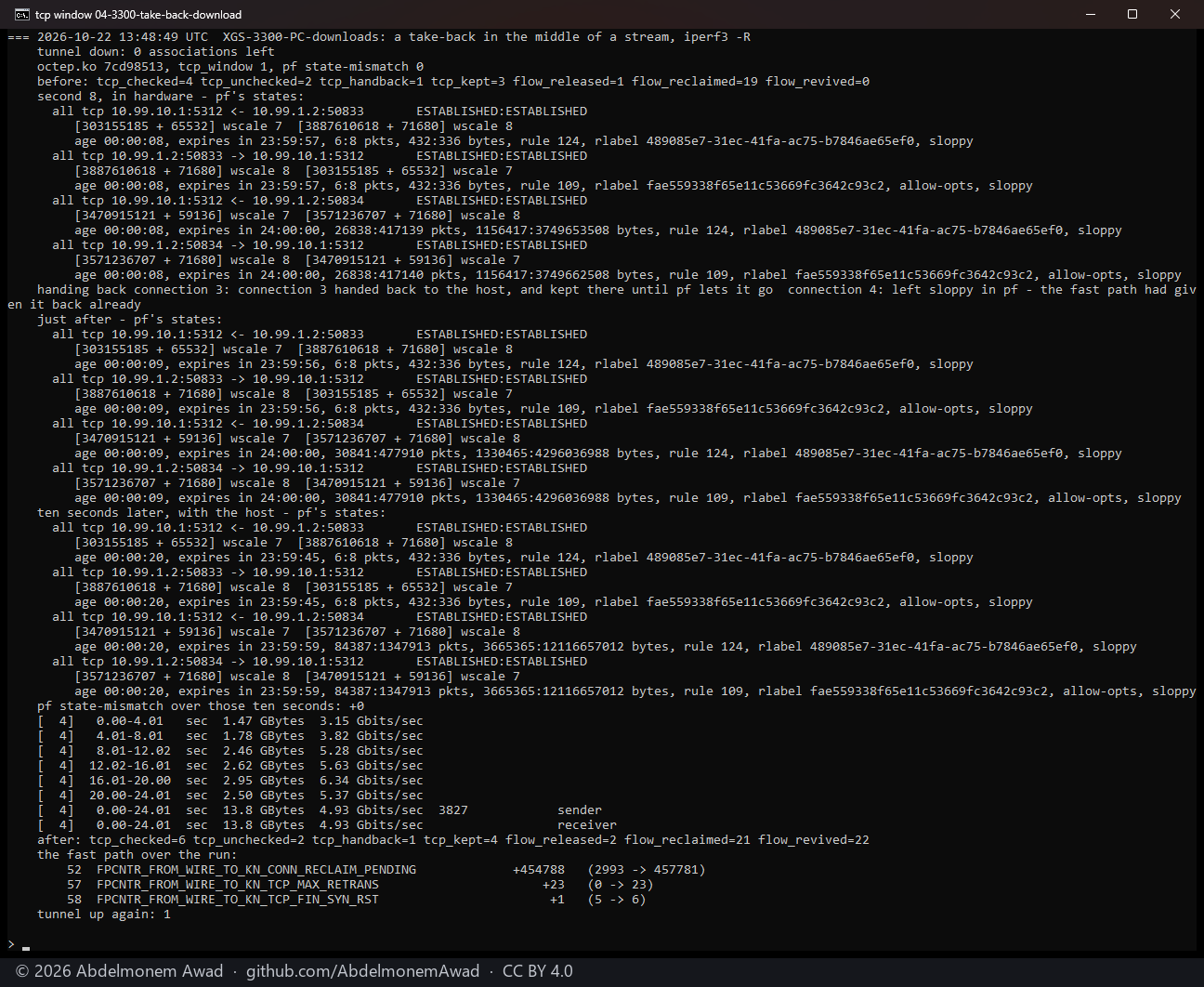
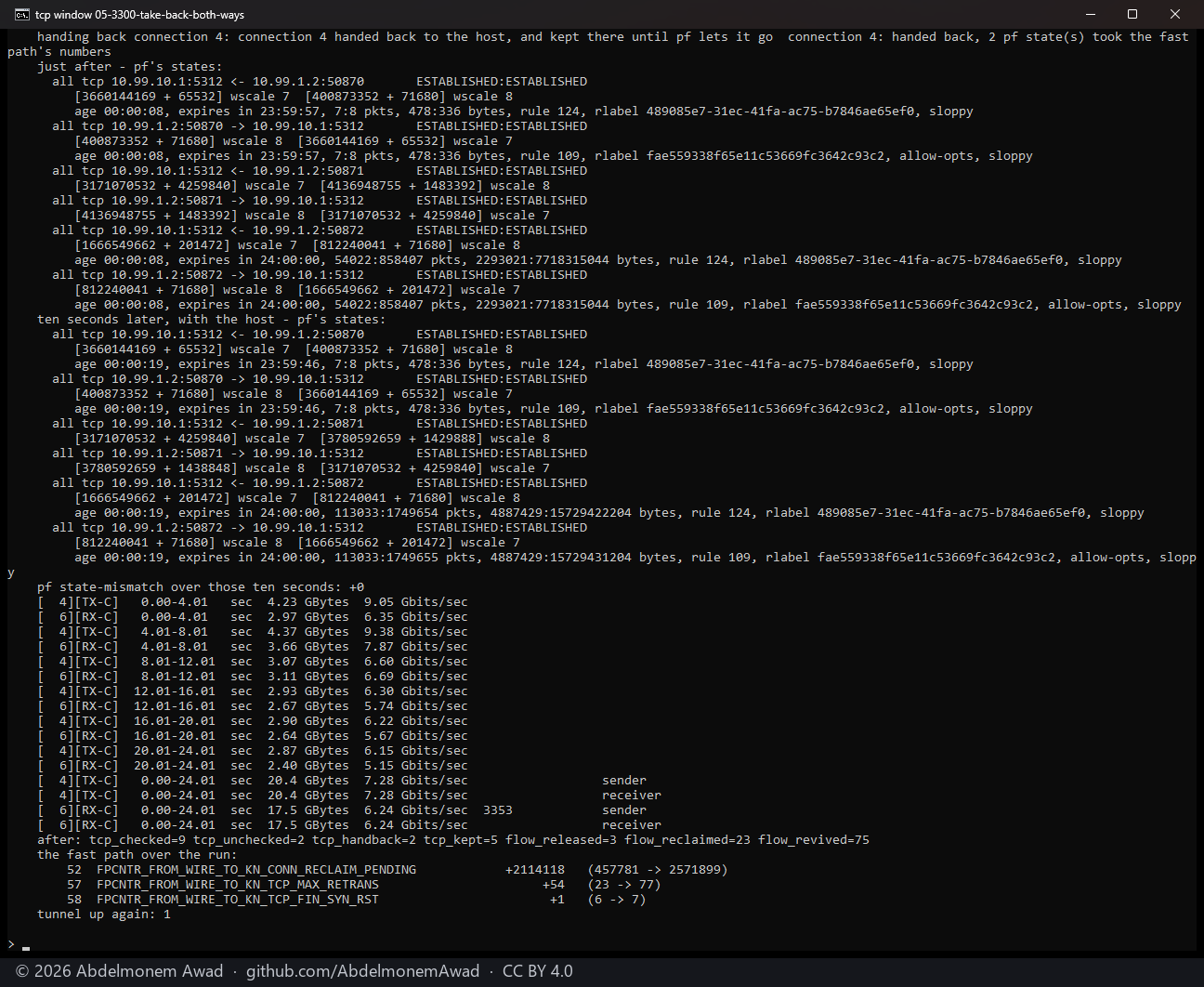
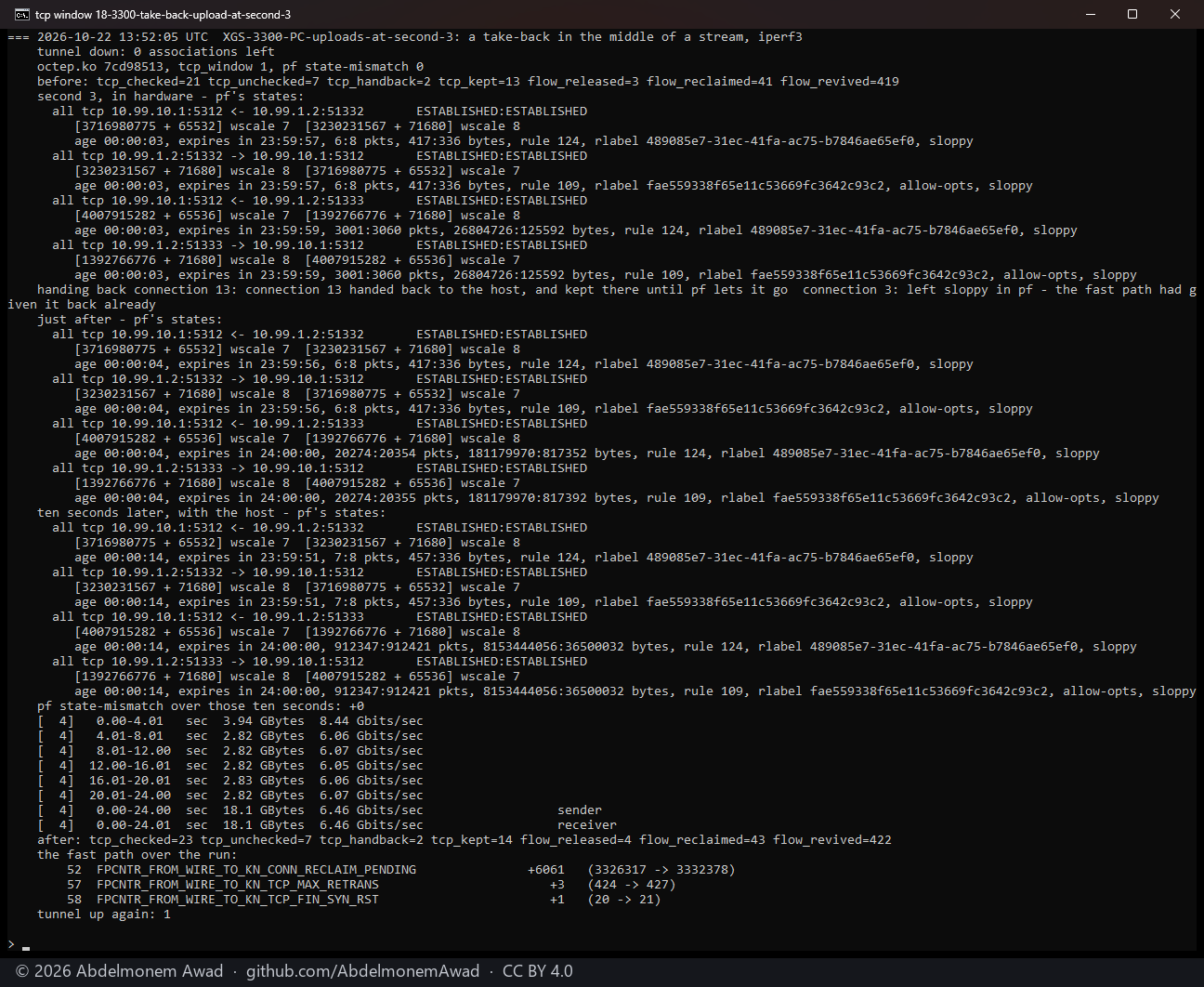
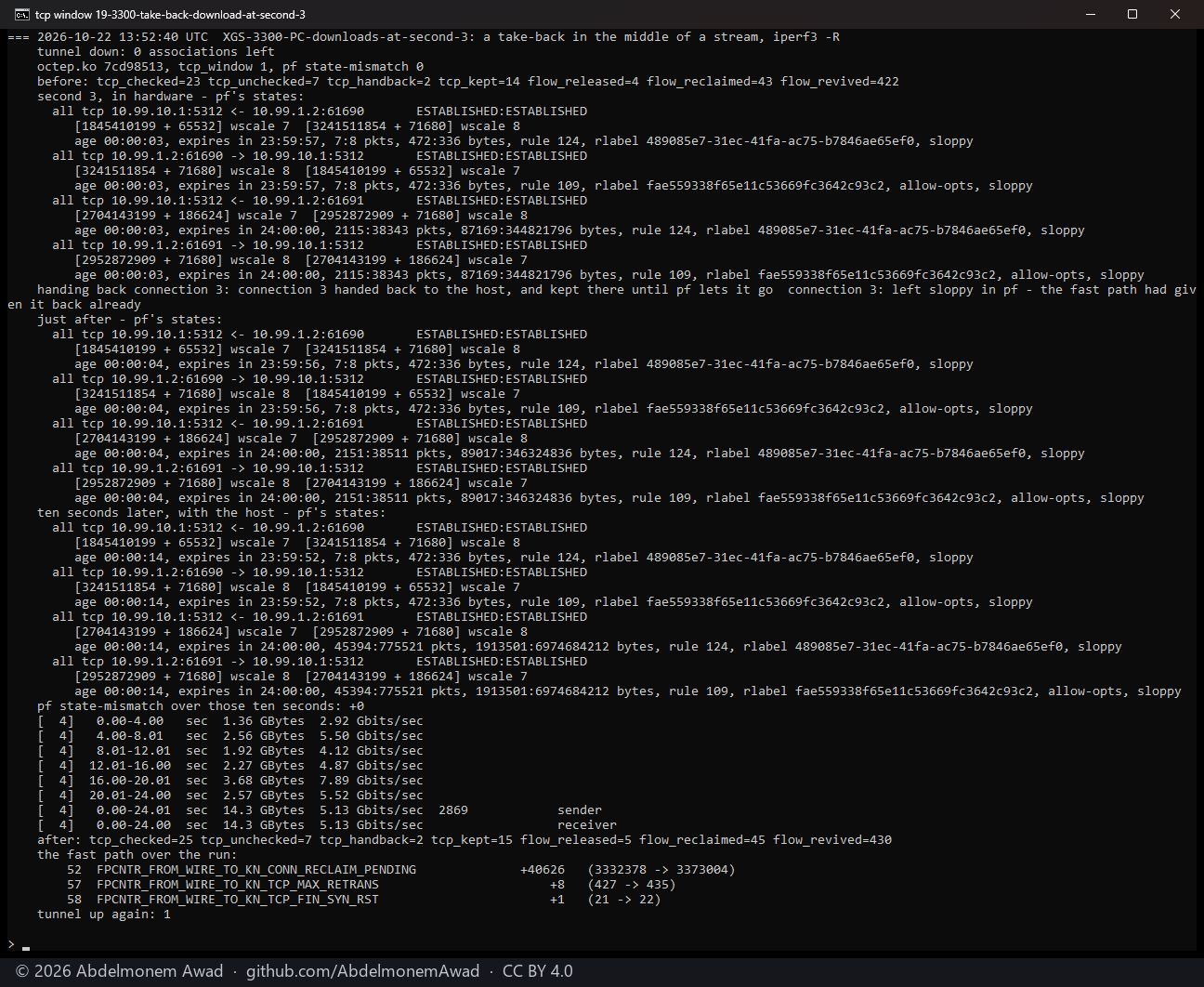
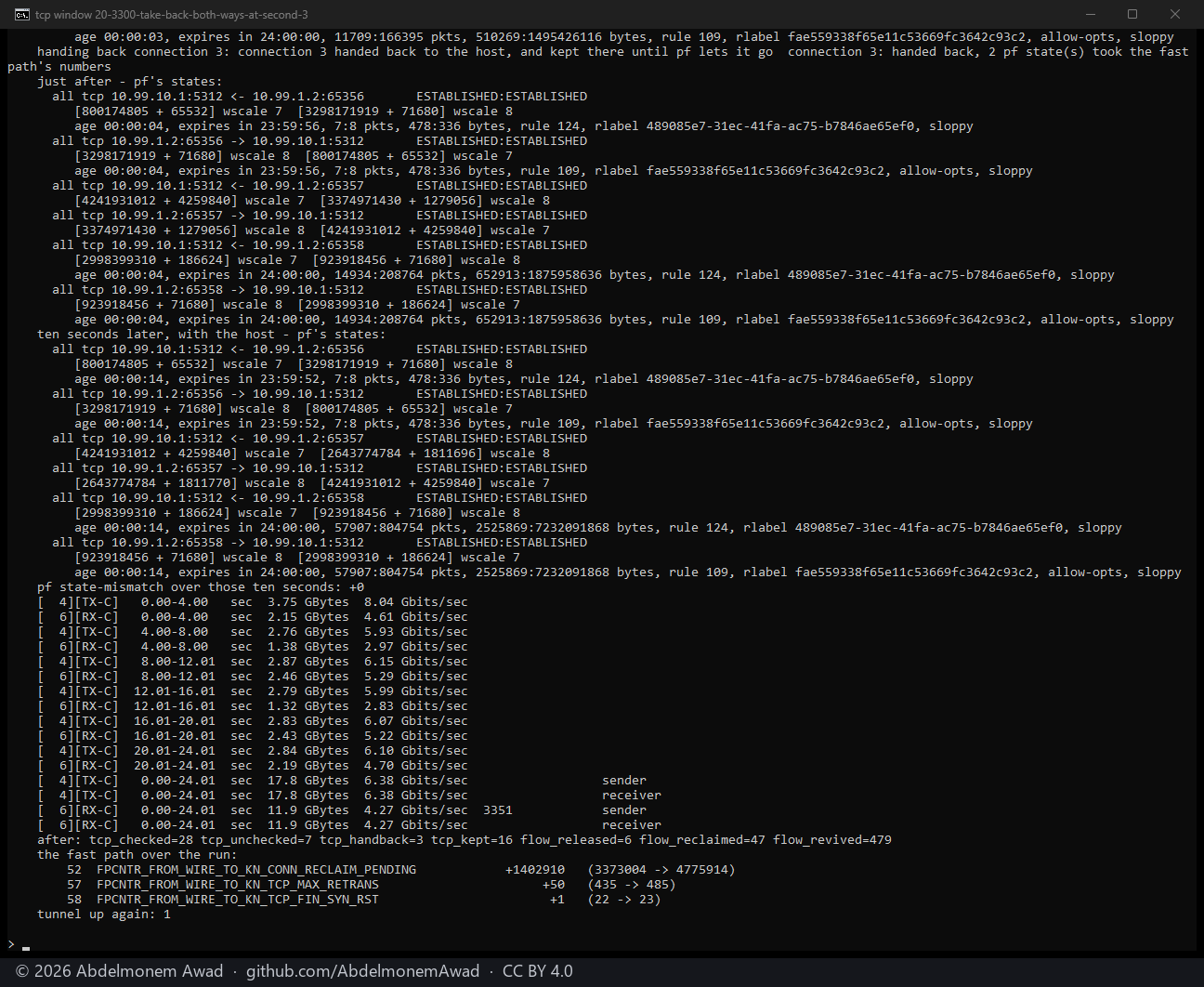
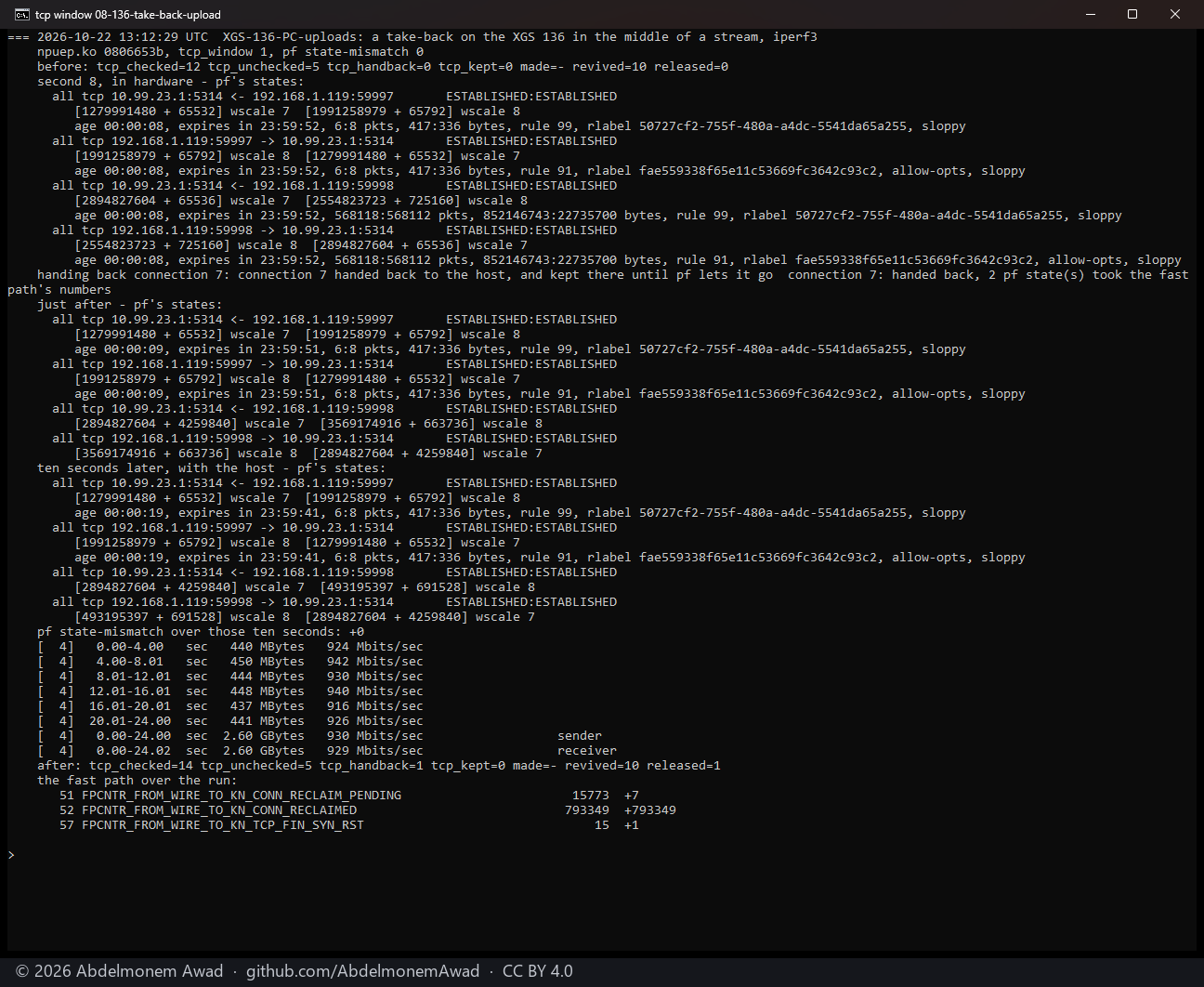
| pf took the fast path's numbers | pf's state-mismatch over 10 s with the host | |
|---|---|---|
| XGS 136 - up, down, both ways | yes, all three | +0 each |
| XGS 3300 at second 8 - up, down, both ways | yes, no (revived unchecked before), yes | +0 each |
| XGS 3300 at second 3 - up, down, both ways | no (revived unchecked before), no (given back before), yes | +0 each |
pf never refused a frame of a connection it took back - neither with the fast path's numbers nor left sloppy.
Ordinary streams
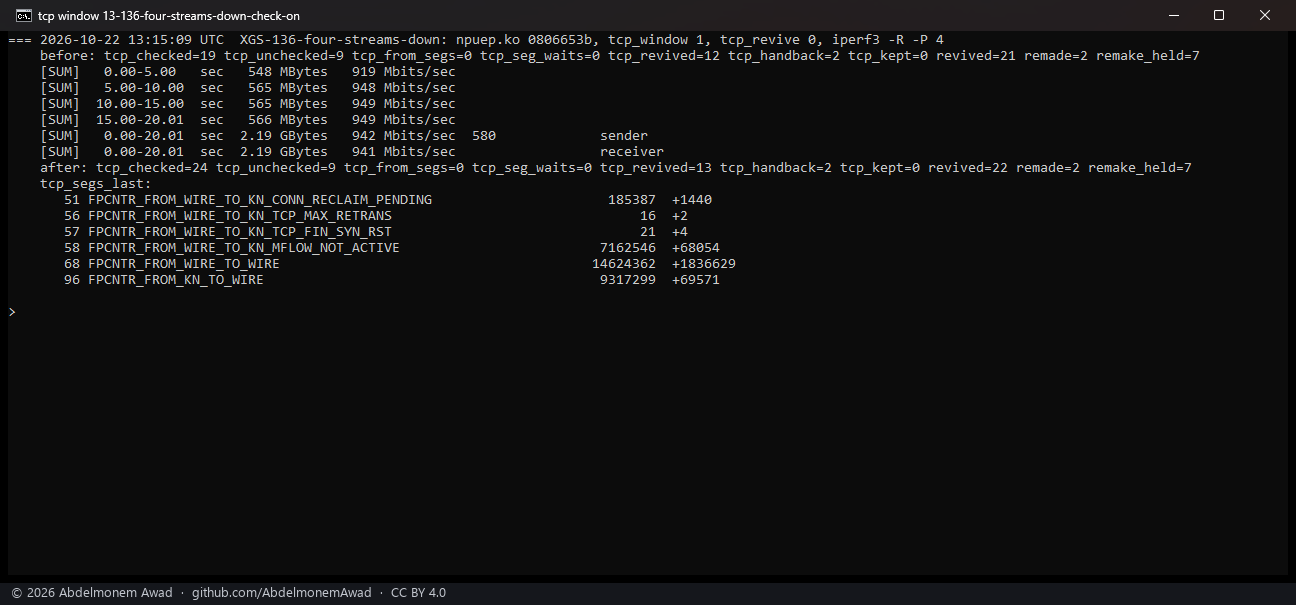
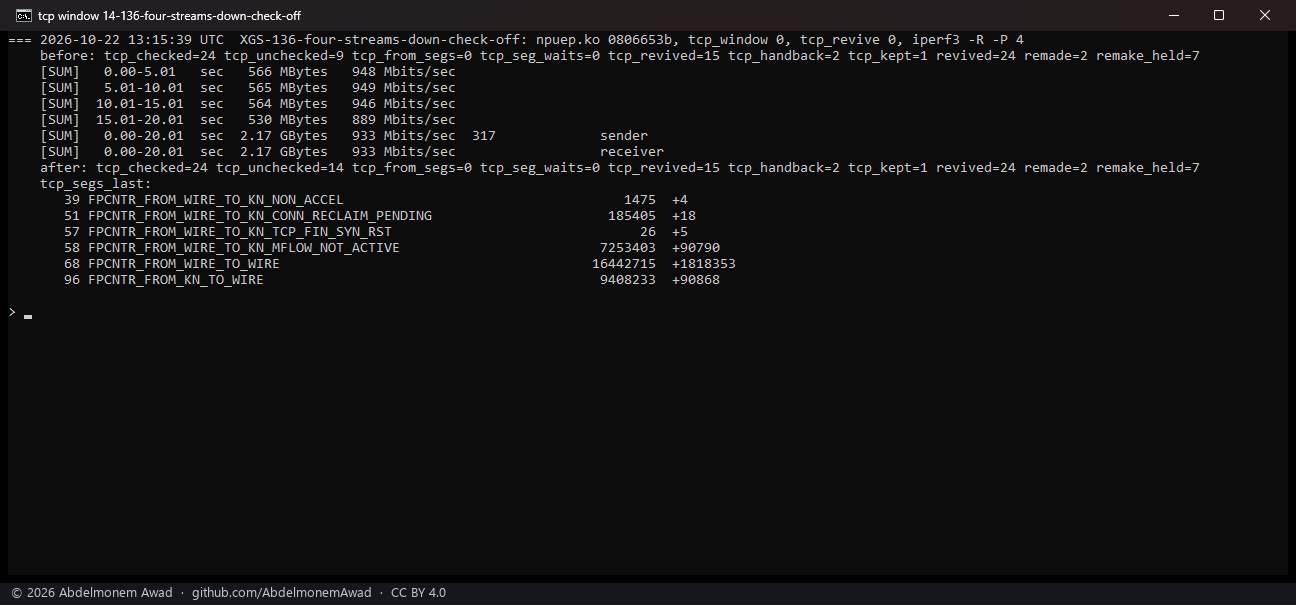
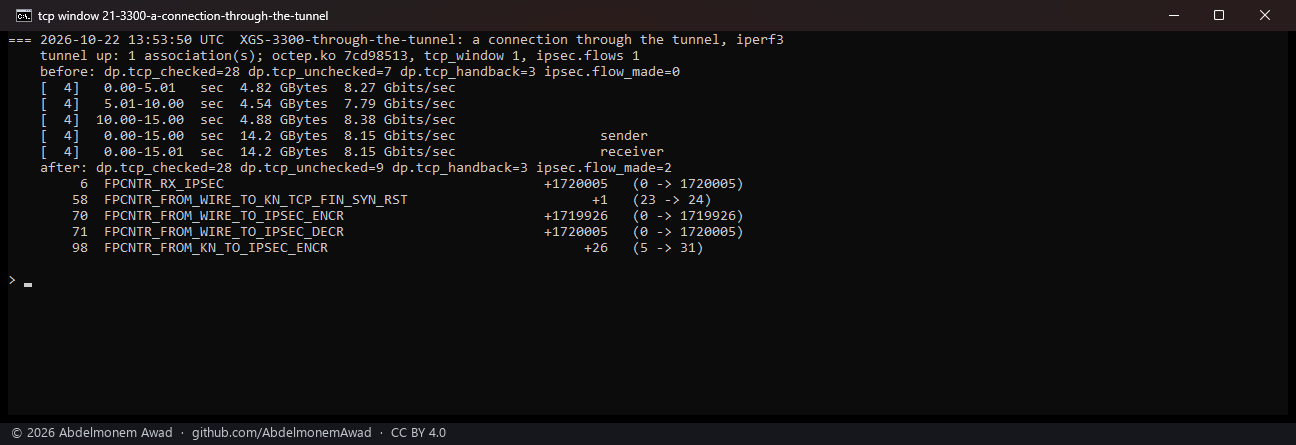
| four streams down, 20 s | check on | check off | ordinary segments dropped by the check |
|---|---|---|---|
| XGS 3300 | 9.91 Gbit/s | 9.78 Gbit/s | 0 |
| XGS 136 | 941 Mbit/s | 933 Mbit/s | 0 |
With the default settings no ordinary segment was dropped by the check in any run of the day: these, and the others on both families before the series.
After the fast path gives a connection back
The fast path gives a connection back to the host by its own rule - ten segments in a row with the
same acknowledgement, end and window (USFP_MAX_RETRANS in the vendor's conn_table.h), which a
loss recovery's duplicate acknowledgements are - and the driver revives it in place with the command
it made it with (FLOW_CREATE_FP). That copy is the state the fast path works from, so a revived
connection goes back unchecked (tcp_revive 0, the default), as every revival did before, and its
take-back leaves pf sloppy. Under four streams at 10 Gbit/s that is about 150 revivals in 20
seconds; a connection the fast path never gives back stays checked to its end.
Two ways of sending a revival back checked were built and measured on the XGS 3300, and both dropped ordinary segments, so both are instruments and neither is the default:
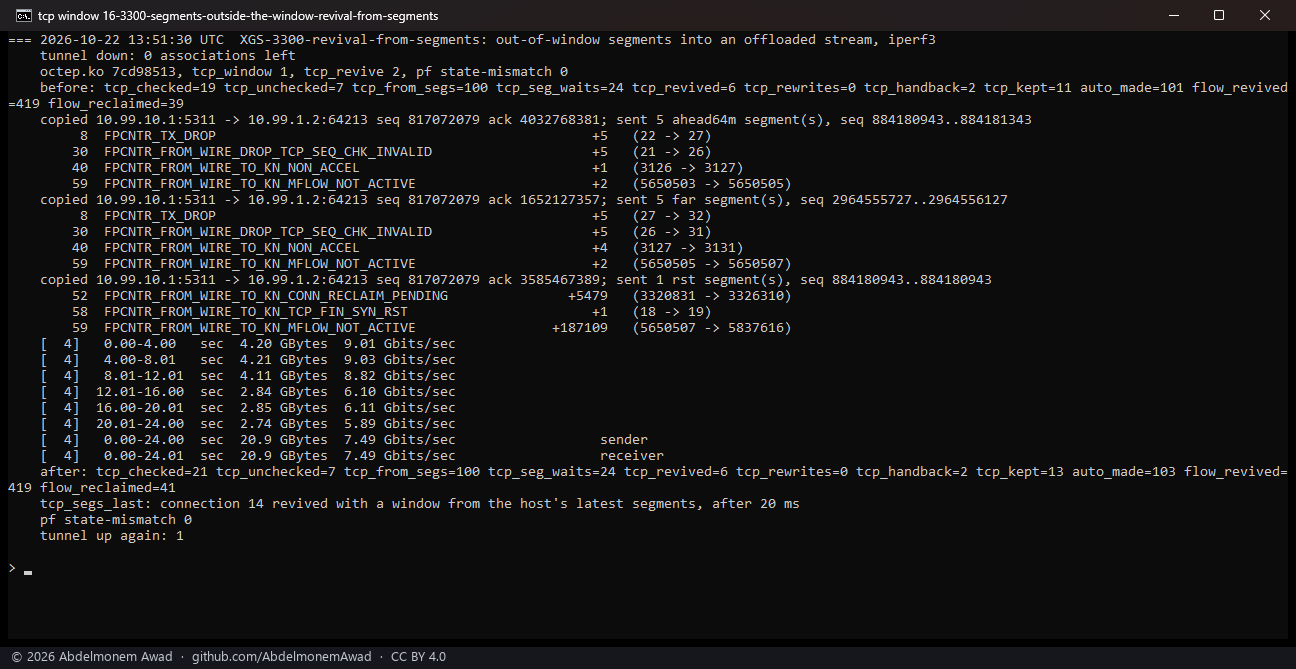
tcp_revive1: the window the fast path answers the reclaim with.tcp_revive2: a window made from the latest segment the host saw in each direction, with room for what the host still forwards after reading them, waited for up to 200 ms.
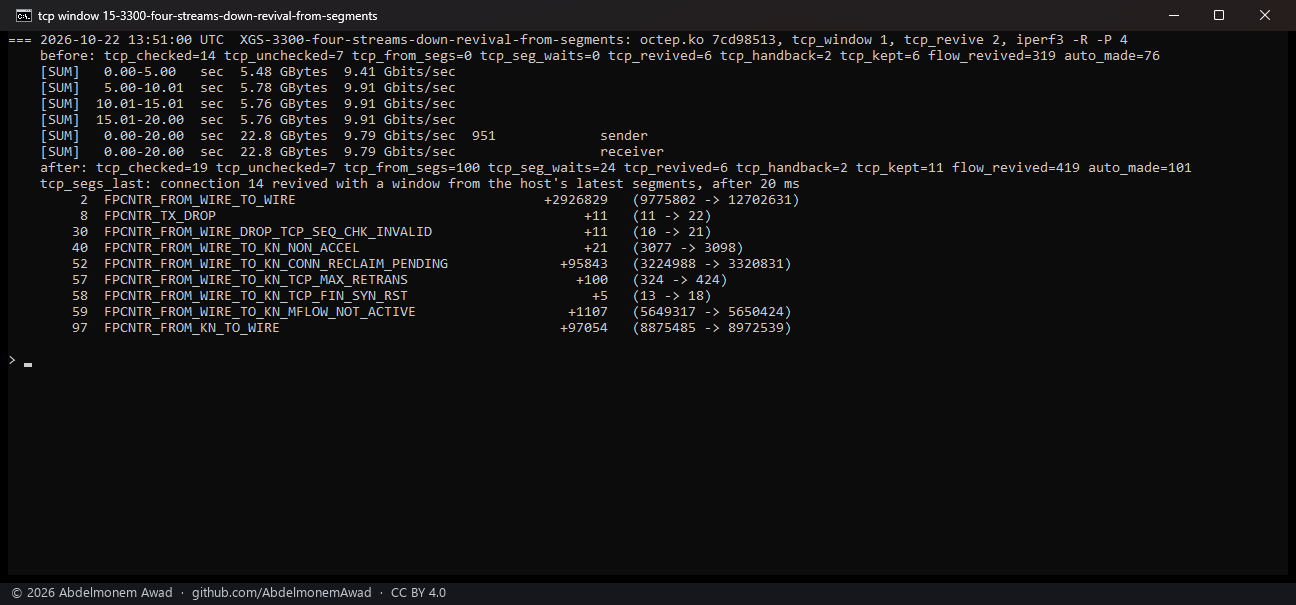
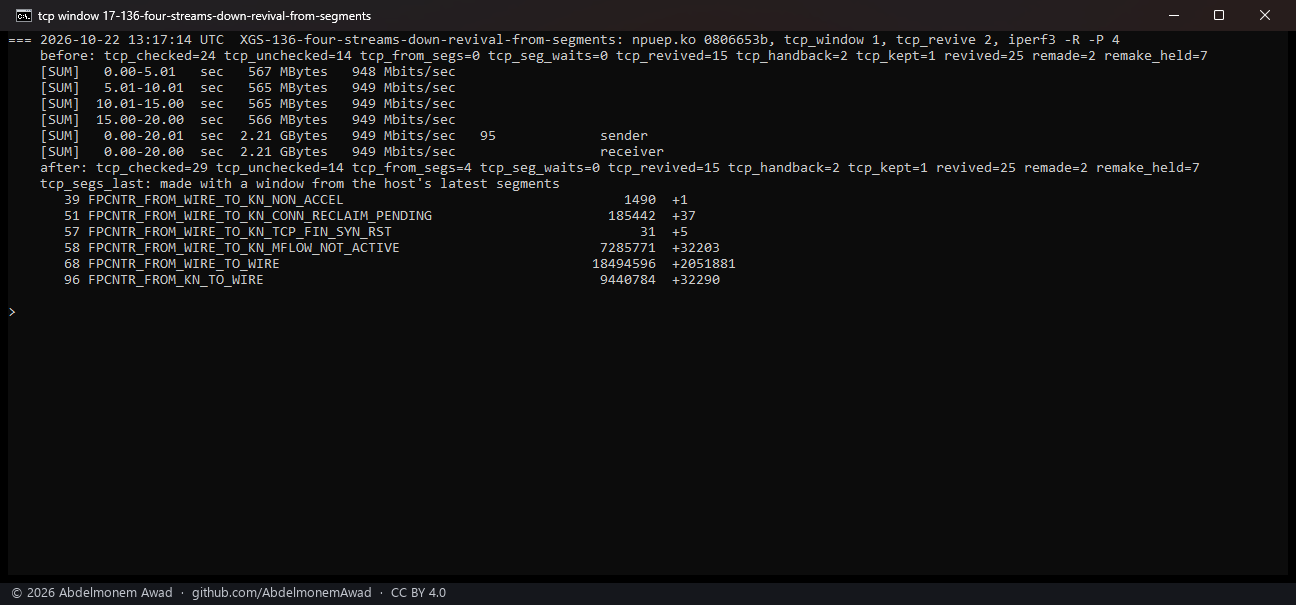
Every run of four streams down on the XGS 3300, 20 seconds each, by how a revival was sent back:
| a revival sent back | runs | ordinary segments dropped by the check, each run |
|---|---|---|
unchecked (tcp_revive 0, the default) |
7 | 0 in every one |
with the fast path's own window (tcp_revive 1) |
4 | 0, 0, 14, 151 |
| from the host's latest segments, no room | 1 | 233 |
| the same, room of twice the window or 4 MiB | 3 | 5, 310, 43 |
| the same, and segments younger than 50 ms and the last revival | 5 | 0, 19, 233, 0, 0 |
| the same, room of 16 MiB | 5 | 0, 0, 0, 0, 0 |
| the same, and every revival trying again after one sent back unchecked | 6 | 510, 36, 68, 51, 321, and 11 (photograph 15) |
The injected segments were dropped with tcp_revive 2 in a run of 25 revivals, as well as in
photograph 16. And dtrace on octep_tcp_segs showed the numbers each window was made from to be
consistent - about 1.7 MB in flight, the PC's window 2 MiB - while some revivals found one direction
silent for a quarter of a second during the give-back: its acknowledgements were not reaching the
host. That is where this stops, open in 679.
What it does not mean
- A connection after its first give-back is not checked, as above - and on a busy link that is most of a long connection's life; a take-back of it leaves pf sloppy.
- A FIN or RST is not checked in hardware: the fast path hands it to the host
(
TO_KN_TCP_FIN_SYN_RST) and gives the connection back, and pf, sloppy for it, takes it - so a blind reset is judged by nobody, as before. - A rule's
sloppyis kept, and a tunnel's connection is sent unchecked, on both families. - IPv6 was not measured with the check, nor a translated connection.
- The XGS 3300's upload figures are the far end's: the first XGS 3300, the iperf3 server, had been up 29 hours with 90,762 receive-watchdog rescues (361), its receive running at 0.4 to 2.5 Gbit/s and the PC's uploads given back by the fast path all the time - so that the runs taken then found every connection given back before the segments or the take-back came. It was rebooted - three times in all - and the XGS 3300's runs here were taken from its last fresh start, the upload take-back first; downloads, where it sends, ran at 9.8 to 9.9 Gbit/s.
- The XGS 3300's module changed once during the series: from octep.ko 6e3320d7 to 7cd98513, which sends a tunnel's connection unchecked, as the XGS 136's driver does - with ipsec.flows 1 only one of its directions is in hardware, and a take-back would have given pf the other's numbers as they were when it was made. Every XGS 3300 photograph here is of 7cd98513.
The discussion of this page is held in the project's GitHub Discussions. Showing it here loads giscus from giscus.app and GitHub, and writing in it needs a GitHub account - what that means.