A ring left with a burst: the interrupt raised, the handler never run. Measured, 2026-10-21
Issue 361: with the trigger on, a few times an hour, a burst landed in one of the XGS 3300's receive rings and waited there until the receive watchdog's next sweep - up to a period, 50 ms - with TCP covering the gap every time. Two instrument builds on 2026-10-13 read the block's registers at such a stall: the ring's interrupt status set, the vector unmasked, nothing pending. The reading drawn from them - a status a visit had left up gives the next packet no edge - is withdrawn below. The ring was left clean; the block raised its interrupt; the host never ran the handler. Why the message does not arrive is still not known. What changed is that the host no longer waits for it: it looks at every ring's head buffer each tick.
The soak, rebuilt inside the lab
The trigger-on soak on a translated path of 2026-10-12, without the peer it used then: the PC on the
second XGS 3300's F1 downloads from the first XGS 3300, behind the second's A4, in three loops of
iperf3 -R, 20 s a pass; the second XGS 3300 translates the PC to its own address on A4 and its trigger
is on, so each connection is handed to the fast path once made and the host's rings go idle between
bursts. An address added to the first XGS 3300's F1 for the run carries it, because the address the
lab already has there is inside the lab's tunnel between the two (images/deploy/lab-3300-361-soak.sh,
not in this repository; the translation rule, the route, the address and the servers are removed at
the end, and each report says so).
Every visit now says how it left the ring
Each pass of a visit already read the status after clearing it, and the count; the last pass's readings are now kept per ring with the time and the ring's handler entry count - no register read more - and a stall prints them beside what the watchdog read.
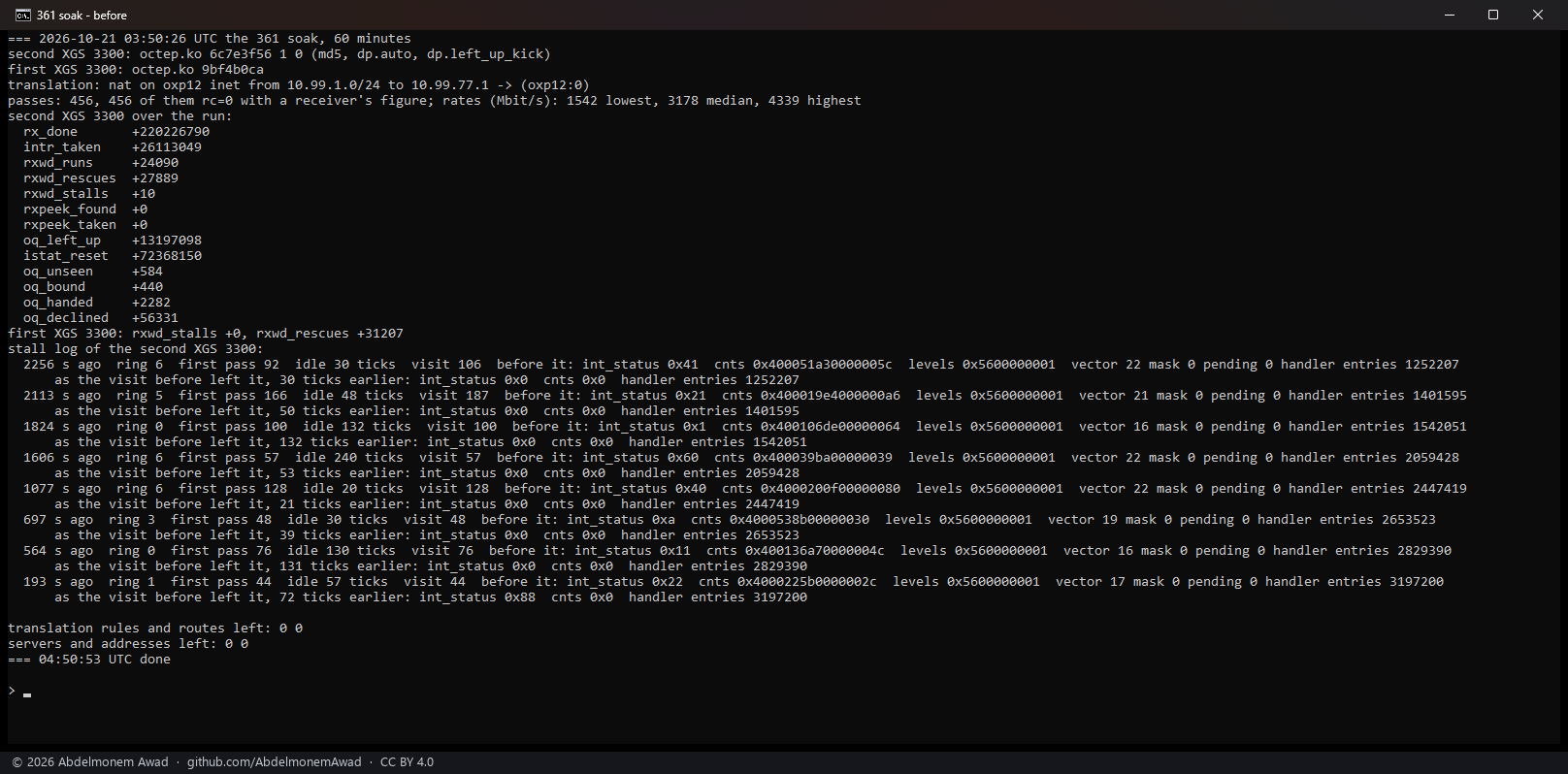
The hour before, octep.ko 6c7e3f56 (03:50 to 04:50 UTC): 456 passes, all complete, 3,178 Mbit/s
median a stream; 10 stalls:
ring 6  first pass 92  idle 30 ticks  visit 106
before it: int_status 0x41  cnts 0x400051a30000005c  levels 0x5600000001  vector 22 mask 0 pending 0 handler entries 1252207
as the visit before left it, 30 ticks earlier: int_status 0x0  cnts 0x0  handler entries 1252207
The visit before left ring 6 clean - status clear, a count of nothing, the count's interrupt bit (62) clear. Then 92 packets, bit 62 set, the vector unmasked, nothing pending in the PBA, and the handler's entry count unchanged: the block raised the interrupt and the handler did not run. Every one of the eight records kept reads the same.
Two things the records showed were wrong, and fixed - and neither was it
The status register holds every ring's bit. int_status 0x41 is bits 0 and 6; ring 3's read 0xa,
ring 1's 0x22. Read through ring N's window the register holds a bit for every ring, bit N for ring N,
and every pass of every servicer wrote back what it read - clearing the other rings' bits too. Each
pass now clears its own and leaves the others (dp.istat_others counts the passes that found others
set: 37,967,104 in the hour below).
Every ring's vector was delivered to cpu0. hw.intrs on both XGS 3300s: octep0 eight times, every
one @cpu0, so the rings' handlers took turns on one CPU. The vendor's host gives each ring's vector a
CPU of its own, and the driver now does too when it hooks them (dp.msix_spread 1, dp.msix_bound 8):
ring0 @cpu0 to ring7 @cpu7.
With the first alone (octep.ko 18b0f9b2) the soak counted a stall in its first minutes; with both
(octep.ko bef3458f), three in its first ten. Each the same way round - ring 5 on cpu5, left clean by
the sweep 50 ticks before, 81 packets, bit 62 set, nothing pending, the handler not run. Both soaks were
stopped there. Neither fix is what keeps a ring from being left.
So the host looks
Between the watchdog's sweeps, every tick, the driver looks at each ring's head buffer in host memory:
the length word the block's DMA writes is poison until a packet lands. A ring whose head has held the
same packet since the last look, with nobody inside, is visited. It reads no register. It finds two
things: a ring whose interrupt was raised and never handled - ring 4 with 6 and then 11 packets, bit 62
set, the handler not run, found after a tick or two instead of a sweep - and a lone packet: the count
interrupt is raised when the count goes past the level, so with a level of one a single packet waits
for the time threshold (cnts 0x3300000001 - a count of 1, bit 62 clear). Each visit is kept in
dp.rxpeek_log, apart from the stalls; dp.rxpeek_found counts them, dp.rxpeek_ticks sets the
interval (1; 0 turns it off). At rest it costs a callout a tick: 1.06 % of the eight CPUs busy with it
on, 0.89 % with it off, a minute each on the same boot.
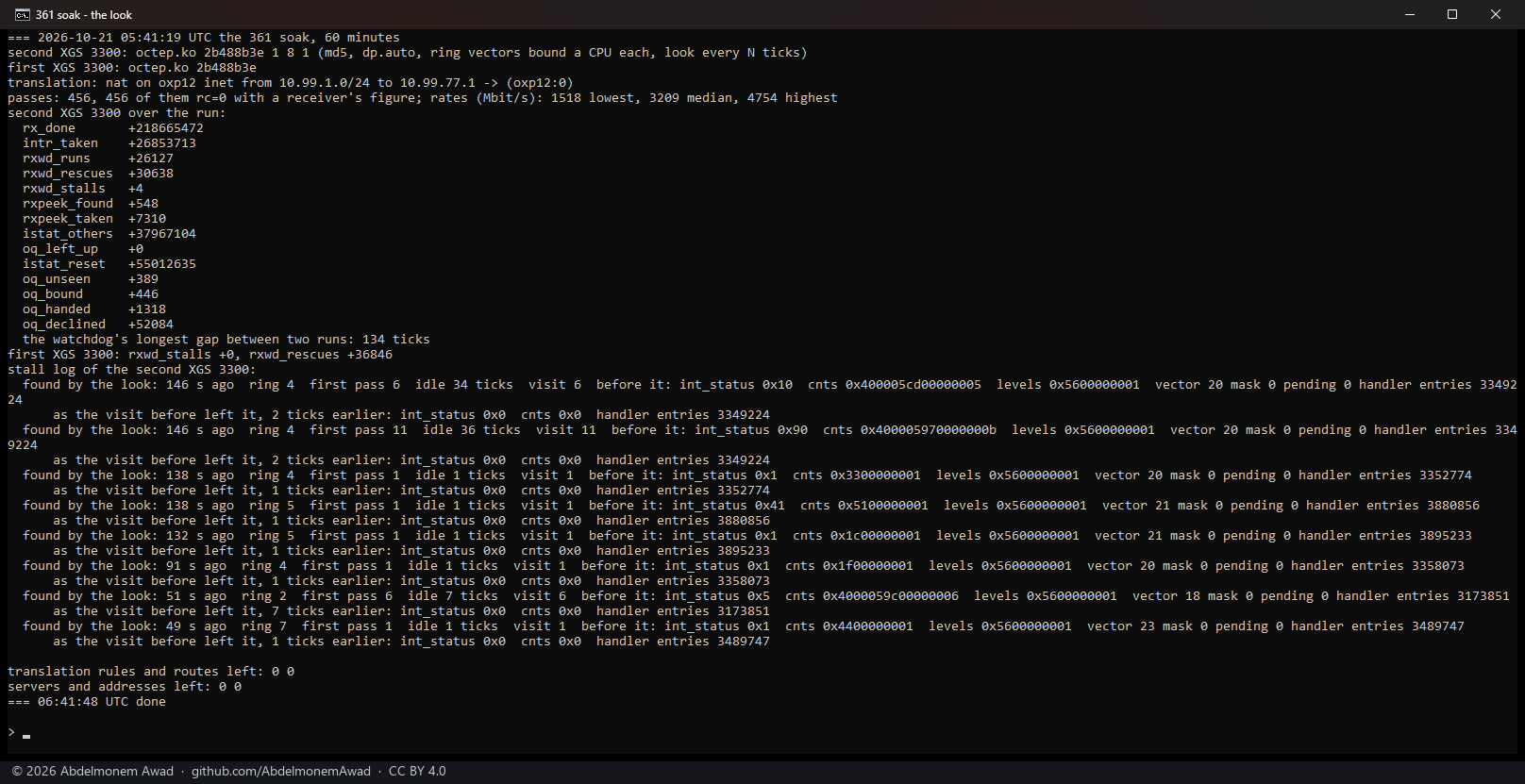
The hour with the look, octep.ko 2b488b3e (05:41 to 06:41 UTC): 456 passes, all complete, 3,209
Mbit/s median a stream; 4 stalls, and 548 rings found by the look before the watchdog came, 7,310
packets taken from them:
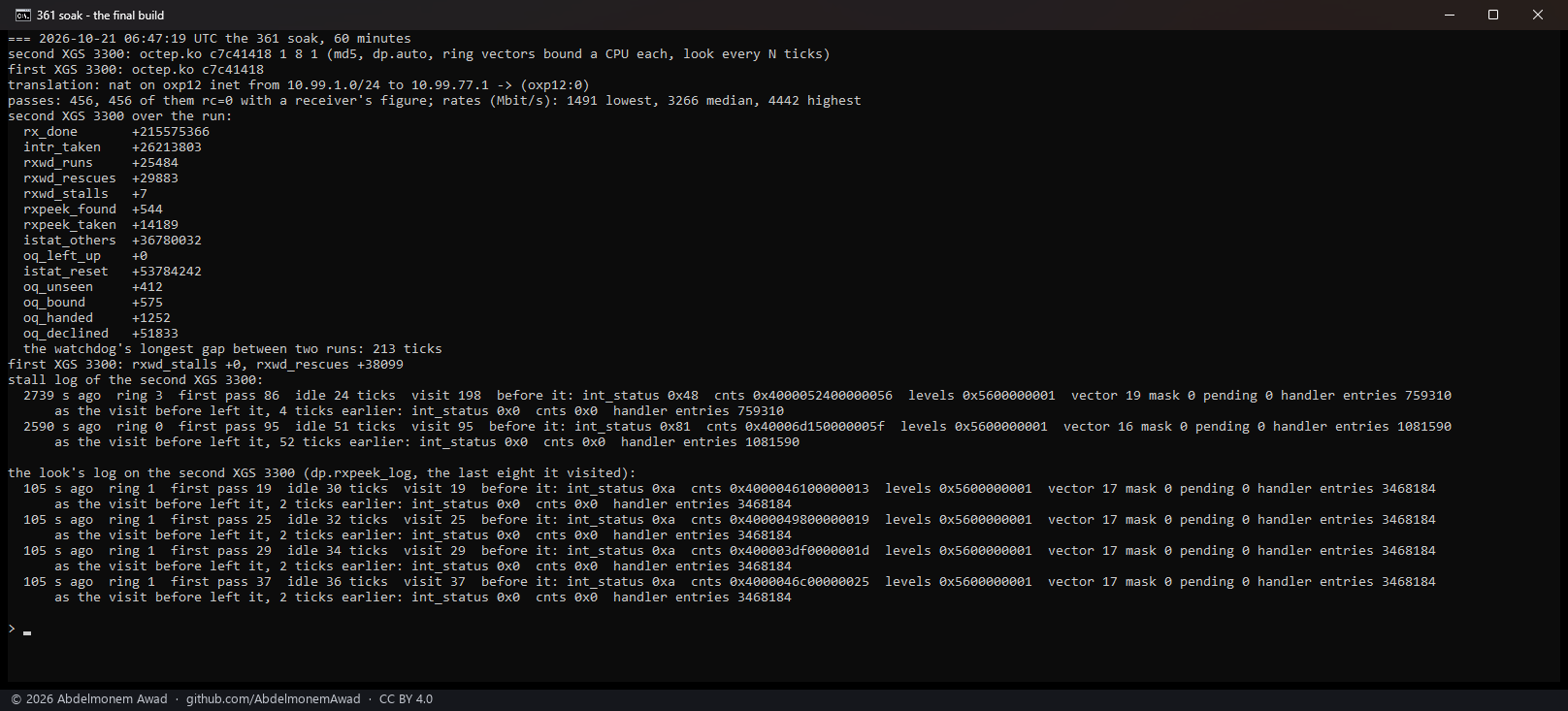
The hour on the build this change ships, octep.ko c7c41418 (this branch with the front-ports
change on top, on both XGS 3300s; 06:47 to 07:47 UTC): 456 passes, all complete, 3,266 Mbit/s median;
7 stalls, 544 rings found by the look, 14,189 packets taken from them:
The stall counter no longer says how long a ring waited. It counts what a sweep finds, and with the
look every tick a sweep that reaches a ring first - ring 3, left 4 ticks before the sweep, 86 packets -
is one the look would have reached a tick later. 10 in the hour before; 4 and 7 in the two hours with
the look. What the look bounds is the wait itself - two looks, two ticks, plus however late the
callout runs (dp.rxwd_gap_max 213 ticks at its worst in that hour) - and measuring that wait per ring
is the next instrument.
A ring that lost its interrupt stays deaf. The look's own log: ring 1 found four times in a row,
two ticks apart - 19, 25, 29, 37 packets - with the handler's entry count 3,468,184 each time. Each
look's visit took the packets, acknowledged them and cleared the ring's own status bit, and the block
still sent nothing for the next ones. Something re-arms a ring that the host's visits do not; the
vendor's host writes RESEND at the end of every poll, and that is the next thing to run against it
(dp.resend, off - an hour with it on in 2026-10-13's build, every ring on cpu0 and every status bit
cleared, counted five stalls against three).
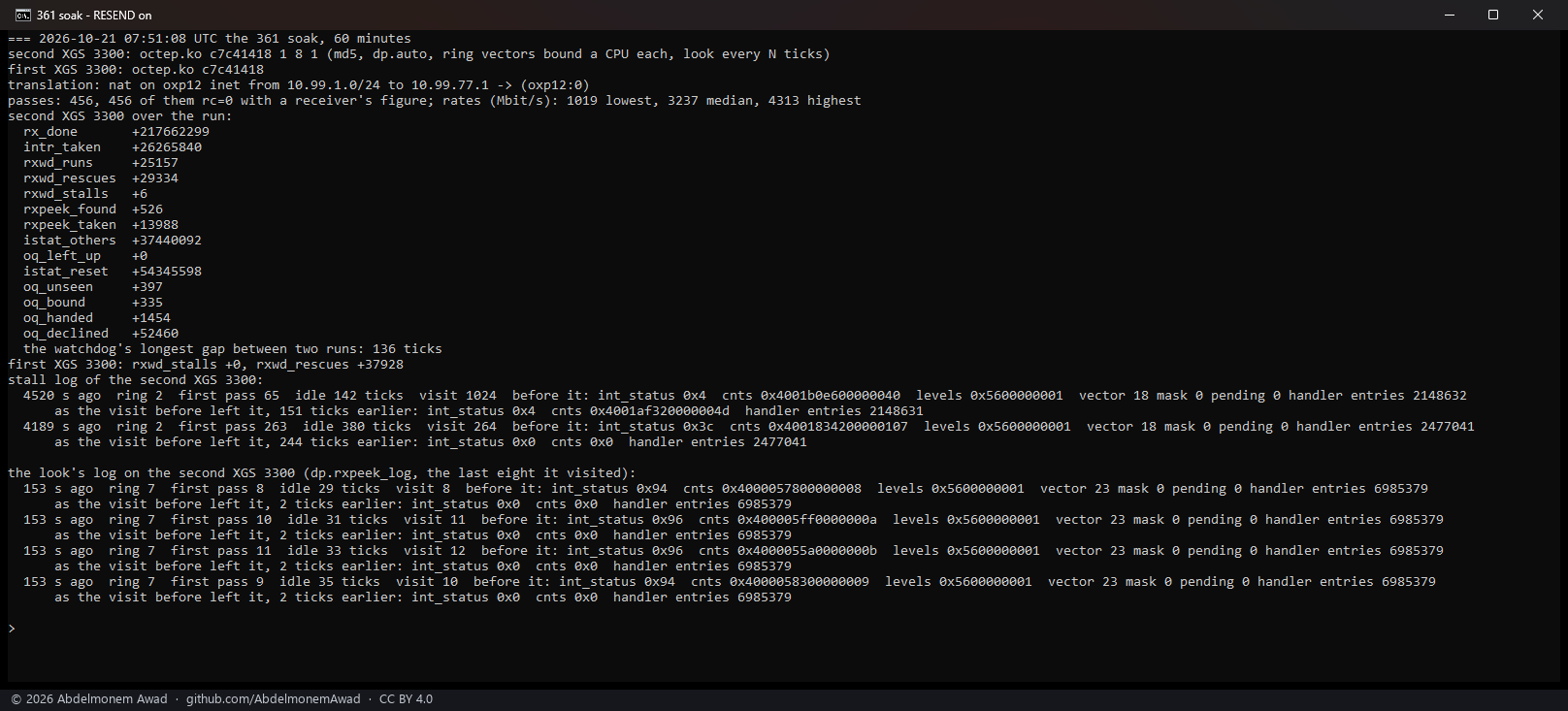
RESEND does not wake it. The same soak, an hour, on the same build with dp.resend 1 - RESEND
written as every visit leaves a ring (07:51 to 08:51 UTC): 456 passes, all complete, 3,237 Mbit/s
median; 6 stalls, 526 rings found by the look - what the two hours without it counted - and in
the look's log ring 7 four times in a row, two ticks apart, 8 to 11 packets, the handler's entry count
6,985,379 each time. dp.resend is back to 0.
What it does not mean
- The interrupt is still lost, now and then. Why the block's message does not reach the host when the ring was left clean and nothing on the host had touched it since is not known. The host finds the ring sooner; it does not make the message arrive.
- The stalls left are not each measured. Some are a sweep reaching a ring a tick before the look;
some may be the callout itself late - the look runs in the watchdog's callout, and
dp.rxwd_gap_max, the longest from one run's start to the next's, read 134 and 213 ticks in the two hours. That is a reading, not a measurement of each. - The XGS 136 is a different driver with its own receive path, and has shown nothing of the kind.
dp.oq_left_up, visits that left a ring empty with its own status bit still set right after the clear, is harmless: 29,718 of 58,003 in a minute of bursts on the first XGS 3300, with the interrupts going on and no ring left. The reading it was built to test is the one withdrawn above.
The discussion of this page is held in the project's GitHub Discussions. Showing it here loads giscus from giscus.app and GitHub, and writing in it needs a GitHub account - what that means.